
Level:
Correct: 0
Incorrect: 0
Marks: 0/0
Exam Practice
Course:
Topics:
Edexcel GCSE Biology (Paper 1) Smart practice A mixed round aimed at your weak spots
Unit 1
Key concepts in biology
Unit 2
Cells and control
Unit 3
Genetics
Unit 4
Natural selection and genetic modification
Unit 5
Health, disease and the development of medicines
Avg
score:
–
Topics
done:
0/38

Neurones, synapses and the reflex arc

Practise 18 exam-style questions on Neurones, synapses and the reflex arc for Edexcel GCSE Biology (Paper 1). Write your answer as you would in the exam and get it marked in seconds against the mark scheme, point by point, with the Study Helper on hand if you get stuck.

  • 18 questions
  • 1–6 marks each
  • Instant marking
  • No sign-up needed
18 questions, marked as you go

Sample questions with model answers

Here are 4 of the questions in this topic, each with a model answer, an explanation of why it earns the marks and the mark scheme an examiner would use.

Question 1

1 mark

How is a signal passed from one neurone to the next across a synapse?

Choose your answer.

  • A an electrical impulse jumps the gap
  • B a chemical diffuses across the gap
  • C the myelin sheath carries it
  • D water moves across by osmosis

Model answer

B - a chemical diffuses across the gap.

Explanation

When an impulse reaches the end of a neurone, a chemical called a neurotransmitter is released, diffuses across the synapse and binds to receptors on the next neurone, starting a new impulse. A common misconception is that the electrical impulse jumps across the gap.

Mark scheme
  1. 1 mark

    B / a chemical diffuses across the gap (1)

    The only correct answer is B. A is not correct because the electrical impulse cannot cross the gap: it is carried across by a neurotransmitter; C is not correct because the myelin sheath insulates the axon and is not found in the gap; D is not correct because the signal is carried by a neurotransmitter, not by water. Accept the letter or the option. If more than one option is given, do not award the mark.
Question 2

2 marks

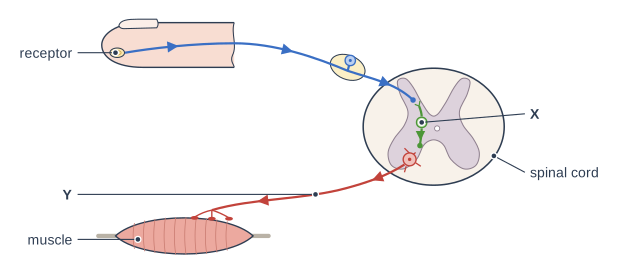
Figure 1 shows the nerve pathway involved when a person pulls their finger away from a sharp object.

Name the types of neurone labelled X and Y.

Diagram of a pathway of nerve cells from a fingertip. On the left, the tip of a finger has a small structure in the skin near the tip; below it is a spindle-shaped block of striped tissue. On the right is a cross-section of a cord with a darker butterfly-shaped area in the middle. A blue nerve cell runs from the small structure in the fingertip to the cord, with its cell body in a swelling just outside the cord; inside the butterfly-shaped area it ends at a tiny gap next to a short green nerve cell, which ends at another tiny gap next to a red nerve cell. The red nerve cell runs out of the cord to the striped tissue, where its branched ends lie on it. Arrowheads along the nerve cells point from the fingertip towards the cord, through the short green cell, and out along the red cell to the striped tissue. The label "receptor" points to the small structure in the skin near the fingertip, where the blue nerve cell begins; label X points to the short green nerve cell inside the butterfly-shaped area of the cord; label Y points to the red nerve cell running from the cord to the striped tissue; the label "muscle" points to the spindle-shaped block of striped tissue at the bottom left; the label "spinal cord" points to the oval cross-section on the right.

Model answer

X is a relay neurone. Y is a motor neurone.

Explanation

In a reflex arc the sensory neurone carries the impulse from the receptor to the spinal cord, a short relay neurone in the spinal cord passes it on, and a motor neurone carries it out to the effector (here a muscle). The direction of the arrows shows which neurone is which.

Mark scheme
  1. 1 mark

    X: relay neurone (1)

    accept intermediate / connector neurone

  2. 1 mark

    Y: motor neurone (1)

    accept effector neurone

Question 3

3 marks

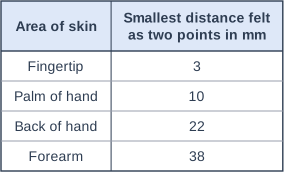
A student touched the skin of a volunteer, who was blindfolded, with the two points of a pair of compasses. She found the smallest distance between the two points at which the volunteer could feel two separate points, not one.

The table shows her results.

Explain the differences in the results.

Table with columns "Area of skin", "Smallest distance felt as two points in mm". Area of skin: Fingertip; Smallest distance felt as two points in mm: 3 | Area of skin: Palm of hand; Smallest distance felt as two points in mm: 10 | Area of skin: Back of hand; Smallest distance felt as two points in mm: 22 | Area of skin: Forearm; Smallest distance felt as two points in mm: 38.

Model answer

The fingertip could feel two separate points only 3 mm apart, but on the forearm the points had to be 38 mm apart. This is because the fingertip has many more touch receptors, closer together, so two points close together still stimulate two different receptors. Each receptor sends impulses along its own sensory neurone, so the brain receives two separate signals and the person feels two points.

Explanation

The smaller the distance, the more sensitive the skin. Sensitive areas have many receptors close together, so two nearby points stimulate separate receptors and separate sensory neurones. Answers should use data from the table and link the result to the number or spacing of receptors.

Mark scheme
  1. 1 mark

    the fingertip could detect two points closest together (3 mm) / is the most sensitive, and the forearm the least (38 mm) (1)

    An explanation linking three from the four points; max 3. accept correct use of data comparing two areas of skin

  2. 1 mark

    the fingertip has more (touch) receptors / its receptors are closer together (1)

    accept ORA for the forearm; accept higher density of receptors

  3. 1 mark

    so two points close together stimulate two different receptors (1)

  4. 1 mark

    each receptor sends impulses along a separate sensory neurone (to the CNS / brain) (1)

    accept the brain receives two separate sets of impulses

Question 4

4 marks

A class of 15 students stood in a line, holding hands. The teacher started a stopwatch as she squeezed the hand of the first student. Each student squeezed the next student's hand as soon as they felt their own hand being squeezed. The teacher stopped the stopwatch when the last student felt the squeeze and raised a hand. The mean time was 4.5 s.

The nerve pathway through each student, from one hand to the other, is about 1.5 m long.

Use the equation speed = distance ÷ time to calculate the speed of transmission.

The fastest neurones carry impulses at about 100 m/s. Explain why the speed you have calculated is much lower than this.

Model answer

Total distance = 15 × 1.5 = 22.5 m
Speed = 22.5 ÷ 4.5 = 5 m/s
This is much lower than 100 m/s because the measured time does not only include impulses travelling along neurones. In each student, the brain has to process the information and decide to squeeze, the signal has to cross many synapses, and the hand muscles have to contract.

Explanation

Multiply the distance per student by the number of students, then divide by the total time. The result is far below real conduction speeds because the time measured is mostly the time for the brain to process the information and for impulses to cross synapses, not the time for impulses to travel along neurones.

Mark scheme
  1. 1 mark

    (total distance = 15 × 1.5 =) 22.5 (m) (1)

    An answer of 5 m/s with no working scores marking points 1 and 2. accept time per student = 4.5 ÷ 15 = 0.3 s for this mark

  2. 1 mark

    (speed = 22.5 ÷ 4.5 =) 5 (m/s) (1)

    accept 1.5 ÷ 0.3 = 5; allow ecf from an incorrect distance or time

  3. 1 mark

    the time includes the brain processing the information / deciding to respond (in each student) (1)

    Max 2 for the explanation (MP3 to MP6). accept the response is voluntary, not a reflex

  4. 1 mark

    the impulse has to cross many synapses, which slows it down (1)

    accept neurotransmitter has to diffuse across each synapse

  5. 1 mark

    the time includes the hand muscles contracting to squeeze the next hand (1)

    accept the time for the effectors (muscles) to respond

  6. 1 mark

    the time includes the teacher's reaction time in starting and stopping the stopwatch (1)

    accept human error in timing

Ready to try the rest? Every answer you write is marked against the mark scheme, so you can see exactly where the marks are.

Study Helper Hints first, answers after you try

Stuck on this one? Ask for a hint and I’ll point you in the right direction, without giving the answer away. Once you’ve checked your answer, I’ll show you how the marks are awarded.