
Level:
Correct: 0
Incorrect: 0
Marks: 0/0
Exam Practice
Course:
Topics:
Edexcel GCSE Biology (Paper 1) Smart practice A mixed round aimed at your weak spots
Unit 1
Key concepts in biology
Unit 2
Cells and control
Unit 3
Genetics
Unit 4
Natural selection and genetic modification
Unit 5
Health, disease and the development of medicines
Avg
score:
–
Topics
done:
0/38

Diffusion, osmosis and active transport

Practise 13 exam-style questions on Diffusion, osmosis and active transport for Edexcel GCSE Biology (Paper 1). Write your answer as you would in the exam and get it marked in seconds against the mark scheme, point by point, with the Study Helper on hand if you get stuck.

  • 13 questions
  • 1–6 marks each
  • Instant marking
  • No sign-up needed
13 questions, marked as you go

Sample questions with model answers

Here are 4 of the questions in this topic, each with a model answer, an explanation of why it earns the marks and the mark scheme an examiner would use.

Question 1

1 mark

Which statement about osmosis is correct?

Choose your answer.

  • A solute moves, using energy
  • B water moves, using energy
  • C solute moves, no energy used
  • D water moves, no energy used

Model answer

D - water moves, no energy used.

Explanation

Osmosis is the net movement of water molecules across a partially permeable membrane from a higher water concentration to a lower water concentration. Like diffusion, it is passive and needs no energy from respiration. Examiners report that some students describe the solute moving instead of the water.

Mark scheme
  1. 1 mark

    D / water moves, no energy used (1)

    The only correct answer is D. A is not correct because in osmosis it is water, not solute, that moves, and osmosis does not need energy from respiration; B is not correct because osmosis is passive and does not need energy from respiration; C is not correct because the solute does not move in osmosis - water moves across the partially permeable membrane. Accept the letter or the option. If more than one option is given, do not award the mark.
Question 2

2 marks

A student wrote this sentence about osmosis.

'During osmosis, water molecules move in one direction only, from the dilute solution into the concentrated solution.'

Explain why the student's sentence is not fully correct.

Model answer

Water molecules move randomly, so some cross the membrane in both directions. Osmosis is the net movement of water: more water molecules move from the dilute solution (higher water concentration) into the concentrated solution (lower water concentration) than move the other way.

Explanation

Particles move randomly, so water molecules cross a membrane in both directions all the time. Osmosis describes the overall (net) result: more water moves from the higher water concentration to the lower water concentration. The word 'net' is what makes a definition of osmosis or diffusion fully correct.

Mark scheme
  1. 1 mark

    water molecules move (randomly) in both directions across the membrane (1)

    An explanation linking two points. accept some water molecules also move from the concentrated solution into the dilute solution

  2. 1 mark

    osmosis is the net movement of water / more water molecules move from the dilute solution (higher water concentration) to the concentrated solution than in the other direction (1)

    accept overall / on balance water moves from a higher to a lower water concentration; ignore 'across a partially permeable membrane' on its own

Question 3

3 marks

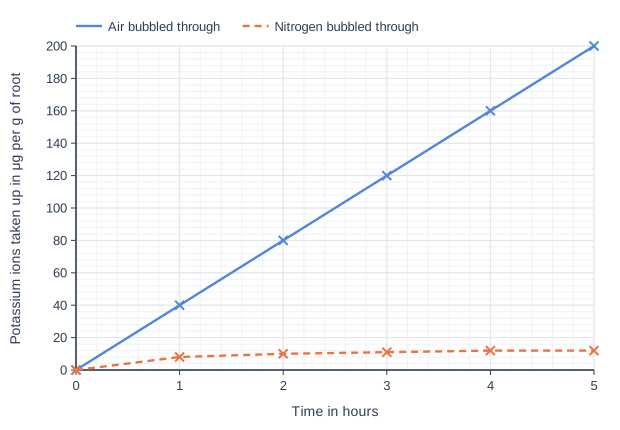
A scientist investigated the uptake of potassium ions by the roots of young bean plants. The roots were placed in two solutions of potassium ions. Air was bubbled through one solution. Nitrogen was bubbled through the other solution, which removed the oxygen from it. The concentration of potassium ions in the root cells was always higher than in the solutions.

The graph shows the results.

Explain the difference between the results for the two solutions.

Line graph of potassium ions taken up in μg per g of root (y-axis, 0 to 200) against time in hours (x-axis, 0 to 5). "Air bubbled through" joins the points (0, 0), (1, 40), (2, 80), (3, 120), (4, 160), (5, 200). "Nitrogen bubbled through" (dashed) joins the points (0, 0), (1, 8), (2, 10), (3, 11), (4, 12), (5, 12).

Model answer

With air, the roots took up 200 μg of potassium ions per g in 5 hours, at a steady rate, but with nitrogen they took up only 12 μg per g, and uptake almost stopped after the first hour. The potassium ions move into the root cells against the concentration gradient, so they must be taken up by active transport, which needs energy from respiration. Without oxygen, aerobic respiration cannot take place in the root cells, so not enough energy is released for active transport and very few potassium ions are taken up.

Explanation

The key link is oxygen → aerobic respiration → energy → active transport. The stem tells you the ions move against the concentration gradient, which rules out diffusion. Good answers also quote data from both lines to support the comparison.

Mark scheme
  1. 1 mark

    the potassium ions are taken up by active transport (1)

    An explanation linking three from the four points; max 3. accept the ions move against the concentration gradient so active transport is needed

  2. 1 mark

    active transport needs energy from respiration (1)

    accept needs ATP from respiration

  3. 1 mark

    with nitrogen there is no oxygen, so (aerobic) respiration cannot take place / less energy is released, so little potassium is taken up (1)

    accept the reverse argument for air: oxygen allows (aerobic) respiration so more energy is released for active transport

  4. 1 mark

    use of data: with air 200 μg per g is taken up in 5 hours compared with 12 μg per g with nitrogen (1)

    accept with air uptake continues at a steady rate (40 μg per g per hour) but with nitrogen it stops after about 1-2 hours; accept any correct comparison of the two lines using numbers

Question 4

4 marks

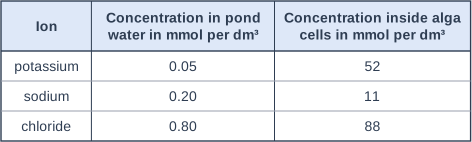
A scientist measured the concentrations of three ions in the water of a pond and inside the cells of a freshwater alga growing in the pond.

The table shows the results.

Calculate how many times more concentrated the potassium ions are inside the alga cells than in the pond water.

Explain how the alga cells take in potassium ions.

Table with columns "Ion", "Concentration in pond water in mmol per dm³", "Concentration inside alga cells in mmol per dm³". Ion: potassium; Concentration in pond water in mmol per dm³: 0.05; Concentration inside alga cells in mmol per dm³: 52 | Ion: sodium; Concentration in pond water in mmol per dm³: 0.20; Concentration inside alga cells in mmol per dm³: 11 | Ion: chloride; Concentration in pond water in mmol per dm³: 0.80; Concentration inside alga cells in mmol per dm³: 88.

Model answer

Number of times greater = 52 ÷ 0.05 = 1040
The concentration of potassium ions is 1040 times greater inside the alga cells.
The cells take in potassium ions by active transport, because the ions move from a lower concentration in the pond water to a higher concentration inside the cells, against the concentration gradient. This uses energy from respiration.

Explanation

To find how many times greater, divide the larger value by the smaller value: 52 ÷ 0.05 = 1040. Because the ions are far more concentrated inside the cells than outside, they cannot enter by diffusion; they must be moved against the concentration gradient by active transport, which needs energy from respiration. A common error is to divide the smaller value by the larger one.

Mark scheme
  1. 1 mark

    52 ÷ 0.05 (1)

    award full marks for the correct answer with no working (points 1 and 2); an answer of 0.00096 (0.05 ÷ 52) scores 0

  2. 1 mark

    1040 (times) (1)

    accept 1.04 × 10³; 1000 / 'about 1000' does not score this point (it scores point 1 only if 52 ÷ 0.05 is seen)

  3. 1 mark

    (by) active transport (1)

    Points 3, 4 and 5: max 2. do not accept diffusion / osmosis

  4. 1 mark

    (because) the potassium ions move from a lower concentration (in the pond water) to a higher concentration (in the cells) / against the concentration gradient (1)

    accept the concentration is higher inside the cells so diffusion cannot be used

  5. 1 mark

    using energy from respiration (1)

    accept using ATP; do not accept 'making energy'

Ready to try the rest? Every answer you write is marked against the mark scheme, so you can see exactly where the marks are.

Study Helper Hints first, answers after you try

Stuck on this one? Ask for a hint and I’ll point you in the right direction, without giving the answer away. Once you’ve checked your answer, I’ll show you how the marks are awarded.