
Level:
Correct: 0
Incorrect: 0
Marks: 0/0
Exam Practice
Course:
Topics:
Edexcel GCSE Biology (Paper 1) Smart practice A mixed round aimed at your weak spots
Unit 1
Key concepts in biology
Unit 2
Cells and control
Unit 3
Genetics
Unit 4
Natural selection and genetic modification
Unit 5
Health, disease and the development of medicines
Avg
score:
–
Topics
done:
0/38

Eukaryotic and prokaryotic cells

Practise 15 exam-style questions on Eukaryotic and prokaryotic cells for Edexcel GCSE Biology (Paper 1). Write your answer as you would in the exam and get it marked in seconds against the mark scheme, point by point, with the Study Helper on hand if you get stuck.

  • 15 questions
  • 1–6 marks each
  • Instant marking
  • No sign-up needed
15 questions, marked as you go

Sample questions with model answers

Here are 4 of the questions in this topic, each with a model answer, an explanation of why it earns the marks and the mark scheme an examiner would use.

Question 1

1 mark

A plant cell has a large permanent vacuole.

State one function of the permanent vacuole.

Model answer

The permanent vacuole contains cell sap, which keeps the cell turgid so that it helps to support the plant.

Explanation

The permanent vacuole is filled with cell sap, a solution of sugars and salts in water; when it is full it presses the cytoplasm against the cell wall and keeps the cell firm (turgid), which helps to support the plant. Do not confuse the vacuole with the cell membrane, which controls what enters and leaves the cell.

Mark scheme
  1. 1 mark

    contains / stores cell sap (1)

    Any one from the two points; max 1. accept stores water / sugars / (mineral) salts / ions (dissolved in the sap); ignore stores food / stores substances / stores waste, unqualified; do not accept controls what enters and leaves the cell (this is the cell membrane) or makes food (this is the chloroplasts).

  2. 1 mark

    keeps the cell {turgid / rigid / firm} / supports the cell (1)

    accept pushes the cytoplasm against the cell wall; accept helps to support the plant / stops the plant wilting; do not accept strengthens the cell wall / is the cell wall.
Question 2

2 marks

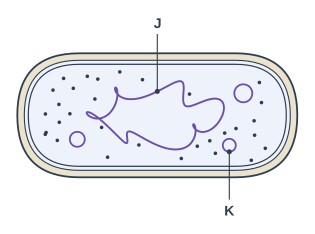
Figure 1 shows a bacterial cell. Structure J and structure K both contain DNA.

Describe two differences between structure J and structure K.

Diagram: a small rod-shaped cell with rounded ends, with a thicker outer layer and a thin line just inside it. In the middle is a long tangled loop of thread that is not enclosed by anything; there are also three small separate rings and tiny dots. Label J points to the long tangled loop of thread in the middle of the cell; label K points to one of the three small separate rings.

Model answer

J, the chromosomal DNA, is a single large loop, but there are several Ks (plasmids), which are small rings of DNA. J carries the genes the bacterium needs to control its activities, whereas the plasmids carry a few extra genes, such as genes for antibiotic resistance, which can be passed to other bacteria.

Explanation

In a prokaryotic cell the chromosomal DNA is one large loop free in the cytoplasm, while plasmids are small extra rings of DNA that often carry useful genes such as antibiotic resistance. Each answer must state a difference: saying one is a loop and the other a ring does not, because both are circular, and naming the structures alone earns no credit.

Mark scheme
  1. 1 mark

    J is (one) large (loop of DNA) and K is (a) small (ring of DNA) / ORA (1)

    Any two from the five points; max 2. Each point must state a difference (or give a feature of one structure that clearly contrasts with the other). accept J is long and K is short; naming the structures alone (chromosomal DNA, plasmid) does not gain a mark; do not accept 'J is a loop but K is a ring', because both are loops (rings) of DNA.

  2. 1 mark

    there is only one J but there are several K / there are several plasmids (1)

    accept the cell has three Ks but only one J.

  3. 1 mark

    J carries the genes the cell needs for its (normal) activities / to survive, whereas K carries (a few) extra genes, e.g. for antibiotic resistance / ORA (1)

    accept either half as the difference, e.g. 'K can carry genes for antibiotic resistance' or 'J controls the activities of the cell'; accept J contains most of the cell's genes.

  4. 1 mark

    K can be passed / transferred to other bacteria (but J is not) (1)

    accept plasmids can be swapped between bacteria.

  5. 1 mark

    K can be copied / can replicate independently of J (1)

    accept K can be copied many times in one cell.

Question 3

3 marks

A student wrote:

'Plant cells do not need mitochondria, because their chloroplasts provide all the energy they need.'

Explain why the student is wrong.

Model answer

Chloroplasts carry out photosynthesis, which uses light energy to make glucose, but this does not release energy for the cell's processes. Mitochondria are the site of aerobic respiration, which releases energy from glucose. Plant cells need energy all the time, including at night when there is no light for photosynthesis, and cells such as root cells have no chloroplasts at all, so plant cells need mitochondria.

Explanation

Photosynthesis stores energy in glucose; respiration in the mitochondria releases it for processes such as making proteins. A common misconception is that plants photosynthesise instead of respiring - in fact all living plant cells respire all the time. Write that respiration releases energy, not that it 'makes' energy.

Mark scheme
  1. 1 mark

    chloroplasts carry out photosynthesis / absorb light (1)

    An explanation linking three from the six points; max 3.

  2. 1 mark

    (photosynthesis) makes glucose / stores energy in glucose (1)

    accept makes food / sugar / starch.

  3. 1 mark

    mitochondria are the site of (aerobic) respiration (1)

    accept mitochondria respire.

  4. 1 mark

    (respiration) releases energy (from glucose) for the cell's processes (1)

    accept produces ATP; ignore makes / produces energy.

  5. 1 mark

    respiration happens all the time / at night / in the dark, when photosynthesis cannot happen (1)

    accept plant cells need energy when there is no light.

  6. 1 mark

    some plant cells / root cells have no chloroplasts (but still need energy) (1)

    accept named plant cells without chloroplasts, e.g. root hair cells, onion bulb cells.

Question 4

4 marks

A scientist investigated the effect of endurance training on muscle cells. Small samples of leg muscle were taken from a group of volunteers before and after 10 weeks of cycling training. The scientist counted the mitochondria in the same area of muscle in electron micrographs.

The mean number of mitochondria was 48 before training and 66 after training.

Calculate the percentage increase in the mean number of mitochondria.

Then explain how this change helps the volunteers to cycle for longer.

Model answer

Increase = 66 - 48 = 18
Percentage increase = 18 ÷ 48 × 100 = 37.5%

With more mitochondria, the muscle cells can carry out more aerobic respiration, so more energy is released for muscle contraction. This means the volunteers' muscles can keep contracting for longer before they tire.

Explanation

Percentage change = (new value - original value) ÷ original value × 100; a common error is to divide by the new value (66), which gives 27.3%. Mitochondria are the site of aerobic respiration, so more mitochondria means more energy can be released for contraction; write 'releases energy', not 'makes energy'.

Mark scheme
  1. 1 mark

    (66 - 48 =) 18 (1)

    An answer of 37.5 or 38 % with no working scores marking points 1 and 2. accept 66 ÷ 48 = 1.375 for this mark. Marking points 3 to 5: any two from the three; max 2. Total max 4.

  2. 1 mark

    (18 ÷ 48 × 100 =) 37.5 (%) (1)

    accept 38; accept ecf from an incorrect subtraction; 137.5 (%) scores marking point 1 only (66 ÷ 48 = 1.375 is a correct step); 27.3 (%) (dividing by 66) scores marking point 1 only (for the difference of 18).

  3. 1 mark

    more (aerobic) respiration (in the muscle cells) (1)

    accept mitochondria are where aerobic respiration happens, linked to more mitochondria.

  4. 1 mark

    more energy is released for (muscle) contraction / movement (1)

    ignore more energy made / produced, unless 'released' is also used; accept more ATP for contraction.

  5. 1 mark

    less anaerobic respiration / less lactic acid made, so the muscles tire less quickly (1)

    accept less muscle fatigue linked to more aerobic respiration.

Ready to try the rest? Every answer you write is marked against the mark scheme, so you can see exactly where the marks are.

Study Helper Hints first, answers after you try

Stuck on this one? Ask for a hint and I’ll point you in the right direction, without giving the answer away. Once you’ve checked your answer, I’ll show you how the marks are awarded.