
Level:
Correct: 0
Incorrect: 0
Marks: 0/0
Exam Practice
Course:
Topics:
Edexcel GCSE Biology (Paper 1) Smart practice A mixed round aimed at your weak spots
Unit 1
Key concepts in biology
Unit 2
Cells and control
Unit 3
Genetics
Unit 4
Natural selection and genetic modification
Unit 5
Health, disease and the development of medicines
Avg
score:
–
Topics
done:
0/38

Darwin, Wallace and the pentadactyl limb

Practise 15 exam-style questions on Darwin, Wallace and the pentadactyl limb for Edexcel GCSE Biology (Paper 1). Write your answer as you would in the exam and get it marked in seconds against the mark scheme, point by point, with the Study Helper on hand if you get stuck.

  • 15 questions
  • 1–6 marks each
  • Instant marking
  • No sign-up needed
15 questions, marked as you go

Sample questions with model answers

Here are 4 of the questions in this topic, each with a model answer, an explanation of why it earns the marks and the mark scheme an examiner would use.

Question 1

1 mark

Darwin used several types of evidence to support his theory in On the Origin of Species, published in 1859. Other evidence that supports the theory was discovered much later.

Which type of evidence was not available to Darwin in 1859?

Choose your answer.

  • A fossils of extinct animals
  • B breeds of domestic pigeon
  • C DNA base sequences
  • D finches from different islands

Model answer

C - DNA base sequences.

Explanation

Darwin's evidence came from his observations on the Beagle voyage (fossils, and the finches and other species of the Galapagos Islands) and from selective breeding, such as his pigeons. The structure of DNA was not discovered until 1953, and comparing the base sequences of different species, which shows how closely related they are, only became possible decades later. A common misconception is that Darwin knew about genes or DNA.

Mark scheme
  1. 1 mark

    C / DNA base sequences (1)

    The only correct answer is C. A is not correct because Darwin collected fossils of extinct animals, such as giant ground sloths, in South America on the voyage of HMS Beagle. B is not correct because Darwin bred pigeons himself and used the breeds produced by pigeon breeders as evidence of how much selection can change a species. D is not correct because Darwin collected finches from different Galapagos islands on the Beagle voyage in 1835. Accept the letter or the option. If more than one option is given, do not award the mark.
Question 2

2 marks

Before Darwin published his theory, scientists classified organisms only by how similar they looked, and most thought that species did not change.

Explain how the theory of evolution by natural selection changed the way that scientists classify organisms.

Model answer

Darwin's theory showed that species evolve from common ancestors, so organisms are now classified by how closely related they are - their evolutionary relationships - rather than only by how similar they look. Scientists now compare DNA base sequences to work out these relationships and draw evolutionary trees.

Explanation

Once species were seen as changing and sharing common ancestors, classification became a way of showing evolutionary relationships. Today these relationships are worked out by comparing DNA, which led to evolutionary trees and the three-domain system. Saying only 'they use DNA' does not explain the change.

Mark scheme
  1. 1 mark

    organisms are now classified by how closely related they are / by their evolutionary relationships / by common ancestors (1)

    An explanation linking two from the three points; max 2. Ignore 'they are classified by DNA' unless linked to how closely related they are.

  2. 1 mark

    because species evolved from common ancestors, species that share a more recent common ancestor are placed in the same group / evolutionary trees show how species are related (1)

  3. 1 mark

    scientists compare DNA (base sequences) to find out how closely related organisms are, e.g. leading to the three-domain system (1)

    Accept 'genetic analysis'.

Question 3

3 marks

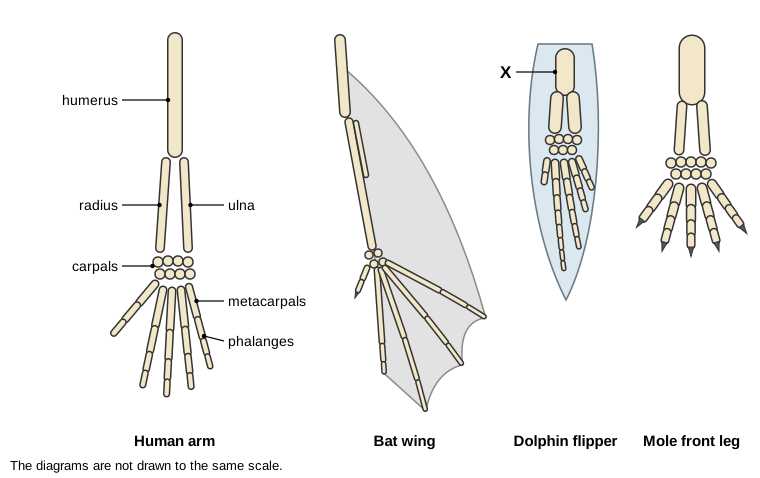
Figure 1 shows the bones in the forelimbs of a human, a bat, a dolphin and a mole. Bats use their wings to fly. Moles use their front legs to dig tunnels through soil.

Use Figure 1 to suggest how the structure of the bat's wing helps it to fly and how the structure of the mole's front leg helps it to dig.

Figure 1: diagrams of the bones in four forelimbs, side by side and not drawn to the same scale: a human arm, a bat wing, a dolphin flipper and a mole front leg. In the human arm, from the shoulder end down: one long bone labelled humerus; two bones side by side labelled radius (on the thumb side) and ulna; a group of eight small wrist bones labelled carpals; then five digits - the bones of the palm are labelled metacarpals and the finger bones are labelled phalanges. The bat wing has one upper bone, two lower bones (one long and one thin and short), small wrist bones, a short thumb with a claw and four very long, spread-out digits with skin stretched between them. The dolphin flipper, drawn inside the outline of the flipper, has a very short, thick upper bone labelled X, two short, flat lower bones, small wrist bones and five digits, two of which have many more bones than a human finger. The mole front leg has a short, very broad upper bone, two short lower bones, small wrist bones and five short, thick digits spread wide, each ending in a claw.

Model answer

The bat's finger bones (metacarpals and phalanges) are very long and spread out, so they hold out a large skin membrane that forms the wing and pushes against the air. They are also thin, which keeps the wing light. The mole's humerus and the other bones of its front leg are short and broad, so the leg is strong enough to push soil aside. Its digits are short, thick and spread wide, making a broad, spade-like front foot, and each digit ends in a large claw that cuts into the soil.

Explanation

Each mark needs a feature you can see in Figure 1 linked to how it helps the animal: long, spread-out finger bones support the bat's wing membrane, and short, broad bones with wide-spread, clawed digits make the mole's front leg a strong digging tool. They are the same bones as in the human arm, changed in shape and size by natural selection for different uses, which is why the pentadactyl limb is evidence for evolution. A common error is to describe a feature without saying how it helps the animal, or to say what the animal does without referring to the structure of its limb.

Mark scheme
  1. 1 mark

    (bat) the finger bones / metacarpals and phalanges are very long and spread out, so they support / stretch out a large wing (skin) membrane (1)

    Any three from the five points; max 3. Max 2 if only the bat or only the mole is described. Each mark needs a feature of the limb that can be seen in Figure 1 linked to how it helps the animal fly or dig: a feature on its own (e.g. 'the bat has long fingers') or a use on its own (e.g. 'the wing is used for flying') does not score. accept digits / fingers for finger bones; accept 'they hold the wing open' / 'they give the wing a large surface to push against the air'; accept the radius / forearm bone is long, making the wing longer / larger.

  2. 1 mark

    (bat) the finger bones are thin, so the wing is light (1)

    accept the bones are slender / narrow, so the wing has a small mass (for flying).

  3. 1 mark

    (mole) the humerus / the bones of the leg are short and broad / thick, so the leg is strong / can push soil aside with a large force (1)

    accept short, broad bones give a large area for (strong) muscles to attach; ignore 'the mole's bones are smaller' with no link to strength or digging.

  4. 1 mark

    (mole) the digits are short, thick and spread wide, so the front foot is broad like a spade / pushes or scoops a lot of soil at a time (1)

    accept a wide hand / paw for shovelling soil.

  5. 1 mark

    (mole) each digit ends in a large claw, to cut into / loosen the soil (1)

    accept the claws dig into / break up the soil.

Question 4

4 marks

Darwin published On the Origin of Species in 1859. At the time, many people, including some scientists, did not accept his theory of evolution by natural selection. Today, almost all biologists accept it.

Explain why the theory was not accepted by many people in 1859 and why it is accepted by biologists today.

Model answer

In 1859 the theory challenged the religious belief that God had created each species and that species never change. Darwin also had little evidence that some people found convincing, and he could not explain how variation arises or how characteristics are inherited, because genes and DNA had not been discovered.

Today the theory is accepted because genetics explains inheritance: characteristics are controlled by genes, and new alleles arise by mutation. Many more fossils have been found, such as Lucy, and evolution has been observed directly - for example, bacteria becoming resistant to antibiotics. Comparing DNA also shows that closely related species have similar base sequences.

Explanation

A full answer explains both sides: why the theory was rejected in 1859 (religious beliefs, too little evidence, no explanation of inheritance) and why it is accepted now (genetics, more fossils, resistance observed directly, DNA comparisons). Answers that only give reasons for one time cannot gain more than 2 marks.

Mark scheme
  1. 1 mark

    1859: it challenged the (religious) belief that God created all species / that species were fixed and did not change (1)

    An explanation including reasons for 1859 (max 2) and reasons for today (max 2); max 4. Max 2 if only reasons for 1859 or only reasons for today are given. Accept 'it went against the Bible / the Church'.

  2. 1 mark

    1859: there was not enough evidence at the time / few fossils showing intermediate forms / evolution had not been seen happening (1)

  3. 1 mark

    1859: Darwin could not explain how variation arises or how characteristics are inherited / genes and DNA were not known (1)

  4. 1 mark

    1859: people did not like the idea that humans evolved from ape-like ancestors / share a common ancestor with apes (1)

    Ignore 'humans evolved from monkeys'.

  5. 1 mark

    today: genes / DNA / Mendel's work explain how characteristics are inherited, and mutations explain how new variation arises (1)

    Accept 'genetics explains inheritance'.

  6. 1 mark

    today: many more fossils have been found, e.g. of human ancestors such as Ardi or Lucy (1)

    Accept 'the fossil record is more complete'.

  7. 1 mark

    today: evolution has been seen happening, e.g. antibiotic resistance in bacteria / pesticide resistance (1)

    Accept any correct example of natural selection observed in a population.

  8. 1 mark

    today: comparing DNA (base sequences) shows how closely related species are / supports common ancestry (1)

    Accept 'DNA evidence supports evolutionary trees'.

Ready to try the rest? Every answer you write is marked against the mark scheme, so you can see exactly where the marks are.

Study Helper Hints first, answers after you try

Stuck on this one? Ask for a hint and I’ll point you in the right direction, without giving the answer away. Once you’ve checked your answer, I’ll show you how the marks are awarded.