
Level:
Correct: 0
Incorrect: 0
Marks: 0/0
Exam Practice
Course:
Topics:
Edexcel GCSE Biology (Paper 1) Smart practice A mixed round aimed at your weak spots
Unit 1
Key concepts in biology
Unit 2
Cells and control
Unit 3
Genetics
Unit 4
Natural selection and genetic modification
Unit 5
Health, disease and the development of medicines
Avg
score:
–
Topics
done:
0/38

ABO blood groups and sex-linked inheritance

Practise 15 exam-style questions on ABO blood groups and sex-linked inheritance for Edexcel GCSE Biology (Paper 1). Write your answer as you would in the exam and get it marked in seconds against the mark scheme, point by point, with the Study Helper on hand if you get stuck.

  • 15 questions
  • 1–6 marks each
  • Instant marking
  • No sign-up needed
15 questions, marked as you go

Sample questions with model answers

Here are 4 of the questions in this topic, each with a model answer, an explanation of why it earns the marks and the mark scheme an examiner would use.

Question 1

1 mark

A man has blood group AB.

Whatever the blood group of his partner, which blood group can none of his children have?

Choose your answer.

  • A group A
  • B group B
  • C group AB
  • D group O

Model answer

D - group O.

Explanation

The man is IAIB, so every sperm cell carries IA or IB. A child with blood group O must be IOIO and needs an IO allele from each parent, so none of his children can be group O. This is why ABO blood groups were once used to show that a man could not be the father of a child.

Mark scheme
  1. 1 mark

    D / group O (1)

    The only correct answer is D. A is not correct because a child who receives IA from him and IA or IO from the mother has group A. B is not correct because a child who receives IB from him and IB or IO from the mother has group B. C is not correct because a child who receives IA from him and IB from the mother, or IB from him and IA from the mother, has group AB. Accept the letter or the option. If more than one option is given, do not award the mark.
Question 2

3 marks

Elena has blood group AB. Her partner, Marcus, has blood group B and is heterozygous.

Calculate the percentage of their children expected to have a blood group that is different from the blood groups of both parents.

Model answer

Elena is IAIB, so her gametes are IA or IB. Marcus is IBIO, so his gametes are IB or IO.
Offspring: IAIB (group AB), IAIO (group A), IBIB (group B), IBIO (group B).
The parents are groups AB and B, so only the IAIO children (group A) have a different blood group from both.
Percentage = 1 out of 4 = 25%

Explanation

Work out the gametes from each genotype, combine them in a Punnett square, then decide the blood group of each offspring genotype, remembering that IO is recessive and IA and IB are codominant. Only group A differs from both parents. A common error is to count group B children as 'different' because their genotype IBIB is different, but the question is about blood groups.

Mark scheme
  1. 1 mark

    Elena's gametes IA and IB, and Marcus is IBIO, with gametes IB and IO (1)

    An answer of 25 % with no working scores 3 marks. accept a Punnett square or genetic diagram showing these gametes

  2. 1 mark

    offspring genotypes IAIB, IAIO, IBIB and IBIO (1)

    accept the phenotypes AB, A, B and B (1 AB : 1 A : 2 B); allow ecf from incorrect gametes

  3. 1 mark

    only IAIO / blood group A is different from both parents, so 25 (%) (1)

    accept 1 in 4 / 0.25 / ¼ expressed as a percentage; do not accept 50 % (blood group B, the same as Marcus) or 75 %; allow ecf from their offspring genotypes

Question 3

3 marks

Red-green colour blindness is inherited through a recessive allele carried on the X chromosome. The allele for normal colour vision is XB and the allele for colour blindness is Xb.

Sofia is colour blind. Her brother, Leo, has normal colour vision.

Deduce the genotypes of Sofia's father and Sofia's mother. Explain your answer.

Model answer

Sofia is colour blind, so she is XbXb, with one X chromosome from each parent. A daughter always receives her father's only X chromosome, so Sofia's father must have Xb: he is XbY and is colour blind. Sofia's mother must also have passed on an Xb. Leo has normal colour vision, so he is XBY, and a son receives his X chromosome from his mother, so the mother also has XB. Sofia's mother is therefore XBXb, a carrier with normal colour vision.

Explanation

Work backwards from the children: a girl with an X-linked recessive condition received the recessive allele from both parents, so her father must have the condition. A brother with normal vision shows that the mother also has the dominant allele. A common error is to give the mother as XbXb, which would make every son colour blind.

Mark scheme
  1. 1 mark

    father is XbY (1)

    Any three from the four points; max 3. accept the father is colour blind

  2. 1 mark

    because Sofia is XbXb, and a daughter always receives her father's (only) X chromosome, so his X must carry Xb (1)

    accept Sofia needs an Xb from each parent; the reason must refer to the father

  3. 1 mark

    mother is XBXb (1)

    accept the mother is a carrier / is heterozygous; do not accept XbXb or XBXB

  4. 1 mark

    because she passed Xb to Sofia, and Leo (XBY) received his X chromosome / XB from his mother (1)

    accept the mother must have XB because Leo has normal colour vision and sons get their X chromosome from their mother; both parts of the evidence are needed for this mark

Question 4

4 marks

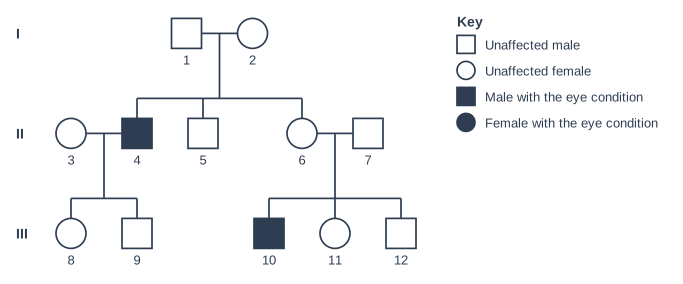
Figure 1 shows how an eye condition has been inherited in a family.

Scientists think that the condition is sex-linked, caused by a recessive allele carried on the X chromosome.

Explain how the information in Figure 1 supports this idea.

Family tree with three generations, labelled I, II and III from top to bottom. Squares are males and circles are females; horizontal lines join couples, and lines down from a couple lead to their children. The key shows: an unshaded square = Unaffected male; an unshaded circle = Unaffected female; a shaded square = Male with the eye condition; a shaded circle = Female with the eye condition. In generation I, person 1 (male, unshaded: unaffected) and person 2 (female, unshaded: unaffected) are a couple; their three children in generation II, from left to right, are person 4 (male, shaded: has the eye condition), person 5 (male, unshaded: unaffected) and person 6 (female, unshaded: unaffected). Person 3 (female, unshaded: unaffected), whose parents are not shown, and person 4 are a couple; their two children in generation III, from left to right, are person 8 (female, unshaded: unaffected) and person 9 (male, unshaded: unaffected). Person 6 and person 7 (male, unshaded: unaffected), whose parents are not shown, are a couple; their three children in generation III, from left to right, are person 10 (male, shaded: has the eye condition), person 11 (female, unshaded: unaffected) and person 12 (male, unshaded: unaffected).

Model answer

Persons 1 and 2 do not have the condition, but their son, person 4, does, so the allele must be recessive and hidden in a parent. Only males (persons 4 and 10) have the condition. This fits an allele on the X chromosome, because a male has only one X chromosome, so a single recessive allele causes the condition. Sons receive their X chromosome from their mother, so person 4 received the allele from person 2, who must be a carrier. Person 6 does not have the condition but passed the allele to her son, person 10, so she is also a carrier. Person 4's son, person 9, does not have the condition, because he received his father's Y chromosome, not his X.

Explanation

The typical pattern of X-linked recessive inheritance is: mostly affected males, unaffected carrier mothers passing the allele to sons, and no passing from father to son. A pedigree can support but not prove this, as a small family could show the same pattern by chance. Good answers name the people in the pedigree as evidence.

Mark scheme
  1. 1 mark

    An explanation linking: persons 1 and 2 do not have the condition but have a son (4) who does / persons 6 and 7 do not have the condition but have a son (10) who does, so the allele is recessive (1)

    An explanation linking four from the six points; max 4. The people must be correctly identified from Figure 1.

  2. 1 mark

    only males have the condition (1)

    accept the affected people (4 and 10) are both male

  3. 1 mark

    a male has only one X chromosome, so one recessive allele (on his X) causes the condition (1)

    accept females would need two recessive alleles

  4. 1 mark

    person 4 received the allele from his mother (person 2), because sons receive their X chromosome from their mother, so person 2 is a carrier (1)

    accept the allele passed from a mother who does not have the condition to her son

  5. 1 mark

    person 6 does not have the condition but passed the allele to her son (10), so she is a carrier who received the allele from her mother (2) (1)

    accept the allele skipped a generation through a female carrier

  6. 1 mark

    the son of affected person 4 (person 9) does not have the condition, because a father passes his Y chromosome, not his X, to his sons (1)

    accept the condition is not passed from father to son

Ready to try the rest? Every answer you write is marked against the mark scheme, so you can see exactly where the marks are.

Study Helper Hints first, answers after you try

Stuck on this one? Ask for a hint and I’ll point you in the right direction, without giving the answer away. Once you’ve checked your answer, I’ll show you how the marks are awarded.