
Level:
Correct: 0
Incorrect: 0
Marks: 0/0
Exam Practice
Course:
Topics:
Edexcel GCSE Biology (Paper 1) Smart practice A mixed round aimed at your weak spots
Unit 1
Key concepts in biology
Unit 2
Cells and control
Unit 3
Genetics
Unit 4
Natural selection and genetic modification
Unit 5
Health, disease and the development of medicines
Avg
score:
–
Topics
done:
0/38

Sexually transmitted infections

Practise 13 exam-style questions on Sexually transmitted infections for Edexcel GCSE Biology (Paper 1). Write your answer as you would in the exam and get it marked in seconds against the mark scheme, point by point, with the Study Helper on hand if you get stuck.

  • 13 questions
  • 1–6 marks each
  • Instant marking
  • No sign-up needed
13 questions, marked as you go

Sample questions with model answers

Here are 4 of the questions in this topic, each with a model answer, an explanation of why it earns the marks and the mark scheme an examiner would use.

Question 1

1 mark

HIV can be passed from one person to another in some body fluids.

Which body fluid does not pass on HIV?

Choose your answer.

  • A blood
  • B semen
  • C saliva
  • D breast milk

Model answer

C - saliva.

Explanation

HIV is passed on in blood, semen, vaginal fluids and breast milk, but not in saliva, so it cannot be caught by kissing or sharing cups. Knowing which fluids carry the virus explains the methods used to reduce its spread, such as condoms, needle exchanges and formula feeding.

Mark scheme
  1. 1 mark

    C / saliva (1)

    The only correct answer is C. A is not correct because HIV is passed on in blood, e.g. by sharing needles; B is not correct because HIV is passed on in semen during unprotected sex; D is not correct because a mother with HIV can pass the virus to her baby in breast milk. Accept the letter or the option. If more than one option is given, do not award the mark.
Question 2

2 marks

Lauren uses the contraceptive pill to prevent pregnancy. The pill contains hormones that stop her ovaries from releasing eggs.

Explain why using the pill does not protect Lauren from chlamydia but using a condom would.

Model answer

The pill only stops eggs being released, so it does not form a barrier and body fluids still pass between partners during sex. A condom is a physical barrier that stops semen or vaginal fluid containing the chlamydia bacteria passing from one person to the other.

Explanation

Chlamydia bacteria are passed on in body fluids during unprotected sex, so only a barrier method such as a condom stops them reaching the partner. Hormonal contraception prevents pregnancy but gives no protection against STIs. Saying only 'condoms protect you' without saying how does not explain the difference.

Mark scheme
  1. 1 mark

    the pill does not form a barrier / does not stop body fluids passing between partners (1)

    An explanation linking: accept 'the pill only stops eggs being released / only prevents pregnancy, so the bacteria can still pass from one person to another'. Ignore 'the pill does not kill bacteria' unqualified.

  2. 1 mark

    a condom is a barrier that stops the bacteria in semen / vaginal fluid passing from one person to the other (1)

    Accept 'a condom stops contact with infected body fluids'. Accept pathogen for bacteria. Reject virus for bacteria.

Question 3

3 marks

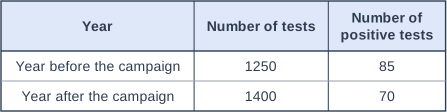
A sexual health clinic ran a campaign to encourage students to use condoms. The clinic tested students for chlamydia in the year before and the year after the campaign.

The table shows the results.

Calculate the percentage decrease in the percentage of tests that were positive.

Table with columns "Year", "Number of tests", "Number of positive tests". Year: Year before the campaign; Number of tests: 1250; Number of positive tests: 85 | Year: Year after the campaign; Number of tests: 1400; Number of positive tests: 70.

Model answer

Before the campaign: 85 ÷ 1250 × 100 = 6.8%
After the campaign: 70 ÷ 1400 × 100 = 5.0%
Percentage decrease = (6.8 - 5.0) ÷ 6.8 × 100 = 26%

Explanation

First find the percentage of tests that were positive in each year, then use percentage change = change ÷ original × 100 with the 'before' value as the original. Comparing 85 with 70 directly is misleading because more students were tested after the campaign. Another common error is to stop at the difference of 1.8 percentage points, which is not the percentage decrease.

Mark scheme
  1. 1 mark

    (before) 85 ÷ 1250 × 100 = 6.8 (%) (1)

    An answer of 26 (%) with no working scores 3 marks. Award 2 marks for 1.8 given as the final answer (the difference between the two percentages, which needs both correct percentages). 17.6 (%), from (85 - 70) ÷ 85 × 100, compares the numbers of positive tests and ignores the different numbers of tests: it is a wrong method and scores 0.

  2. 1 mark

    (after) 70 ÷ 1400 × 100 = 5.0 (%) (1)

    Accept 5.

  3. 1 mark

    (6.8 - 5.0) ÷ 6.8 × 100 = 26 (%) (1)

    Accept values that round to 26 (e.g. 26.5, 26.47). Allow ecf from their two percentages.

Question 4

4 marks

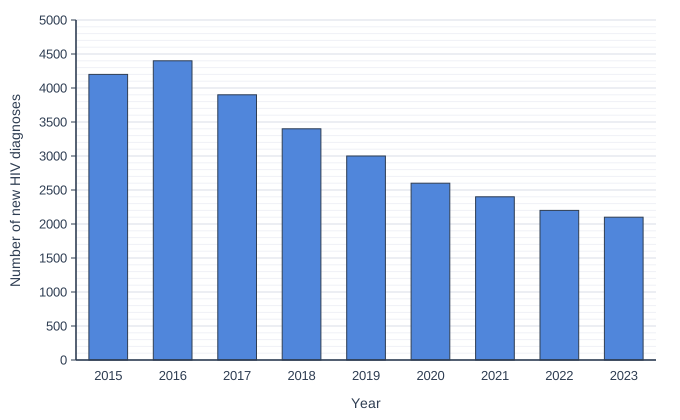
The bar chart shows the number of new HIV diagnoses each year in a country from 2015 to 2023.

In 2016, the country doubled the number of people tested for HIV. From 2017, the country offered PrEP free of charge. PrEP is a medicine that people who do not have HIV can take to greatly reduce their risk of becoming infected if they are exposed to the virus.

Explain the changes in the number of new HIV diagnoses shown by the bar chart.

Bar chart of Number of new HIV diagnoses for each year: 2015 4200, 2016 4400, 2017 3900, 2018 3400, 2019 3000, 2020 2600, 2021 2400, 2022 2200, 2023 2100.

Model answer

In 2016 the number of new diagnoses increased from 4200 to 4400. This is because twice as many people were tested, so more people who were already infected with HIV were found.

From 2017 the number of new diagnoses fell every year, to 2100 in 2023, which is less than half the 2016 number. PrEP greatly reduced the risk of people who did not have HIV becoming infected when they were exposed, so there were fewer new infections. Also, the people found by testing in 2016 could be treated, so the amount of virus in their body fluids fell and they were much less likely to pass HIV on.

Explanation

The number of diagnoses depends both on how many people are newly infected and on how many people are tested, which explains the rise in 2016. The fall from 2017 matches fewer new infections, because PrEP prevents infection and treated people pass on less virus. Good answers describe each change, use figures from the chart and give a biological reason for each change.

Mark scheme
  1. 1 mark

    the number of diagnoses increased in 2016 because more testing found people who were already infected (1)

    Any four from the five points; max 4. Accept 'more people were tested, so more cases were found / diagnosed'.

  2. 1 mark

    the number of diagnoses fell every year from 2017 (to 2023) (1)

    Accept a description of the fall with figures, e.g. from 4400 in 2016 to 2100 in 2023.

  3. 1 mark

    a correct manipulation of the data, e.g. diagnoses more than halved from 2016 to 2023 / fell by 2300 (1)

    Accept a correct percentage decrease, e.g. 52% from 2016 to 2023, or 50% from 2015 to 2023.

  4. 1 mark

    PrEP prevented HIV-negative people being infected, so there were fewer new infections (1)

    Accept 'fewer people caught HIV because they took PrEP'. Ignore 'PrEP cures HIV'.

  5. 1 mark

    people diagnosed (in 2016) were treated / knew their status, so they were less likely to pass HIV on (1)

    Accept 'treatment makes the virus undetectable so it cannot be passed on' / 'people diagnosed used condoms'. Accept other valid reasons for fewer new infections, e.g. more condom use or needle exchanges, for this mark.

Ready to try the rest? Every answer you write is marked against the mark scheme, so you can see exactly where the marks are.

Study Helper Hints first, answers after you try

Stuck on this one? Ask for a hint and I’ll point you in the right direction, without giving the answer away. Once you’ve checked your answer, I’ll show you how the marks are awarded.