Practise 26 exam-style questions on Two's complement for Cambridge IGCSE Computer Science (Paper 1). Write your answer as you would in the exam and get it marked in seconds against the mark scheme, point by point, with an AI tutor on hand if you get stuck.
26 questions
1–6 marks each
Instant marking
No sign-up needed
20 questions, marked as you go
Sample questions with model answers
Here are 4 of the questions in this topic, each with a model answer, an explanation of why it earns the marks and the mark scheme an examiner would use.
Question 1
1 mark
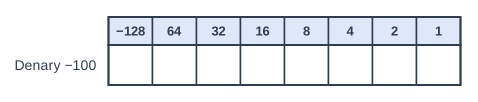
The diagram shows an 8-bit register with two's complement place values.
Give the 8-bit two's complement integer that represents denary −100.
Model answer
−100 = −128 + 16 + 8 + 4 = 10011100
Explanation
Start with −128 (a 1 in the left-most box) and then add positive place values to get back up to −100: you need +28, which is 16 + 8 + 4. The other method is +100 = 01100100, invert to 10011011 and add 1.
Mark scheme
1 mark
10011100
accept with or without spaces
Question 2
2 marks
A student wants to store the denary number +200 as an 8-bit two's complement integer.
Explain why this is not possible.
Model answer
The largest positive number that 8-bit two's complement can hold is 01111111 = +127. 200 is larger than this: its binary pattern 11001000 has a 1 in the most significant bit, so in two's complement it would mean −128 + 72 = −56 instead of +200.
Explanation
In two's complement the left-most bit is used for the −128 place value, so only 7 bits are left for positive values (0 to 127). Ordinary 8-bit binary reaches 255, but two's complement swaps the top half of that range for negative numbers.
Mark scheme
1 mark
The largest positive value in 8-bit two's complement is +127
max 2
1 mark
200 would need a 1 in the most significant bit, which would make the number negative / it would be read as −56
1 mark
More bits would be needed (e.g. 16-bit two's complement)
Question 3
3 marks
A register shows its contents in hexadecimal as E4. The contents are an 8-bit two's complement integer.
Convert E4 into binary, and then into denary. Show your working.
Model answer
E = 1110 and 4 = 0100, so E4 = 11100100 The left-most bit is 1, so the number is negative. −128 + 64 + 32 + 4 = −128 + 100 = −28
Explanation
Hexadecimal converts to binary nibble by nibble. Then treat the bits as two's complement: the left-most bit is −128. Giving 228 means the bits were read as an ordinary unsigned number.
Mark scheme
1 mark
Binary: 11100100
accept with or without spaces
1 mark
−128 + 64 + 32 + 4
accept invert and add 1: 00011100 = 28
1 mark
−28
do not accept 228; allow follow-through from an incorrect binary value
Question 4
4 marks
State whether each statement about 8-bit two's complement is true or false.
Statement 1: The most significant bit has a place value of −128. Statement 2: The largest positive value that can be represented is 255. Statement 3: Every negative number has 1 as its most significant bit. Statement 4: 11111111 represents −127.
Model answer
Statement 1: true Statement 2: false (the largest is +127) Statement 3: true Statement 4: false (11111111 is −1)
Explanation
With the left-most bit worth −128, positive numbers only use the other seven bits, so they stop at 127. 11111111 is −128 + 127 = −1; the pattern for −127 is 10000001.
Mark scheme
1 mark
Statement 1: true
1 mark
Statement 2: false
it is 127
1 mark
Statement 3: true
1 mark
Statement 4: false
it represents −1
Ready to try the rest? Every answer you write is marked against the mark scheme, so you can see exactly where the marks are.
Ctrl + Enter to check
AI TutorHints first, answers after you try
Hi! Stuck? Ask me for a hint and I’ll help you work it out. Once you’ve checked your answer I can explain exactly where the marks are.