
Level:
Correct: 0
Incorrect: 0
Marks: 0/0
Exam Practice
Subject:
Topics:
Cambridge IGCSE Computer Science (Paper 1) Smart practice A mixed round aimed at your weak spots
Unit 1
Data representation
Unit 2
Data transmission
Unit 3
Hardware
Unit 4
Software
Unit 5
The internet and its uses
Unit 6
Automated and emerging technologies
Automated systems
Automated systems
0%
Artificial intelligence
0%
Avg
score:
–
Topics
done:
0/39

Encryption

Practise 25 exam-style questions on Encryption for Cambridge IGCSE Computer Science (Paper 1). Write your answer as you would in the exam and get it marked in seconds against the mark scheme, point by point, with an AI tutor on hand if you get stuck.

  • 25 questions
  • 1–6 marks each
  • Instant marking
  • No sign-up needed
20 questions, marked as you go

Sample questions with model answers

Here are 4 of the questions in this topic, each with a model answer, an explanation of why it earns the marks and the mark scheme an examiner would use.

Question 1

1 mark

An encryption system uses keys that are 12 bits long.

State how many different keys are possible.

Model answer

2¹² = 4096 different keys

Explanation

Each bit can be 0 or 1, so every extra bit doubles the number of possible keys: n bits give 2ⁿ keys. 2¹⁰ = 1024, so 2¹² = 1024 × 4 = 4096.

Mark scheme
  1. 1 mark

    4096

    accept 2¹² if evaluated as 4096; do not accept 2¹² unevaluated, 12 or 24
Question 2

2 marks

A Caesar cipher replaces each letter with the letter a fixed number of places later in the alphabet. The number of places is the key, and the alphabet wraps round from Z back to A.

The ciphertext CWFD was produced using a Caesar cipher with a key of 5.

Decrypt the ciphertext to find the original word.

Model answer

Move each letter 5 places back:
C → X (wrapping back past A to Z)
W → R
F → A
D → Y (wrapping back past A to Z)
Plaintext: XRAY

Explanation

To decrypt, the same key is applied in reverse: move each letter 5 places back. C and D are near the start of the alphabet, so counting back wraps round past A to the end of the alphabet: C, B, A, Z, Y, X. Forgetting to wrap round is the usual mistake.

Mark scheme
  1. 1 mark

    Any two or three letters correct and in the correct positions (X R A Y)

    e.g. XRAI or HRAY (a wrap-around error) scores 1 mark

  2. 1 mark

    XRAY (all four letters correct)

    XRAY scores both marks; accept X-RAY, lower case or spaces between the letters

Question 3

3 marks

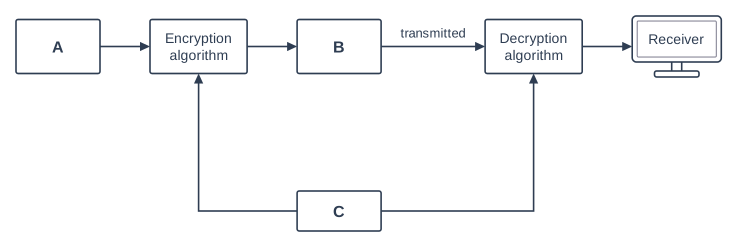
The diagram shows data being sent from one computer to another using symmetric encryption.

Identify A, B and C.

Block diagram with six parts in three rows. Top row, left to right: a box labelled A, a box "Encryption algorithm", a box labelled B, a box "Decryption algorithm" and a computer (monitor) "Receiver". Bottom row: a box labelled C. Connections: an arrow from box A to "Encryption algorithm"; an arrow from "Encryption algorithm" to box B; an arrow from box B to "Decryption algorithm", labelled "transmitted"; an arrow from "Decryption algorithm" to "Receiver"; an arrow from box C to "Encryption algorithm"; an arrow from box C to "Decryption algorithm".

Model answer

A is the plaintext.
B is the ciphertext.
C is the (secret) key, the same key being used by both the encryption and the decryption algorithm.

Explanation

Plaintext goes into the encryption algorithm, which uses a key to produce ciphertext; the ciphertext is transmitted and the decryption algorithm turns it back into plaintext. In symmetric encryption one key, C, is used for both steps, so the receiver must also have a copy of it.

Mark scheme
  1. 1 mark

    A: plaintext

    accept 'plain text'; accept 'original/unencrypted data'; do not accept 'data' or 'message' on its own

  2. 1 mark

    B: ciphertext

    accept 'cipher text'; accept 'encrypted data'

  3. 1 mark

    C: (secret / symmetric) key

    accept 'encryption key' or 'the shared key'; do not accept 'public key' or 'private key'

Question 4

4 marks

Compare symmetric encryption and asymmetric encryption.

Model answer

Both methods use an encryption algorithm and a key to turn plaintext into ciphertext, so intercepted data is meaningless. Symmetric encryption uses one key for both encryption and decryption, whereas asymmetric encryption uses a matching pair of keys: a public key to encrypt and a private key to decrypt. With symmetric encryption the key has to be sent to the recipient, so it could be intercepted and used to decrypt the data, whereas with asymmetric encryption the private key is never sent, which makes it more secure.

Explanation

A comparison needs both methods in each point, such as 'symmetric uses one key whereas asymmetric uses two'. The biggest difference is how the key reaches the recipient: the symmetric key must be shared, but the asymmetric private key never leaves its owner.

Mark scheme
  1. 1 mark

    Similarity: both use an encryption algorithm and key(s) to turn plaintext into ciphertext / both make intercepted data meaningless

    max 4; max 1 mark for similarities

  2. 1 mark

    Symmetric uses one key / the same key to encrypt and decrypt, whereas asymmetric uses two different keys (public and private)

    a difference must state both sides, or a clear comparative, to earn the mark

  3. 1 mark

    In symmetric encryption the key must be sent to the recipient, whereas in asymmetric encryption the private key is never sent / shared

  4. 1 mark

    If the symmetric key is intercepted the data can be decrypted, whereas intercepting a public key does not allow the data to be decrypted

  5. 1 mark

    Asymmetric encryption is more secure (as the decryption key is never transmitted)

  6. 1 mark

    Symmetric encryption is quicker / needs less processing than asymmetric encryption

Ready to try the rest? Every answer you write is marked against the mark scheme, so you can see exactly where the marks are.

AI Tutor Hints first, answers after you try

Hi! Stuck? Ask me for a hint and I’ll help you work it out. Once you’ve checked your answer I can explain exactly where the marks are.