Practise 30 exam-style questions on Parity, checksum and echo check for Cambridge IGCSE Computer Science (Paper 1). Write your answer as you would in the exam and get it marked in seconds against the mark scheme, point by point, with an AI tutor on hand if you get stuck.
30 questions
1–6 marks each
Instant marking
No sign-up needed
20 questions, marked as you go
Sample questions with model answers
Here are 4 of the questions in this topic, each with a model answer, an explanation of why it earns the marks and the mark scheme an examiner would use.
Question 1
1 mark
A parity check is used to detect errors in bytes after transmission.
State one limitation of a parity check on a single byte.
Model answer
It cannot detect an error if two bits have changed, because the number of 1s stays even (or odd).
Explanation
A parity check only counts the 1s. If two bits change, the count goes up or down by 0 or 2, so its parity stays the same and the error is missed. Even when an error is found, a single parity bit cannot show which bit is wrong.
Mark scheme
1 mark
It cannot detect an error if an even number of bits (e.g. two bits) have changed / it cannot identify which bit is wrong / it cannot correct the error
any one
Question 2
2 marks
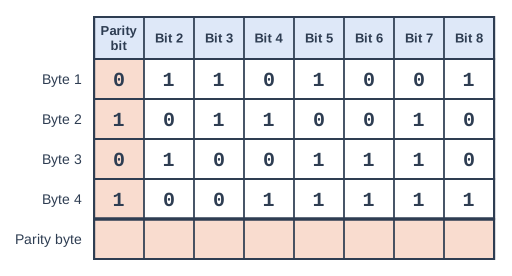
The diagram shows a block of four bytes that are to be transmitted using a parity block check with even parity. The first bit of each byte is its parity bit. The parity byte, at the bottom, has been left blank.
State the parity byte.
Model answer
00001010
Column by column, the numbers of 1s in the four bytes are 2, 2, 2, 2, 3, 2, 3, 2. Each even column gets a 0 and each odd column gets a 1 to make it even.
Explanation
Each bit of the parity byte makes the number of 1s in its column even. Work down each column, count the 1s, and write 0 if the count is already even or 1 if it is odd. Do not work along the rows: the rows already have their own parity bits.
Mark scheme
2 marks
00001010
2 marks for all eight bits correct; 1 mark for six or seven bits correct; accept with or without a space
Question 3
3 marks
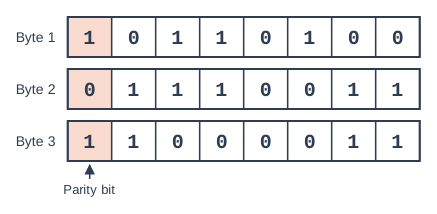
The diagram shows three bytes that have been received using even parity. The first bit of each byte is the parity bit.
Identify which byte has been received with an error and explain how you know.
Model answer
Byte 2 has been received with an error. It contains five 1s, which is an odd number, but with even parity every byte should contain an even number of 1s. Bytes 1 and 3 each contain four 1s, so they pass the check.
Explanation
Count the 1s in each byte, including the parity bit. With even parity any byte with an odd count has failed. The check tells you which byte is wrong but not which bit, so Byte 2 would have to be resent.
Mark scheme
1 mark
Byte 2
1 mark
Byte 2 contains five 1s / an odd number of 1s
1 mark
Even parity requires an even number of 1s (Bytes 1 and 3 each have four 1s)
Question 4
4 marks
A bank sends very large files of customer transactions between its offices every night. It must choose one error detection method: parity check, checksum or echo check.
Suggest the most suitable method and justify your choice.
Model answer
A checksum is the most suitable method. Only one checksum is added to each block, so very little extra data is sent with the large files. It also detects errors that a parity check would miss, such as two bits changing in a byte, which matters because transaction data must be accurate. An echo check would be unsuitable because sending every file back again would double the amount of data and the time taken.
Explanation
Justify the choice using features of the scenario: very large files favour a method with little extra data, and financial data needs reliable detection. Explaining why the other methods are less suitable strengthens the justification.
Mark scheme
1 mark
Checksum
if a different method is chosen, justification marks may still be awarded for valid comparative points, max 3
1 mark
Only one checksum value is added per block, so little extra data is sent with very large files
max 3 for justification
1 mark
It detects errors that a parity check can miss, such as two bits changing in one byte (important for accurate financial data)
1 mark
An echo check would send all the data back, doubling the transmission time for very large files
1 mark
An echo check cannot tell which direction the error happened in, so correct data may be resent unnecessarily
Ready to try the rest? Every answer you write is marked against the mark scheme, so you can see exactly where the marks are.
Ctrl + Enter to check
AI TutorHints first, answers after you try
Hi! Stuck? Ask me for a hint and I’ll help you work it out. Once you’ve checked your answer I can explain exactly where the marks are.