
Level:
Correct: 0
Incorrect: 0
Marks: 0/0
Exam Practice
Subject:
Topics:
Cambridge IGCSE Computer Science (Paper 1) Smart practice A mixed round aimed at your weak spots
Unit 1
Data representation
Unit 2
Data transmission
Unit 3
Hardware
Unit 4
Software
Unit 5
The internet and its uses
Unit 6
Automated and emerging technologies
Automated systems
Automated systems
0%
Artificial intelligence
0%
Avg
score:
–
Topics
done:
0/39

Methods of data transmission

Practise 28 exam-style questions on Methods of data transmission for Cambridge IGCSE Computer Science (Paper 1). Write your answer as you would in the exam and get it marked in seconds against the mark scheme, point by point, with an AI tutor on hand if you get stuck.

  • 28 questions
  • 1–6 marks each
  • Instant marking
  • No sign-up needed
20 questions, marked as you go

Sample questions with model answers

Here are 4 of the questions in this topic, each with a model answer, an explanation of why it earns the marks and the mark scheme an examiner would use.

Question 1

1 mark

Give one example of a use of simplex data transmission.

Model answer

A sensor sending temperature readings to a computer, where the computer never sends data back to the sensor.

Explanation

Simplex means data travels in one direction only, so the example must be a device that only sends or only receives. Anything involving a conversation, such as a phone call or walkie-talkie, needs data in both directions and is not simplex.

Mark scheme
  1. 1 mark

    Any suitable one-way use, e.g. a keyboard sending data to a computer / a sensor sending readings to a computer or microprocessor / a television or radio broadcast / a computer sending data to a printer / a computer sending data to a monitor

    the example must only need data to travel in one direction; do not accept a telephone call, video call or walkie-talkie
Question 2

2 marks

Explain why parallel data transmission is not suitable for sending data over long distances.

Model answer

Over a long distance the bits travelling along the different wires may arrive at slightly different times, which is called skew. This means the receiver may combine bits from different bytes, so the data is corrupted.

Explanation

The main reason is skew: the further the data travels, the more out of step the separate wires become. A point plus its consequence (errors in the data) earns both marks; cost and interference are also valid reasons.

Mark scheme
  1. 1 mark

    The bits on the different wires may arrive at different times / out of synchronisation (skew)

    max 2

  2. 1 mark

    So the data may be corrupted / the receiver may read bits from the wrong byte / errors occur

    expansion of the skew point

  3. 1 mark

    Long cables with many wires are expensive

  4. 1 mark

    There is more interference/crosstalk between the wires over a long cable

Question 3

3 marks

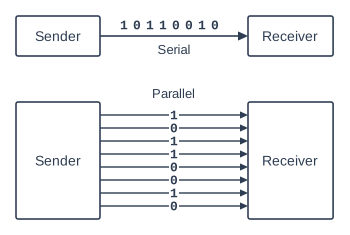
The diagram shows the byte 10110010 being sent from a sender to a receiver using serial transmission and using parallel transmission.

Describe how the data is sent in each method.

Block diagram with four parts in two rows. Top row, left to right: a box "Sender" and a box "Receiver". Bottom row, left to right: a box "Sender" and a box "Receiver". Connections: an arrow from "Sender" (top row) to "Receiver" (top row), labelled "Serial", with the bits 1 0 1 1 0 0 1 0 written along it, listed from the "Sender" (top row) end; 8 parallel wires from "Sender" (bottom row) to "Receiver" (bottom row), each with an arrowhead at the "Receiver" (bottom row) end, labelled "Parallel"; one bit on each wire, top to bottom: 1, 0, 1, 1, 0, 0, 1, 0.

Model answer

In serial transmission the bits of 10110010 are sent one at a time, one after another, along a single wire. In parallel transmission all eight bits are sent at the same time, each along its own wire, so eight wires are used.

Explanation

The diagram shows the difference: one wire carrying the bits in sequence for serial, and eight wires carrying one bit each for parallel. For full marks describe both how many bits travel at once and how many wires are used.

Mark scheme
  1. 1 mark

    Serial: the bits are sent one at a time / one after another

    max 3

  2. 1 mark

    Serial: along a single wire/channel

  3. 1 mark

    Parallel: all eight bits are sent at the same time

  4. 1 mark

    Parallel: each bit travels along its own wire / eight wires are used

Question 4

4 marks

Give the missing terms A to D in this description of data transmission.

In A data transmission, data is sent one bit at a time along a single wire. In B data transmission, several bits are sent at the same time along several wires, which is faster over short distances. A connection where data can only travel in one direction is called C. A connection where data can travel in both directions at the same time is called D.

Model answer

A: serial
B: parallel
C: simplex
D: full-duplex

Explanation

Serial and parallel describe how many bits are sent at once; simplex, half-duplex and full-duplex describe the direction of the data. Full-duplex is both directions at the same time, whereas half-duplex is both directions but one at a time.

Mark scheme
  1. 1 mark

    A: serial

  2. 1 mark

    B: parallel

  3. 1 mark

    C: simplex

  4. 1 mark

    D: full-duplex

    do not accept 'duplex' on its own or 'half-duplex'

Ready to try the rest? Every answer you write is marked against the mark scheme, so you can see exactly where the marks are.

AI Tutor Hints first, answers after you try

Hi! Stuck? Ask me for a hint and I’ll help you work it out. Once you’ve checked your answer I can explain exactly where the marks are.