
Level:
Correct: 0
Incorrect: 0
Marks: 0/0
Exam Practice
Subject:
Topics:
Cambridge IGCSE Computer Science (Paper 1) Smart practice A mixed round aimed at your weak spots
Unit 1
Data representation
Unit 2
Data transmission
Unit 3
Hardware
Unit 4
Software
Unit 5
The internet and its uses
Unit 6
Automated and emerging technologies
Automated systems
Automated systems
0%
Artificial intelligence
0%
Avg
score:
–
Topics
done:
0/39

Digital currency and blockchain

Practise 19 exam-style questions on Digital currency and blockchain for Cambridge IGCSE Computer Science (Paper 1). Write your answer as you would in the exam and get it marked in seconds against the mark scheme, point by point, with an AI tutor on hand if you get stuck.

  • 19 questions
  • 1–6 marks each
  • Instant marking
  • No sign-up needed
19 questions, marked as you go

Sample questions with model answers

Here are 4 of the questions in this topic, each with a model answer, an explanation of why it earns the marks and the mark scheme an examiner would use.

Question 1

1 mark

Blockchain, in its basic form, is described as a digital ledger.

State what is meant by a digital ledger.

Model answer

A digital ledger is an electronic record of transactions.

Explanation

A ledger is a record of transactions, like an account book. A blockchain is a digital ledger: a time-stamped series of records of transactions that cannot be altered.

Mark scheme
  1. 1 mark

    An electronic/digital record (database) of (all) transactions

    accept 'a list of transactions stored electronically'; do not accept 'a digital currency' or 'a type of money'
Question 2

2 marks

Blockchain is described as decentralised.

Explain what this means.

Model answer

There is no central bank or server in control of the ledger. Instead, every computer in the blockchain network holds a copy of the whole blockchain, and transactions are verified by the network.

Explanation

Decentralised means control and storage are shared out across many computers rather than held by one organisation. This is also what makes the records so hard to alter: a change would have to be made on most of the copies at once.

Mark scheme
  1. 1 mark

    There is no central authority/server/bank that holds or controls the ledger

    max 2

  2. 1 mark

    Every computer (node) in the network holds a copy of the whole blockchain/ledger

  3. 1 mark

    Transactions are checked/verified by computers in the network instead of one organisation

Question 3

3 marks

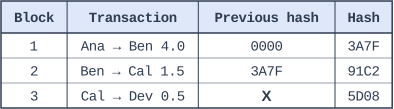
The table shows three blocks from a blockchain. The hash values have been shortened to four hexadecimal digits, and one value is labelled X.

State the value of X and explain why it must have this value.

Trace table with four columns: Block, Transaction, Previous hash and Hash. Row 1: Block = 1, Transaction = "Ana → Ben 4.0", Previous hash = 0000, Hash = 3A7F. Row 2: Block = 2, Transaction = "Ben → Cal 1.5", Previous hash = 3A7F, Hash = 91C2. Row 3: Block = 3, Transaction = "Cal → Dev 0.5", Previous hash is the letter X, Hash = 5D08.

Model answer

X = 91C2. Each block stores the hash value of the previous block, and block 2's hash is 91C2. This links block 3 to block 2, forming the chain, so if block 2 were changed its hash would no longer match.

Explanation

The previous hash field always copies the hash of the block before. Block 2's hash is 91C2, so block 3's previous hash must also be 91C2. Block 1 has 0000 because there is no block before it.

Mark scheme
  1. 1 mark

    X = 91C2

    accept lower case 91c2

  2. 1 mark

    Each block stores the hash (value) of the previous block

  3. 1 mark

    This links the blocks together in order / forms the chain, so any change to block 2 would be detected

Question 4

4 marks

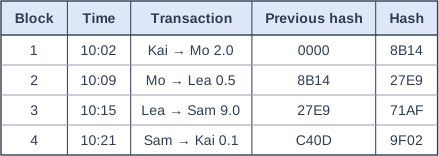
The table shows four blocks from a blockchain. The hash values have been shortened to four hexadecimal digits.

A criminal changed the transaction in one of the blocks and the hash value of that block was recalculated. No other values were changed.

Identify the block that was changed and explain how the change is detected.

Table with columns "Block", "Time", "Transaction", "Previous hash", "Hash". Block: 1; Time: 10:02; Transaction: Kai → Mo 2.0; Previous hash: 0000; Hash: 8B14 | Block: 2; Time: 10:09; Transaction: Mo → Lea 0.5; Previous hash: 8B14; Hash: 27E9 | Block: 3; Time: 10:15; Transaction: Lea → Sam 9.0; Previous hash: 27E9; Hash: 71AF | Block: 4; Time: 10:21; Transaction: Sam → Kai 0.1; Previous hash: C40D; Hash: 9F02.

Model answer

Block 3 was changed. Block 4's previous hash is C40D, but block 3's hash is now 71AF, so they do not match. Changing the data in block 3 changed its hash, which broke the link to block 4. Also, every other computer in the network still holds the unchanged copy, so the altered blockchain does not match and is rejected.

Explanation

Check each previous hash against the hash of the block above. Blocks 1-2 and 2-3 match, but block 4 still holds C40D, the original hash of block 3. So block 3 is the one whose data, and therefore hash, changed. This is why blockchain records are said to be unalterable.

Mark scheme
  1. 1 mark

    Block 3

    max 4

  2. 1 mark

    Block 4's previous hash (C40D) does not match block 3's hash (71AF)

    both values or a clear reference to the mismatch between block 3 and block 4 needed

  3. 1 mark

    Changing the data in a block changes its hash, so the link to the next block is broken / the chain is broken

  4. 1 mark

    Every other computer in the network holds an unchanged copy, so the altered copy does not match and is rejected

  5. 1 mark

    To hide the change, every following block would need to be changed on most computers in the network, which is not practical

Ready to try the rest? Every answer you write is marked against the mark scheme, so you can see exactly where the marks are.

AI Tutor Hints first, answers after you try

Hi! Stuck? Ask me for a hint and I’ll help you work it out. Once you’ve checked your answer I can explain exactly where the marks are.