
Level:
Correct: 0
Incorrect: 0
Marks: 0/0
Exam Practice
Subject:
Topics:
Cambridge IGCSE Computer Science (Paper 1) Smart practice A mixed round aimed at your weak spots
Unit 1
Data representation
Unit 2
Data transmission
Unit 3
Hardware
Unit 4
Software
Unit 5
The internet and its uses
Unit 6
Automated and emerging technologies
Automated systems
Automated systems
0%
Artificial intelligence
0%
Avg
score:
–
Topics
done:
0/39

Character sets: ASCII and Unicode

Practise 24 exam-style questions on Character sets: ASCII and Unicode for Cambridge IGCSE Computer Science (Paper 1). Write your answer as you would in the exam and get it marked in seconds against the mark scheme, point by point, with an AI tutor on hand if you get stuck.

  • 24 questions
  • 1–6 marks each
  • Instant marking
  • No sign-up needed
20 questions, marked as you go

Sample questions with model answers

Here are 4 of the questions in this topic, each with a model answer, an explanation of why it earns the marks and the mark scheme an examiner would use.

Question 1

1 mark

The capital letter 'A' and the lower case letter 'a' have different ASCII codes.

State why they must have different codes.

Model answer

They are different characters, and every character in a character set must have its own unique binary code so that the computer can tell them apart.

Explanation

A character set maps every character to exactly one unique code. Upper and lower case letters look different and mean different things in text, so they need different codes ('A' is 65 and 'a' is 97 in ASCII). If they shared a code, the computer could not know which one to display.

Mark scheme
  1. 1 mark

    Each character in a character set must have its own unique code, so that the computer can tell the two characters apart

    accept 'they are different characters, so each needs a unique binary code'; do not accept 'because one is bigger'
Question 2

2 marks

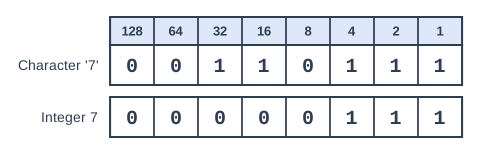
The diagram shows the binary value stored when the character '7' is typed into a text file using ASCII, and the binary value stored when the integer 7 is stored as a number.

Explain why the two binary values are different.

Two 8-bit registers, each drawn as a row of 8 boxes, with the place values 128, 64, 32, 16, 8, 4, 2, 1 above the columns. Row 1 (labelled "Character '7'"): 00110111. Row 2 (labelled "Integer 7"): 00000111.

Model answer

The character '7' is text, so it is stored using its ASCII code, which is 55 in denary (00110111). The integer 7 is a number, so its actual value is converted directly into binary (00000111).

Explanation

A character set gives every symbol a code, including the digit symbols: '0' is 48, '1' is 49, and so on, so '7' is 55. A number is stored as its value in binary instead. This is why a digit typed as text must be converted before it can be used in a calculation.

Mark scheme
  1. 1 mark

    The character '7' is stored as its ASCII code (55) / a code from the character set

    max 2

  2. 1 mark

    The integer 7 is stored as its actual value converted to binary

    accept 'pure binary of 7'

  3. 1 mark

    The character is treated as text/a symbol, not as a number, so it cannot be used directly in calculations

Question 3

3 marks

A travel company has a website that shows information in English, Greek, Arabic and Chinese.

Explain why the text on the website is stored using Unicode rather than ASCII.

Model answer

ASCII can only represent 128 or 256 characters, which is only enough for English letters, digits and punctuation, so it has no codes for Greek, Arabic or Chinese characters. Unicode uses more bits per character, so it has enough unique codes to represent a much greater range of characters, including those from all of these languages. This means all four languages can be stored and displayed correctly on the same website.

Explanation

The limit of ASCII comes from its small number of bits per character: 7 or 8 bits only give 128 or 256 codes. Unicode uses more bits per character, so it can give a code to characters from almost every written language. Chinese alone has thousands of characters, far more than ASCII could ever hold.

Mark scheme
  1. 1 mark

    ASCII can only represent a limited number of characters (128/256)

    max 3

  2. 1 mark

    ASCII mainly contains English/Latin characters, so Greek, Arabic and Chinese characters cannot be represented (there are no ASCII codes for them)

  3. 1 mark

    Unicode can represent a much greater range of characters, including the characters of many different languages

  4. 1 mark

    Unicode uses more bits per character (e.g. 16 or 32), so there are enough unique codes for all of these characters

  5. 1 mark

    So all of the languages can be stored/displayed correctly on the same website

Question 4

4 marks

Give the missing terms A to D in this description of how text is represented.

Text must be converted to A before it can be processed by a computer. Each character is given a unique code from a B. ASCII is one example and uses 7 or 8 bits per character. C uses more bits per character, so it can represent a greater range of characters, including different languages and D.

Model answer

A: binary
B: character set
C: Unicode
D: emojis

Explanation

Computers process everything in binary, so each character is given a unique binary code from a character set. ASCII and Unicode are the two character sets in the syllabus; Unicode uses more bits per character, which gives it room for many languages and emojis.

Mark scheme
  1. 1 mark

    A: binary

    accept 0s and 1s

  2. 1 mark

    B: character set

  3. 1 mark

    C: Unicode

  4. 1 mark

    D: emojis

    accept symbols

Ready to try the rest? Every answer you write is marked against the mark scheme, so you can see exactly where the marks are.

AI Tutor Hints first, answers after you try

Hi! Stuck? Ask me for a hint and I’ll help you work it out. Once you’ve checked your answer I can explain exactly where the marks are.