Practise 29 exam-style questions on Sensors for Cambridge IGCSE Computer Science (Paper 1). Write your answer as you would in the exam and get it marked in seconds against the mark scheme, point by point, with an AI tutor on hand if you get stuck.
29 questions
1–6 marks each
Instant marking
No sign-up needed
20 questions, marked as you go
Sample questions with model answers
Here are 4 of the questions in this topic, each with a model answer, an explanation of why it earns the marks and the mark scheme an examiner would use.
Question 1
1 mark
A car switches its headlights on automatically when it gets dark.
Name the sensor used to do this.
Model answer
A light sensor.
Explanation
A light sensor uses a photoelectric cell whose output depends on the brightness of the light falling on it. When the reading drops below a stored value, the car's microprocessor switches the headlights on.
Mark scheme
1 mark
Light sensor
do not accept 'infra-red sensor'
Question 2
2 marks
A council is deciding how to switch its street lights on and off. One option is a timer set to the same times every day. The other is a light sensor.
Explain why a light sensor is more suitable than a timer.
Model answer
The time it gets dark changes throughout the year, and it can also become dark during the day in very bad weather, so a fixed timer would often switch the lights at the wrong time. A light sensor responds to the actual light level, so the lights come on whenever it is dark and stay off when it is light, which improves safety and saves energy.
Explanation
The advantage of a sensor is that it measures the real conditions rather than assuming them. A timer works only if darkness always happens at the same time, which it does not. Answers should say why a timer fails (seasons, weather) as well as what the sensor does.
Mark scheme
1 mark
The time it gets dark changes through the year/with the seasons
max 2
1 mark
It can also get dark during the day because of weather (e.g. heavy storm clouds)
1 mark
The light sensor responds to the actual light level, so the lights are on only when needed / are never off when it is dark
1 mark
Saves energy/money because lights are not on when it is already light
Question 3
3 marks
A water company uses a level sensor to monitor the water in a reservoir and warn nearby towns of possible flooding.
Describe how the level sensor and a microprocessor are used to give the warning.
Model answer
The level sensor measures the height of the water in the reservoir and continuously sends readings, converted into digital by an ADC, to the microprocessor. The microprocessor compares each reading with a stored safe maximum level. If the water level is above this value, the microprocessor sends out a warning, such as sounding sirens or sending messages to the nearby towns; otherwise it carries on monitoring.
Explanation
This is a monitoring system: the microprocessor compares the readings with a stored value and gives a warning, but it does not change the water level itself. A level sensor (often using ultrasound) measures how high a liquid is, which is different from a flow sensor that measures how fast liquid is moving.
Mark scheme
1 mark
The level sensor measures the height/level of the water and sends readings (continuously/regularly) to the microprocessor
max 3
1 mark
The readings are converted to digital by an ADC
1 mark
The microprocessor compares each reading with a stored maximum/safe level
1 mark
If the level is above the stored value, the microprocessor sends a warning (e.g. sounds an alarm or sends messages to the towns)
1 mark
Otherwise it continues to take readings / monitoring continues
Question 4
4 marks
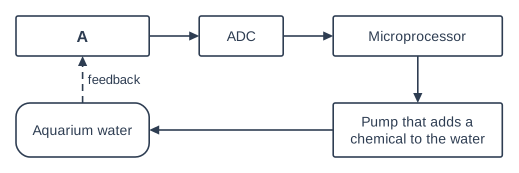
The diagram shows a system that keeps the water in an aquarium at the correct acidity for tropical fish.
Identify the sensor labelled A and describe how the system keeps the acidity of the water correct.
Model answer
A is a pH sensor. It continuously measures the acidity of the water and sends readings through the ADC, which converts them into digital data, to the microprocessor. The microprocessor compares each reading with the stored acceptable range. If the water is outside the range, it switches on the pump to add the chemical; when the reading is back within range it switches the pump off. This repeats continuously, so the sensor measures the effect of the chemical (feedback).
Explanation
This is a control system: sensor → ADC → microprocessor (compares with stored values) → actuator, with feedback from the sensor. Acidity is measured by a pH sensor. Full answers describe both what happens when the reading is out of range and that the loop keeps repeating.
Mark scheme
1 mark
A: pH sensor
max 4
1 mark
The sensor sends readings (continuously) to the microprocessor, through the ADC which converts them to digital
1 mark
The microprocessor compares each reading with stored values/the acceptable range
1 mark
If the reading is outside the range, the microprocessor switches on the pump to add the chemical; if it is within range the pump is switched off/stays off
1 mark
The process repeats continuously (feedback), so the effect of the chemical is measured
Ready to try the rest? Every answer you write is marked against the mark scheme, so you can see exactly where the marks are.
Ctrl + Enter to check
AI TutorHints first, answers after you try
Hi! Stuck? Ask me for a hint and I’ll help you work it out. Once you’ve checked your answer I can explain exactly where the marks are.