Practise 23 exam-style questions on Cores, cache and clock speed for Cambridge IGCSE Computer Science (Paper 1). Write your answer as you would in the exam and get it marked in seconds against the mark scheme, point by point, with an AI tutor on hand if you get stuck.
23 questions
1–6 marks each
Instant marking
No sign-up needed
20 questions, marked as you go
Sample questions with model answers
Here are 4 of the questions in this topic, each with a model answer, an explanation of why it earns the marks and the mark scheme an examiner would use.
Question 1
1 mark
A CPU has a clock speed of 3 GHz.
State how many clock cycles it carries out each second.
Giga means one thousand million (1 000 000 000) when measuring frequency. Unlike storage units such as GiB, clock speeds use powers of 1000, not 1024.
Mark scheme
1 mark
3 000 000 000
accept 3 billion or 3 × 10⁹; do not accept answers using 1024, e.g. 3 221 225 472
Question 2
2 marks
Explain how increasing the clock speed of a CPU can improve its performance.
Model answer
A higher clock speed means more clock cycles every second, so the CPU can fetch, decode and execute more instructions per second and programs run faster.
Explanation
The link to explain is: more cycles per second → more instructions processed per second. Saying 'the computer is faster' without explaining why does not earn the second mark.
Mark scheme
1 mark
More clock cycles are carried out per second
accept 'more pulses per second'
1 mark
So more instructions can be fetched, decoded and executed per second / instructions are processed faster
do not accept 'the computer is faster' on its own
Question 3
3 marks
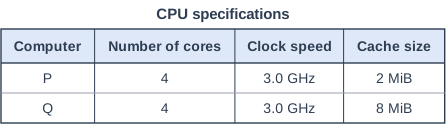
The table shows the CPUs in two computers, P and Q.
Identify which computer is likely to perform better, and explain why.
Model answer
Computer Q. Both CPUs have 4 cores and a 3.0 GHz clock, but Q has a larger cache (8 MiB rather than 2 MiB). It can store more frequently used instructions and data in the cache, so it has to fetch from slower RAM less often.
Explanation
When two CPUs are compared, look for the factor that differs. Here only the cache size differs, so the explanation must be about cache: more of the data the CPU needs is close at hand, avoiding slower RAM.
Mark scheme
1 mark
Computer Q
max 3
1 mark
Q has a larger cache (8 MiB compared with 2 MiB), while the number of cores and clock speed are the same
1 mark
More frequently used instructions / data can be stored in the cache
1 mark
So Q has to fetch from slower RAM less often
Question 4
4 marks
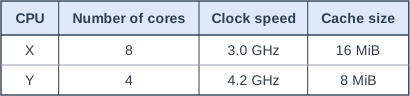
A video editor uses software that can split its work between many cores. The table shows two CPUs, X and Y.
Identify which CPU would be more suitable for the video editor and justify your choice.
Model answer
CPU X would be more suitable. It has twice as many cores as Y (8 compared with 4), and because the video software can split its work between cores, more of the video can be processed at the same time. X also has a larger cache (16 MiB compared with 8 MiB), so it needs fewer slow fetches from RAM. Y has a faster clock speed, so each of its cores is faster, but with all cores working X carries out more cycles per second in total (24 billion compared with 16.8 billion).
Explanation
A justified choice uses the data in the table and links it to the scenario. Because the software uses many cores, the number of cores matters more than the speed of each core here, and the larger cache is a further advantage of X.
Mark scheme
1 mark
X has twice as many cores (8 compared with 4)
max 4; choosing X with no justification scores 0; no marks for choosing Y unless the points made are correct
1 mark
So more parts of the video can be processed at the same time / the software can use all 8 cores in parallel
1 mark
X has a larger cache (16 MiB compared with 8 MiB), so fewer slow fetches from RAM are needed
1 mark
Although Y has a faster clock speed (4.2 GHz), so each core processes more instructions per second
1 mark
When all cores are used, X can carry out more cycles per second in total (8 × 3.0 = 24 billion compared with 4 × 4.2 = 16.8 billion)
Ready to try the rest? Every answer you write is marked against the mark scheme, so you can see exactly where the marks are.
Ctrl + Enter to check
AI TutorHints first, answers after you try
Hi! Stuck? Ask me for a hint and I’ll help you work it out. Once you’ve checked your answer I can explain exactly where the marks are.