Level:
Correct: 0
Incorrect: 0
Marks: 0/0
Exam Practice
Subject:
Topics:
Cambridge IGCSE Computer Science (Paper 1) Smart practice A mixed round aimed at your weak spots
Unit 1
Data representation
Unit 2
Data transmission
Unit 3
Hardware
Unit 4
Software
Unit 5
The internet and its uses
Unit 6
Automated and emerging technologies
Automated systems
Automated systems
0%
Artificial intelligence
0%
Avg
score:
–
Topics
done:
0/39

Automated systems

Practise 31 exam-style questions on Automated systems for Cambridge IGCSE Computer Science (Paper 1). Write your answer as you would in the exam and get it marked in seconds against the mark scheme, point by point, with an AI tutor on hand if you get stuck.

  • 31 questions
  • 1–6 marks each
  • Instant marking
  • No sign-up needed
20 questions, marked as you go

Sample questions with model answers

Here are 4 of the questions in this topic, each with a model answer, an explanation of why it earns the marks and the mark scheme an examiner would use.

Question 1

1 mark

A factory uses an automated system to fill tanks with liquid.

Name a suitable actuator to control the flow of liquid into a tank.

Model answer

A solenoid valve.

Explanation

A valve is an actuator: when the microprocessor sends a signal, it opens or closes to start or stop the flow of liquid. A flow or level sensor measures the liquid, but cannot control it.

Mark scheme
  1. 1 mark

    A valve (solenoid valve)

    accept a pump; do not accept a flow sensor or level sensor

Question 2

2 marks

Explain why an automated system, rather than a person, is used to monitor the temperature inside a nuclear reactor.

Model answer

A nuclear reactor is a dangerous environment because of radiation, so it is not safe for people to take readings. An automated system can monitor the temperature continuously and react instantly if it rises, for example by increasing the coolant flow.

Explanation

Automation is chosen where conditions are hazardous and a fast, constant response is critical. Two separate reasons are needed: safety for people, and the speed or continuity of monitoring.

Mark scheme
  1. 1 mark

    The environment is dangerous (radiation / very high temperatures), so people cannot safely take readings there

    max 2

  2. 1 mark

    The system takes readings continuously (24/7) and can react instantly to a dangerous rise in temperature

    accept an example of the reaction, e.g. lowering control rods or increasing the coolant flow

  3. 1 mark

    Readings are more accurate / there is no human error

Question 3

3 marks

A car park has an automated barrier at its entrance.

Describe how sensors, a microprocessor and an actuator could be used to raise the barrier when a car arrives and lower it after the car has passed through.

Model answer

A magnetic field sensor in the road detects when a car arrives and sends a signal to the microprocessor. The microprocessor sends a signal to the motor to raise the barrier. An infrared sensor detects when the car has passed through, and the microprocessor then signals the motor to lower the barrier.

Explanation

Two sensing events are needed: the car arriving and the car having passed, so that the barrier does not come down on the car. The actuator here is the motor that moves the barrier. Remember that the microprocessor, not the sensor, sends the signal to the actuator.

Mark scheme
  1. 1 mark

    A sensor (e.g. magnetic field, pressure or infrared sensor) detects a car at the barrier and sends a signal to the microprocessor

    max 3

  2. 1 mark

    The microprocessor (checks that a space is available / the ticket is valid and) sends a signal to a motor (actuator) to raise the barrier

  3. 1 mark

    A second sensor (e.g. an infrared beam) detects when the car has passed under the barrier

  4. 1 mark

    The microprocessor then sends a signal to the motor to lower the barrier

Question 4

4 marks

An automated system keeps vaccines in a laboratory fridge between 2 °C and 8 °C. Every 10 minutes the microprocessor checks a temperature sensor and a door sensor and uses these rules:

- if the temperature is above 8 °C, switch the cooling motor on
- if the temperature is below 2 °C, switch the cooling motor off
- if the door has been open for more than 2 minutes, sound the buzzer
- in all other cases, make no change

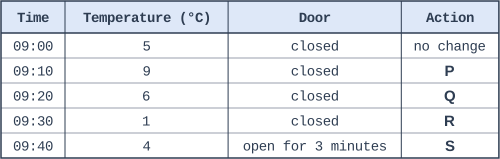
The table shows the readings at five times. State the action the microprocessor takes at each of P, Q, R and S.

Trace table with four columns: Time, Temperature (°C), Door and Action. Row 1: Time = 09:00, Temperature (°C) = 5, Door = closed, Action = "no change". Row 2: Time = 09:10, Temperature (°C) = 9, Door = closed, Action is the letter P. Row 3: Time = 09:20, Temperature (°C) = 6, Door = closed, Action is the letter Q. Row 4: Time = 09:30, Temperature (°C) = 1, Door = closed, Action is the letter R. Row 5: Time = 09:40, Temperature (°C) = 4, Door = "open for 3 minutes", Action is the letter S.

Model answer

P: 9 °C is above 8 °C, so the cooling motor is switched on.
Q: 6 °C is within the range, so no change is made and the cooling motor stays on.
R: 1 °C is below 2 °C, so the cooling motor is switched off.
S: the door has been open for more than 2 minutes, so the buzzer sounds.

Explanation

The microprocessor compares each reading with the stored values and only acts when a rule applies. At Q the temperature is back within the range, so nothing changes and the motor keeps cooling until the temperature drops below 2 °C. Switching it off at 6 °C is a common mistake.

Mark scheme
  1. 1 mark

    P: switch the cooling motor on

  2. 1 mark

    Q: no change (the cooling motor stays on)

    do not accept 'switch the cooling motor off' - 6 °C is within the range, so no rule applies

  3. 1 mark

    R: switch the cooling motor off

  4. 1 mark

    S: sound the buzzer

    accept 'sound the buzzer; the motor stays off'

Ready to try the rest? Every answer you write is marked against the mark scheme, so you can see exactly where the marks are.

AI Tutor Hints first, answers after you try

Hi! Stuck? Ask me for a hint and I’ll help you work it out. Once you’ve checked your answer I can explain exactly where the marks are.