Practise 35 exam-style questions on Keeping data safe: security solutions for Cambridge IGCSE Computer Science (Paper 1). Write your answer as you would in the exam and get it marked in seconds against the mark scheme, point by point, with an AI tutor on hand if you get stuck.
35 questions
1–6 marks each
Instant marking
No sign-up needed
20 questions, marked as you go
Sample questions with model answers
Here are 4 of the questions in this topic, each with a model answer, an explanation of why it earns the marks and the mark scheme an examiner would use.
Question 1
1 mark
A student receives this message: 'Congratulations! You have won a £500 voucher. Reply within one hour to claim your prize.'
State one feature of the tone of this message that suggests it may be a scam.
Model answer
It puts pressure on the student to act quickly by saying they must reply within one hour.
Explanation
Scammers use urgency so people act before thinking, and unexpected prizes that seem too good to be true. Genuine organisations rarely demand an immediate reply. Recognising this tone is one of the solutions for keeping data safe from phishing.
Mark scheme
1 mark
Any one from: it creates urgency / pressure (reply within one hour); the offer is too good to be true (a prize the student did not enter for)
accept 'it is overexcited / over-friendly'; do not accept 'spelling mistakes' (there are none)
Question 2
2 marks
Explain how checking the spelling and tone of a message can help a person avoid being a victim of phishing.
Model answer
Phishing messages often have spelling and grammar errors or use an urgent or threatening tone to pressure people, while real companies write carefully and professionally. If the person spots these signs, they will realise the message is probably fake and will not click its link or hand over their details.
Explanation
Checking spelling and tone is a human security measure: it relies on the reader noticing that a message does not look like it came from a real organisation. Marks come from saying what the warning signs are and what the person then does (or does not do) as a result.
Mark scheme
1 mark
Phishing messages often contain spelling or grammar mistakes / an urgent, threatening or unusually informal tone, whereas genuine organisations check their messages and write professionally
1 mark
Noticing these signs warns the person the message may be fake, so they do not click the link / reply / give personal details
Question 3
3 marks
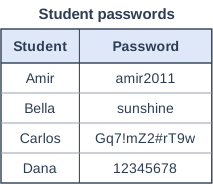
The table shows the passwords chosen by four students for the school network.
Identify the student with the strongest password and give two reasons why it is the strongest.
Model answer
Carlos has the strongest password. It is the longest at 12 characters, and it mixes upper and lower case letters, numbers and symbols, so it is not a word or a pattern and would take far longer to crack by brute force than the others.
Explanation
Strong passwords are long, use a mix of character types and avoid words, names, dates and simple sequences. Amir's password contains his name and probably a year, 'sunshine' is a dictionary word and 12345678 is one of the most common passwords, so all three could be guessed quickly.
Mark scheme
1 mark
Carlos
accept the password Gq7!mZ2#rT9w
1 mark
It is the longest password (12 characters)
reasons: max 2
1 mark
It contains a mix of upper case letters, lower case letters, numbers and symbols
accept any two of these types for this mark
1 mark
It is not a dictionary word / not personal information (name or year of birth) / not a simple sequence such as 12345678
1 mark
There are far more possible combinations, so it is much harder to guess / would take much longer to crack with a brute-force attack
do not accept 'it is harder to remember'
Question 4
4 marks
Describe how a firewall helps to keep the data on a company's network safe.
Model answer
A firewall sits between the company's network and the internet and examines all incoming and outgoing traffic. It checks each item of traffic against a set of rules set by the network manager and blocks anything that does not meet them, such as traffic from known undesirable IP addresses. It logs traffic and warns the manager about attempted unauthorised access, helping to keep hackers out.
Explanation
The key ideas are position (between the network and the internet), monitoring of traffic in both directions, comparison with rules, and blocking. 'It stops viruses' on its own is not enough: describe how the firewall decides what to block.
Mark scheme
1 mark
Sits between the company network / computer and the internet (external network)
max 4
1 mark
Monitors / examines all incoming and outgoing traffic
1 mark
Checks the traffic against a set of rules / criteria (set by the user or network manager)
1 mark
Blocks traffic that does not meet the rules
1 mark
Can block traffic from / to particular IP addresses / keeps a list of undesirable IP addresses
1 mark
Can block access to certain (undesirable) websites
1 mark
Logs traffic so it can be checked later
1 mark
Warns the user / network manager about attempted unauthorised access, or when software tries to access an external source
1 mark
Helps prevent hackers gaining access / malware entering the network
Ready to try the rest? Every answer you write is marked against the mark scheme, so you can see exactly where the marks are.
Ctrl + Enter to check
AI TutorHints first, answers after you try
Hi! Stuck? Ask me for a hint and I’ll help you work it out. Once you’ve checked your answer I can explain exactly where the marks are.