
Level:
Correct: 0
Incorrect: 0
Marks: 0/0
Exam Practice
Subject:
Topics:
Cambridge IGCSE Computer Science (Paper 1) Smart practice A mixed round aimed at your weak spots
Unit 1
Data representation
Unit 2
Data transmission
Unit 3
Hardware
Unit 4
Software
Unit 5
The internet and its uses
Unit 6
Automated and emerging technologies
Automated systems
Automated systems
0%
Artificial intelligence
0%
Avg
score:
–
Topics
done:
0/39

Representing sound

Practise 24 exam-style questions on Representing sound for Cambridge IGCSE Computer Science (Paper 1). Write your answer as you would in the exam and get it marked in seconds against the mark scheme, point by point, with an AI tutor on hand if you get stuck.

  • 24 questions
  • 1–6 marks each
  • Instant marking
  • No sign-up needed
20 questions, marked as you go

Sample questions with model answers

Here are 4 of the questions in this topic, each with a model answer, an explanation of why it earns the marks and the mark scheme an examiner would use.

Question 1

1 mark

A sound card can record 32 different amplitude levels for each sample.

State the sample resolution used by the sound card.

Model answer

5 bits, because 2 to the power 5 = 32.

Explanation

Each extra bit doubles the number of levels: 1 bit gives 2, 2 bits give 4, 3 bits give 8, 4 bits give 16 and 5 bits give 32. So 32 levels need a sample resolution of 5 bits. A common mistake is to confuse the number of levels with the number of bits.

Mark scheme
  1. 1 mark

    5 bits

    accept 5; do not accept 32 bits
Question 2

2 marks

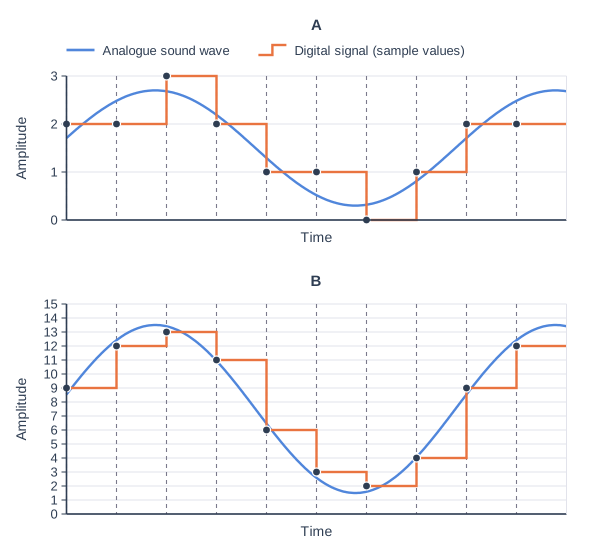
The diagram shows the same sound wave sampled in two different ways, A and B. Both recordings take the same number of samples.

Explain why recording B is a more accurate representation of the sound wave than recording A.

Two graphs, one above the other, of the same analogue sound wave sampled in two different ways. Upper graph (titled "A"): amplitude on the vertical axis, numbered in 4 levels from 0 to 3, against time on the horizontal axis. A smooth curve shows the analogue wave. Dashed vertical lines mark 10 samples taken at regular intervals, starting at time 0; a dot on each line sits on the level recorded for that sample (the nearest level to the wave). A stepped orange line (the digital signal) holds each sample's level until the next sample; a legend above the upper graph names the analogue sound wave and the digital signal. Lower graph (titled "B"): amplitude on the vertical axis, numbered in 16 levels from 0 to 15, against time on the horizontal axis. A smooth curve shows the analogue wave. Dashed vertical lines mark 10 samples taken at regular intervals, starting at time 0; a dot on each line sits on the level recorded for that sample (the nearest level to the wave). A stepped orange line (the digital signal) holds each sample's level until the next sample.

Model answer

Recording B uses a higher sample resolution: 4 bits per sample instead of 2, so it has 16 amplitude levels instead of 4. Each sample in B can therefore be recorded much closer to the real amplitude of the wave, with less rounding.

Explanation

The sample rate is the same in both, so the difference is in the vertical axis: the number of levels. With only 4 levels, many samples must be rounded a long way from the true amplitude. B is more accurate, but each sample needs twice as many bits, so its file is twice as large.

Mark scheme
  1. 1 mark

    B has a higher sample resolution / uses more bits per sample (4 bits instead of 2)

    max 2

  2. 1 mark

    B has more amplitude levels (16 instead of 4)

  3. 1 mark

    So each sample in B is closer to the actual amplitude of the wave / is rounded less

Question 3

3 marks

Explain the effect of increasing the sample resolution when a sound is recorded.

Model answer

Increasing the sample resolution means more bits are used for each sample, so more different amplitude levels can be represented. Each sample can then be stored closer to the real amplitude of the wave, so the recording is more accurate. However, each sample takes more bits, so the file size increases.

Explanation

Each extra bit doubles the number of amplitude levels, for example 8 bits give 256 levels and 16 bits give 65 536. More levels means less rounding of each sample, so a more accurate recording, but every sample is bigger, so the file is larger.

Mark scheme
  1. 1 mark

    More bits are used to store each sample

    max 3

  2. 1 mark

    More amplitude levels/values can be represented

  3. 1 mark

    Each sample is closer to the actual amplitude (less rounding), so the recording is more accurate / closer to the original sound

    accept 'better quality'

  4. 1 mark

    The file size increases

Question 4

4 marks

Give the missing terms A to D in this description of how a sound is stored.

To store a sound, the computer measures the A of the sound wave at regular time intervals. Each measurement is called a B. The number of measurements taken each second is the C, and the number of bits used to store each measurement is the D.

Model answer

A: amplitude
B: sample
C: sample rate
D: sample resolution

Explanation

Sampling measures the amplitude of the wave; each measurement is a sample. Sample rate is samples per second and sample resolution is bits per sample. Mixing up rate and resolution is the most common error in this topic.

Mark scheme
  1. 1 mark

    A: amplitude

    accept height

  2. 1 mark

    B: sample

  3. 1 mark

    C: sample rate

    accept sampling rate; do not accept 'frequency' on its own

  4. 1 mark

    D: sample resolution

    accept bit depth

Ready to try the rest? Every answer you write is marked against the mark scheme, so you can see exactly where the marks are.

AI Tutor Hints first, answers after you try

Hi! Stuck? Ask me for a hint and I’ll help you work it out. Once you’ve checked your answer I can explain exactly where the marks are.