Network hardware: NIC, MAC and IP addresses, routers
Practise 35 exam-style questions on Network hardware: NIC, MAC and IP addresses, routers for Cambridge IGCSE Computer Science (Paper 1). Write your answer as you would in the exam and get it marked in seconds against the mark scheme, point by point, with an AI tutor on hand if you get stuck.
35 questions
1–6 marks each
Instant marking
No sign-up needed
20 questions, marked as you go
Sample questions with model answers
Here are 4 of the questions in this topic, each with a model answer, an explanation of why it earns the marks and the mark scheme an examiner would use.
Question 1
1 mark
State which type of IP address can change each time a device connects to a network.
Model answer
A dynamic IP address.
Explanation
A dynamic IP address is allocated each time a device connects, so it can change. A static IP address stays the same. Both IPv4 and IPv6 addresses can be static or dynamic.
Mark scheme
1 mark
Dynamic (IP address)
do not accept IPv6 or MAC address
Question 2
2 marks
Describe the difference between a static IP address and a dynamic IP address.
Model answer
A static IP address stays the same every time the device connects to the network. A dynamic IP address is allocated by the network each time the device connects, so it can be different each time.
Explanation
Static means fixed and dynamic means it can change. Dynamic addresses are given out automatically, usually by a router, each time a device joins the network; static addresses are kept for devices that must always be found at the same address, such as servers.
Mark scheme
1 mark
A static IP address does not change / stays the same each time the device connects
1 mark
A dynamic IP address is allocated each time the device connects and can change
accept 'is temporary'
Question 3
3 marks
A MAC address is written as 12 hexadecimal digits. The first 6 digits are the manufacturer code and the last 6 digits are the serial code.
Calculate: • the number of bits in the whole MAC address • the number of bytes in the whole MAC address • the number of different serial codes that one manufacturer code can have, as a power of 2.
Show your working.
Model answer
Each hexadecimal digit represents 4 bits. Bits in the whole MAC address = 12 × 4 = 48 bits Bytes = 48 ÷ 8 = 6 bytes The serial code has 6 hex digits = 6 × 4 = 24 bits Number of different serial codes = 2²⁴
Explanation
One hex digit is one nibble (4 bits), so 12 digits is 48 bits, or 6 bytes. With n bits there are 2ⁿ different patterns, so the 24-bit serial code allows 2²⁴ (16 777 216) devices per manufacturer code. A common slip is to use 8 bits per hex digit.
Mark scheme
1 mark
12 × 4 = 48 bits
working must show 4 bits per hex digit
1 mark
48 ÷ 8 = 6 bytes
follow through from an incorrect number of bits
1 mark
Serial code is 6 × 4 = 24 bits, so 2²⁴ different serial codes
accept 2^24 or 16 777 216
Question 4
4 marks
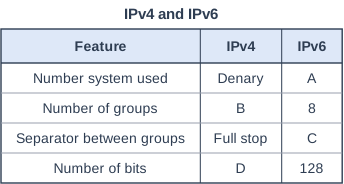
The table shows a comparison of IPv4 and IPv6 addresses. Four values are missing, labelled A to D.
Give the missing values A to D.
Model answer
A: hexadecimal B: 4 C: colon D: 32
Explanation
IPv4 is 32 bits written as four denary groups (0 to 255) separated by full stops. IPv6 is 128 bits written as eight groups of four hexadecimal digits separated by colons. Each IPv6 group is 16 bits, and each IPv4 group is 8 bits.
Mark scheme
1 mark
A: hexadecimal
accept hex / base 16
1 mark
B: 4
accept four
1 mark
C: colon
accept :
1 mark
D: 32
Ready to try the rest? Every answer you write is marked against the mark scheme, so you can see exactly where the marks are.
Ctrl + Enter to check
AI TutorHints first, answers after you try
Hi! Stuck? Ask me for a hint and I’ll help you work it out. Once you’ve checked your answer I can explain exactly where the marks are.