
Level:
Correct: 0
Incorrect: 0
Marks: 0/0
Exam Practice
Subject:
Topics:
Cambridge IGCSE Computer Science (Paper 1) Smart practice A mixed round aimed at your weak spots
Unit 1
Data representation
Unit 2
Data transmission
Unit 3
Hardware
Unit 4
Software
Unit 5
The internet and its uses
Unit 6
Automated and emerging technologies
Automated systems
Automated systems
0%
Artificial intelligence
0%
Avg
score:
–
Topics
done:
0/39

Check digits and ARQ

Practise 24 exam-style questions on Check digits and ARQ for Cambridge IGCSE Computer Science (Paper 1). Write your answer as you would in the exam and get it marked in seconds against the mark scheme, point by point, with an AI tutor on hand if you get stuck.

  • 24 questions
  • 1–6 marks each
  • Instant marking
  • No sign-up needed
20 questions, marked as you go

Sample questions with model answers

Here are 4 of the questions in this topic, each with a model answer, an explanation of why it earns the marks and the mark scheme an examiner would use.

Question 1

1 mark

Automatic repeat query (ARQ) is being used to send data from one computer to another.

State what the receiver sends back to the sender when the data is received without any errors.

Model answer

A positive acknowledgement.

Explanation

A positive acknowledgement tells the sender that the data arrived correctly, so it can move on to the next data. If an error is found, the receiver sends a negative acknowledgement instead.

Mark scheme
  1. 1 mark

    A positive acknowledgement (ACK)

    'acknowledgement' on its own is not enough; do not accept 'negative acknowledgement' or 'a copy of the data'
Question 2

2 marks

Automatic repeat query (ARQ) is being used to send data.

Describe what happens when the receiver detects an error in the data it has received.

Model answer

The receiver sends a negative acknowledgement back to the sender, and when the sender receives it, it sends the same data again.

Explanation

In ARQ a negative acknowledgement is a request to repeat the data. This is what 'automatic repeat' means: the data is resent without a person having to do anything.

Mark scheme
  1. 1 mark

    The receiver sends a negative acknowledgement (NAK) to the sender

  2. 1 mark

    The sender resends the data

    accept 'the data is sent again automatically'

Question 3

3 marks

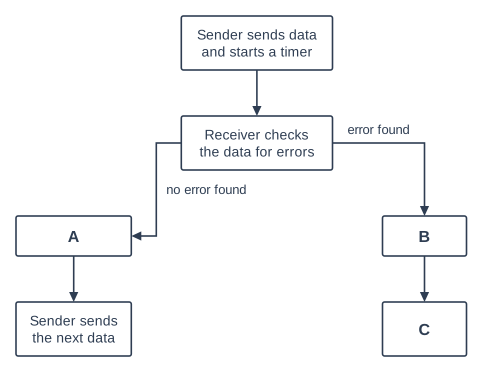
The diagram shows how automatic repeat query (ARQ) is used when data is sent from one device to another.

Identify the actions labelled A, B and C.

Block diagram with six parts in four rows. Top row: a box "Sender sends data and starts a timer". Second row: a box "Receiver checks the data for errors". Third row, left to right: a box labelled A and a box labelled B. Bottom row, left to right: a box "Sender sends the next data" and a box labelled C. Connections: an arrow from "Sender sends data and starts a timer" to "Receiver checks the data for errors"; an arrow from "Receiver checks the data for errors" to box A, labelled "no error found"; an arrow from "Receiver checks the data for errors" to box B, labelled "error found"; an arrow from box A to "Sender sends the next data"; an arrow from box B to box C.

Model answer

A: the receiver sends a positive acknowledgement to the sender.
B: the receiver sends a negative acknowledgement to the sender.
C: the sender resends the data.

Explanation

After checking the data, the receiver replies with a positive acknowledgement if there is no error, or a negative acknowledgement if there is. A negative acknowledgement, or no acknowledgement before the timeout, makes the sender send the same data again.

Mark scheme
  1. 1 mark

    A: the receiver sends a positive acknowledgement (to the sender)

    accept 'ACK sent'

  2. 1 mark

    B: the receiver sends a negative acknowledgement (to the sender)

    accept 'NAK sent' / 'request to resend'

  3. 1 mark

    C: the sender resends the data

Question 4

4 marks

A file is sent in four blocks using automatic repeat query (ARQ):
- Block 1 arrives without errors.
- Block 2 arrives, but interference has corrupted it.
- Block 3 arrives without errors, but the acknowledgement sent back by the receiver is lost.
- Block 4 arrives without errors.

Describe what happens to each block.

Model answer

Block 1: the receiver finds no errors and sends a positive acknowledgement, so the sender moves on to the next block.
Block 2: the receiver detects the error and sends a negative acknowledgement, so the sender resends block 2.
Block 3: the acknowledgement is lost, so the sender's timer runs out without any acknowledgement arriving; the timeout makes the sender resend block 3 automatically.
Block 4: the receiver finds no errors and sends a positive acknowledgement, so the sender knows the transfer is complete.

Explanation

Each part of ARQ handles a different situation: a positive acknowledgement confirms good data, a negative acknowledgement requests a resend of corrupted data, and the timeout deals with anything that goes missing, including lost acknowledgements.

Mark scheme
  1. 1 mark

    Block 1: the receiver sends a positive acknowledgement and the sender then sends the next block

  2. 1 mark

    Block 2: the receiver detects the error and sends a negative acknowledgement, so the sender resends block 2

  3. 1 mark

    Block 3: the sender receives no acknowledgement, so when the timeout expires it resends block 3

  4. 1 mark

    Block 4: the receiver sends a positive acknowledgement, so the sender knows the whole file has been received

Ready to try the rest? Every answer you write is marked against the mark scheme, so you can see exactly where the marks are.

AI Tutor Hints first, answers after you try

Hi! Stuck? Ask me for a hint and I’ll help you work it out. Once you’ve checked your answer I can explain exactly where the marks are.