
Level:
Correct: 0
Incorrect: 0
Marks: 0/0
Exam Practice
Course:
Topics:
Edexcel GCSE Biology (Paper 2) Smart practice A mixed round aimed at your weak spots
Unit 1
Key concepts in biology
Unit 6
Plant structures and their functions
Unit 7
Animal coordination, control and homeostasis
Unit 8
Exchange and transport in animals
Unit 9
Ecosystems and material cycles
Avg
score:
–
Topics
done:
0/38

Transpiration and translocation

Practise 16 exam-style questions on Transpiration and translocation for Edexcel GCSE Biology (Paper 2). Write your answer as you would in the exam and get it marked in seconds against the mark scheme, point by point, with the Study Helper on hand if you get stuck.

  • 16 questions
  • 1–6 marks each
  • Instant marking
  • No sign-up needed
16 questions, marked as you go

Sample questions with model answers

Here are 4 of the questions in this topic, each with a model answer, an explanation of why it earns the marks and the mark scheme an examiner would use.

Question 1

1 mark

Water is transported from the roots to the leaves of a plant in the xylem.

Which substances are carried in the xylem?

Choose your answer.

  • A water and mineral ions
  • B water and sucrose
  • C sucrose only
  • D mineral ions and starch

Model answer

A - water and mineral ions

Explanation

The xylem carries water and the mineral ions dissolved in it up from the roots to the leaves in the transpiration stream. Sucrose is carried in the phloem, and starch is a storage molecule that is not transported because it is insoluble.

Mark scheme
  1. 1 mark

    A / water and mineral ions (1)

    The only correct answer is A. B is not correct because sucrose is carried in the phloem, not the xylem. C is not correct because sucrose is carried in the phloem and the xylem carries water. D is not correct because starch is insoluble and is not transported; it is stored, for example in roots and tubers. Accept the letter or the option. If more than one option is given, do not award the mark.
Question 2

2 marks

Aphids are small insects that feed on plants. An aphid pushes its thin, tube-shaped mouthparts into a plant stem until the tip of the tube is inside the phloem. It then feeds on the liquid in the phloem.

Explain why aphids feed from the phloem rather than from the xylem.

Model answer

The phloem transports sucrose made in the leaves, so the liquid in it is rich in sugar, which the aphid can use as food. The xylem carries only water and mineral ions, so it contains no sugar for the aphid.

Explanation

Phloem transports dissolved sucrose by translocation, so phloem sap is a good energy source; xylem sap is mostly water with mineral ions. Scientists even use aphid mouthparts to collect phloem sap for analysis.

Mark scheme
  1. 1 mark

    the phloem (liquid) contains sucrose / sugar / food (1)

    An explanation linking: accept the phloem transports sucrose (by translocation); accept dissolved sugars

  2. 1 mark

    the xylem carries (only) water and mineral ions / the xylem has no sucrose (1)

    accept the xylem liquid has no (or very little) energy source / food; do not accept the xylem carries sucrose

Question 3

3 marks

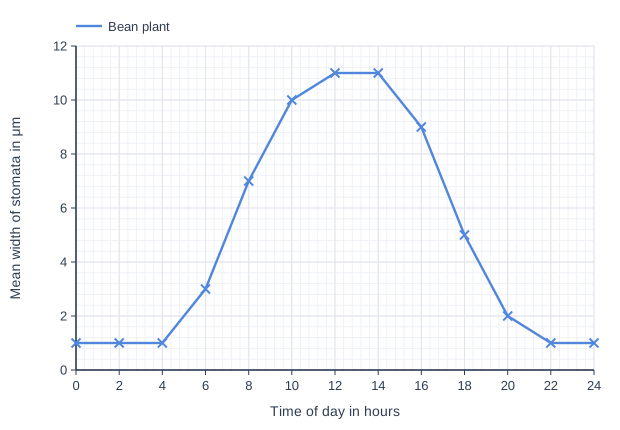
A scientist measured the width of the stomata on the leaves of a bean plant at different times of day on a sunny day in June. It was dark from 22:00 to 04:00.

The graph shows the mean width of the stomata.

Describe and explain the changes in the width of the stomata during the 24 hours.

Line graph of mean width of stomata in μm (y-axis, 0 to 12) against time of day in hours (x-axis, 0 to 24). "Bean plant" joins the points (0, 1), (2, 1), (4, 1), (6, 3), (8, 7), (10, 10), (12, 11), (14, 11), (16, 9), (18, 5), (20, 2), (22, 1), (24, 1).

Model answer

The stomata are almost closed (1 μm) at night. They start to open at about 04:00, when it gets light, are widest (11 μm) between 12:00 and 14:00, and then close again in the evening, back to 1 μm by 22:00 when it is dark. In the light the stomata open so that carbon dioxide can diffuse into the leaf for photosynthesis. In the dark there is no photosynthesis, so the stomata close to reduce the loss of water by transpiration.

Explanation

Stomata are a compromise: open, they let in carbon dioxide for photosynthesis but also let water vapour out. They open in the light when photosynthesis can happen and close in the dark to save water. Good answers describe the pattern with times and widths and then give a reason for both opening and closing.

Mark scheme
  1. 1 mark

    the stomata open (widen) in the morning / are widest in the middle of the day and close (narrow) in the evening (1)

    An explanation linking three from the four points; max 3. accept use of data, e.g. width rises from 1 μm at 04:00 to 11 μm at 12:00-14:00 and falls back to 1 μm by 22:00

  2. 1 mark

    (stomata open in the light) to let carbon dioxide into the leaf (1)

    accept so that carbon dioxide can diffuse in; do not accept 'to let oxygen in' or 'to let air in' as the only reason

  3. 1 mark

    for photosynthesis (1)

    accept photosynthesis needs light so it only happens in the day

  4. 1 mark

    (stomata close in the dark) to reduce water loss / transpiration (as there is no photosynthesis to need carbon dioxide) (1)

    accept to stop the plant losing water vapour at night

Question 4

4 marks

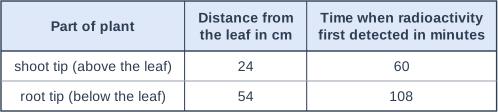
A scientist supplied one leaf on the stem of a bean plant with carbon dioxide containing radioactive carbon. The radioactive carbon became part of the sucrose made in the leaf.

The table shows when radioactive sucrose was first detected in other parts of the plant. No radioactivity was detected in the xylem.

Calculate the mean rate of movement of the radioactive sucrose from the leaf to the root tip, in cm per hour.

Explain what the results show about the transport of sucrose.

Table with columns "Part of plant", "Distance from the leaf in cm", "Time when radioactivity first detected in minutes". Part of plant: shoot tip (above the leaf); Distance from the leaf in cm: 24; Time when radioactivity first detected in minutes: 60 | Part of plant: root tip (below the leaf); Distance from the leaf in cm: 54; Time when radioactivity first detected in minutes: 108.

Model answer

Time = 108 ÷ 60 = 1.8 hours
Rate = 54 ÷ 1.8 = 30 cm per hour
The radioactive sucrose reached the shoot tip above the leaf and the root tip below it, so sucrose is transported both up and down the plant. No radioactivity was found in the xylem, so the sucrose is transported in the phloem by translocation, from the leaf to the growing parts of the plant where it is needed.

Explanation

Rate = distance ÷ time, with the time converted to hours (108 minutes = 1.8 hours), giving 30 cm per hour; leaving the rate as 0.5 cm per minute or dividing the time by the distance are the common errors. Detection above and below the leaf shows that translocation moves sucrose in both directions, in the phloem rather than the xylem.

Mark scheme
  1. 1 mark

    108 ÷ 60 = 1.8 (hours) / 54 ÷ 108 = 0.5 (cm per minute) (1)

    award full marks for the calculation (points 1 and 2) for the correct answer with no working; an answer of 0.5 (cm per hour) scores point 1 only (rate in cm per minute, not converted to hours); 2.0 (108 ÷ 54) scores 0

  2. 1 mark

    30 (cm per hour) (1)

    accept 30.0

  3. 1 mark

    sucrose is transported (both) up and down the plant / in both directions (1)

    Points 3, 4 and 5: max 2. accept it moved to the shoot tip above and the root tip below the leaf

  4. 1 mark

    sucrose is transported in the phloem (not the xylem) (1)

    accept by translocation; reject by transpiration

  5. 1 mark

    (it is transported) from the leaves to the growing parts / roots / where it is needed (for respiration or growth) (1)

    accept to where it is used or stored

Ready to try the rest? Every answer you write is marked against the mark scheme, so you can see exactly where the marks are.

Study Helper Hints first, answers after you try

Stuck on this one? Ask for a hint and I’ll point you in the right direction, without giving the answer away. Once you’ve checked your answer, I’ll show you how the marks are awarded.