
Level:
Correct: 0
Incorrect: 0
Marks: 0/0
Exam Practice
Course:
Topics:
Edexcel GCSE Biology (Paper 2) Smart practice A mixed round aimed at your weak spots
Unit 1
Key concepts in biology
Unit 6
Plant structures and their functions
Unit 7
Animal coordination, control and homeostasis
Unit 8
Exchange and transport in animals
Unit 9
Ecosystems and material cycles
Avg
score:
–
Topics
done:
0/38

Food security

Practise 13 exam-style questions on Food security for Edexcel GCSE Biology (Paper 2). Write your answer as you would in the exam and get it marked in seconds against the mark scheme, point by point, with the Study Helper on hand if you get stuck.

  • 13 questions
  • 1–6 marks each
  • Instant marking
  • No sign-up needed
13 questions, marked as you go

Sample questions with model answers

Here are 4 of the questions in this topic, each with a model answer, an explanation of why it earns the marks and the mark scheme an examiner would use.

Question 1

1 mark

Which of these is an environmental change caused by human activity that can reduce food security?

Choose your answer.

  • A ash from a volcanic eruption
  • B a frost on a cold spring night
  • C soil erosion after deforestation
  • D a hailstorm damaging crops

Model answer

C - soil erosion after deforestation.

Explanation

When people clear forests, there are no tree roots to hold the soil, so rain and wind wash or blow away the fertile topsoil and less land can grow crops. The other options can damage crops, but they are natural events, not changes caused by human activity.

Mark scheme
  1. 1 mark

    C / soil erosion after deforestation (1)

    The only correct answer is C. A is not correct because a volcanic eruption is a natural event, not caused by human activity. B is not correct because a frost is a natural weather event. D is not correct because a hailstorm is a natural weather event. Accept the letter or the option. If more than one option is given, do not award the mark.
Question 2

2 marks

In some countries, land that was used to grow maize for food is now used to grow maize for making bioethanol, a fuel for vehicles.

Explain how using land to grow crops for biofuels can reduce food security.

Model answer

Land used for biofuel crops cannot be used to grow food, so less food is produced. As food crops become scarcer their price rises, so poorer people may not be able to afford enough food.

Explanation

Biofuels are renewable, but they compete with food crops for land, water and fertiliser. This raises food prices and can lead to more forest being cleared for farmland, which is a sustainability issue.

Mark scheme
  1. 1 mark

    less land / fewer crops are available to produce food (1)

    Any two from the four points; max 2.

  2. 1 mark

    less food is produced / demand for crops rises, so food prices rise / poorer people cannot afford enough food (1)

    Accept 'demand for maize rises, so its price rises'.

  3. 1 mark

    biofuel crops use water / fertiliser that could have been used to grow food crops (1)

    Accept 'competition for water and fertiliser makes them more expensive for food growers'.

  4. 1 mark

    forests / grasslands may be cleared to grow more crops, causing soil erosion, so less fertile land for growing food in future (1)

    Do not accept 'biofuels pollute the air'. Ignore 'damages habitats' with no link to food production.

Question 3

3 marks

Scientists have estimated that world wheat production falls by about 6 % for each 1 °C rise in global mean temperature (Asseng and others, 2015).

In 2023, the world produced about 795 million tonnes of wheat (FAO). Assume that each person eats 65 kg of wheat in a year.

Calculate how many people's yearly supply of wheat would be lost if the global mean temperature rose by 1 °C.

1 tonne = 1000 kg

Model answer

Wheat lost = 795 × 0.06 = 47.7 million tonnes
= 47 700 000 × 1000 = 4.77 × 10¹⁰ kg
Number of people = 4.77 × 10¹⁰ ÷ 65 = 7.3 × 10⁸ people (about 734 million)

Explanation

Find 6 % of the production, convert tonnes to kilograms (× 1000), then divide by the wheat one person eats. The commonest errors are forgetting to convert to kilograms (a power of ten error) and dividing the whole production by 65 without taking 6 % of it. The answer shows how a small rise in temperature, caused by human activity, could affect the food of hundreds of millions of people.

Mark scheme
  1. 1 mark

    (wheat lost =) 795 × 0.06 = 47.7 (million tonnes) / 4.77 × 10⁷ tonnes (1)

    An answer of 7.3 × 10⁸ (about 734 million) with no working scores 3 marks. An answer with a power of ten error, e.g. 7.3 × 10⁵ (tonnes not converted to kg), scores 1 mark. The steps may be done in a different order, e.g. 7.95 × 10¹¹ kg ÷ 65 = 1.22 × 10¹⁰ people, then × 0.06: award MP1 for finding 6 % (× 0.06) and MP2 for converting to kg and dividing by 65. Do not award MP1 for 795 × 6 = 4770 with no correct percentage.

  2. 1 mark

    4.77 × 10¹⁰ (kg) ÷ 65 / 47 700 000 × 1000 ÷ 65 (1)

    ecf from an incorrect mass of wheat lost in MP1. Do not award MP2 or MP3 if the final answer is the whole production ÷ 65 (1.2 × 10¹⁰), with no 6 % taken.

  3. 1 mark

    7.3 × 10⁸ (people) / 734 million (people) (1)

    Accept values that round to 7.3 × 10⁸, e.g. 733 846 154 or 7.34 × 10⁸. Accept any correct form (standard form or not). ecf from MP2.

Question 4

4 marks

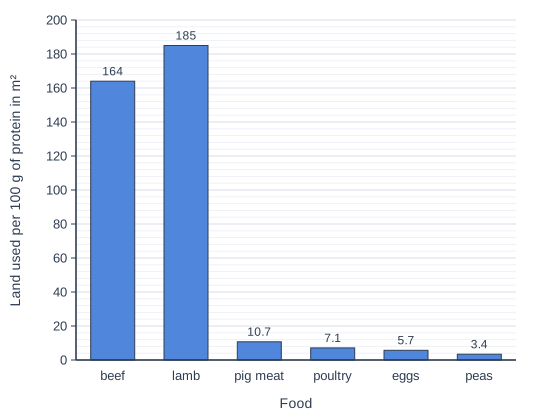
The bar chart shows the area of land used for one year to produce 100 g of protein from different foods. The beef is from cattle raised for meat. The values are global means from a study that combined data from farms around the world.

(Data: Poore and Nemecek, 2018, via Our World in Data.)

Calculate how many times more land is used to produce 100 g of protein from beef than from peas.

Use your knowledge of energy transfer to explain why increasing meat consumption could reduce food security.

Bar chart of land used per 100 g of protein in m² for each food: beef 164, lamb 185, pig meat 10.7, poultry 7.1, eggs 5.7, peas 3.4.

Model answer

Number of times more land = 164 ÷ 3.4 = 48 times.

Cattle are primary consumers, so the energy in beef has passed through one more trophic level than the energy in peas. Most of the energy in the plants the cattle eat is lost in respiration, movement, keeping warm and faeces, and only about 10 % ends up in their biomass. So much more land is needed to produce the same amount of protein from meat than from crops eaten directly. As more meat is eaten, more land is used for animals and their feed, leaving less land to grow food for people.

Explanation

'How many times more' means divide the larger value by the smaller one: 164 ÷ 3.4 = 48. Because energy is lost at each trophic level, eating plants directly feeds many more people from the same land, so rising meat consumption puts more pressure on farmland and reduces food security.

Mark scheme
  1. 1 mark

    164 ÷ 3.4 (1)

    An answer of 48 with no working scores marking points 1 and 2. Then any two from MP3-MP5 for the explanation; max 4 in total. Do not award for 3.4 ÷ 164 = 0.021 or for 164 − 3.4 = 160.6.

  2. 1 mark

    48 (times) (1)

    Accept answers from 48 to 49, e.g. 48.2.

  3. 1 mark

    beef comes from a higher trophic level than peas / cattle are primary consumers but peas are producers (1)

    Accept 'meat is one more step along the food chain'.

  4. 1 mark

    most of the energy in the plants the animals eat is lost (in respiration / movement / keeping warm / faeces) / only about 10 % is transferred to their biomass (1)

    Do not accept 'energy is used up' or 'energy is made into heat' with no idea that little reaches the animal's biomass. Do not accept 'energy is lost in respiration' if it says energy is produced by respiration.

  5. 1 mark

    so much more land is needed to produce the same amount of food from animals than from crops eaten directly, leaving less land to feed people / so fewer people can be fed from each hectare (1)

    Accept 'land used for grazing or growing animal feed could grow food for people instead'.

Ready to try the rest? Every answer you write is marked against the mark scheme, so you can see exactly where the marks are.

Study Helper Hints first, answers after you try

Stuck on this one? Ask for a hint and I’ll point you in the right direction, without giving the answer away. Once you’ve checked your answer, I’ll show you how the marks are awarded.