Level:
Correct: 0
Incorrect: 0
Marks: 0/0
Exam Practice
Course:
Topics:
Edexcel GCSE Biology (Paper 2) Smart practice A mixed round aimed at your weak spots
Unit 1
Key concepts in biology
Unit 6
Plant structures and their functions
Unit 7
Animal coordination, control and homeostasis
Unit 8
Exchange and transport in animals
Unit 9
Ecosystems and material cycles
Avg
score:
–
Topics
done:
0/38

Root hair cells, xylem and phloem

Practise 14 exam-style questions on Root hair cells, xylem and phloem for Edexcel GCSE Biology (Paper 2). Write your answer as you would in the exam and get it marked in seconds against the mark scheme, point by point, with the Study Helper on hand if you get stuck.

  • 14 questions
  • 1–6 marks each
  • Instant marking
  • No sign-up needed
14 questions, marked as you go

Sample questions with model answers

Here are 4 of the questions in this topic, each with a model answer, an explanation of why it earns the marks and the mark scheme an examiner would use.

Question 1

1 mark

Name the sugar that is transported around a plant in the phloem.

Model answer

Sucrose

Explanation

Glucose made in photosynthesis is converted to sucrose, which is the form in which sugar is carried in the phloem. Living phloem cells use energy to transport the sucrose around the plant. Answers of 'sugar' or 'glucose' do not gain the mark, because the sugar must be named as sucrose.

Mark scheme
  1. 1 mark

    sucrose (1)

    do not accept glucose / starch / sugar / carbohydrate; accept phonetic spellings

Question 2

2 marks

Phloem tissue is made of sieve tube cells and companion cells. Companion cells contain many mitochondria.

Explain why companion cells contain many mitochondria.

Model answer

Mitochondria are where aerobic respiration releases energy. Companion cells need a lot of energy to transport sucrose into the sieve tubes by active transport, so that the phloem can move sucrose around the plant.

Explanation

The phloem is made of living cells that use energy to transport sucrose, and the companion cells supply this energy. Answers must use 'release' (not 'make') energy and name sucrose, the sugar carried in the phloem. Water transport in the xylem does not use energy from the cells.

Mark scheme
  1. 1 mark

    mitochondria release energy by (aerobic) respiration (1)

    An explanation linking: do not accept 'mitochondria make / produce energy'

  2. 1 mark

    the energy is used to (actively) transport / load sucrose into the sieve tubes / move sucrose through the phloem (1)

    accept active transport of sucrose; accept the energy is passed to / used by the sieve tube cells to move sucrose; ignore 'to keep the sieve tube cells alive' on its own; do not accept sugar / glucose for sucrose; do not accept 'to transport water'

Question 3

3 marks

A gardener spread far more fertiliser than the instructions recommended around some young tomato plants, and then watered it in. The fertiliser contains mineral ions that dissolve in the soil water.

The next day the plants had wilted, even though the soil was moist.

Explain why the plants wilted.

Model answer

The mineral ions from the extra fertiliser dissolve in the soil water, so the soil water has a higher solute concentration, and a lower water concentration, than the cell sap of the root hair cells. Water therefore moves out of the root hair cells into the soil by osmosis, across their partially permeable membranes, instead of moving in. Less water reaches the leaves through the xylem, so the leaf cells lose water, are no longer turgid and the plants wilt.

Explanation

Root hair cells normally absorb water by osmosis because their cell sap has a lower water concentration than the soil water. Too much dissolved fertiliser reverses this gradient, so the roots lose water even though the soil is moist. A common error is to blame a lack of water in the soil; the cause is the direction of the water concentration gradient.

Mark scheme
  1. 1 mark

    the soil water now has a higher concentration of dissolved ions / solutes, so it has a lower water concentration than the cell sap of the root hair cells (1)

    An explanation linking three from the four points; max 3. accept the soil water is more concentrated than the cell sap; do not accept the fertiliser absorbs the water

  2. 1 mark

    so water moves out of the root hair cells into the soil / water is no longer absorbed into the root hair cells (1)

    accept water moves from the roots to the soil

  3. 1 mark

    by osmosis (across the partially permeable cell membrane) (1)

    must be linked to the movement of water; do not accept diffusion of water or active transport of water

  4. 1 mark

    so less water passes up the xylem to the leaves / the cells lose water and are no longer turgid, so the plant wilts (1)

    accept the leaves lose more water by transpiration than the roots take up

Question 4

4 marks

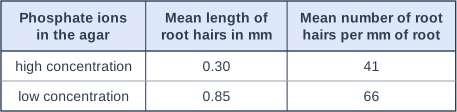
A scientist grew seedlings of thale cress on agar containing a high concentration or a low concentration of phosphate ions. After 15 days she measured the root hairs of the seedlings.

The table shows the results.

Calculate the percentage increase in the mean length of the root hairs in the low-phosphate agar compared with the high-phosphate agar.

Explain how the changes shown in the table help the seedlings to take up phosphate ions.

Table with columns "Phosphate ions in the agar", "Mean length of root hairs in mm", "Mean number of root hairs per mm of root". Phosphate ions in the agar: high concentration; Mean length of root hairs in mm: 0.30; Mean number of root hairs per mm of root: 41 | Phosphate ions in the agar: low concentration; Mean length of root hairs in mm: 0.85; Mean number of root hairs per mm of root: 66.

Model answer

Increase in length = 0.85 − 0.30 = 0.55 mm
Percentage increase = 0.55 ÷ 0.30 × 100 = 183 %

In low-phosphate agar the root hairs are longer and there are more of them per mm of root (66 compared with 41), so the roots have a much larger surface area. More phosphate ions can therefore be absorbed by active transport, and the longer root hairs reach phosphate ions in a larger volume of soil around the root.

Explanation

Percentage change = change ÷ original value × 100, and the original value is the high-phosphate length (0.30 mm); dividing by 0.85 gives 64.7 %, which is wrong. The seedlings respond to a shortage of phosphate by growing more and longer root hairs, which increases the surface area for absorbing mineral ions. A full answer links the change in the root hairs to surface area and to the uptake of the ions.

Mark scheme
  1. 1 mark

    (increase in length =) 0.85 − 0.30 / 0.55 (mm) (1)

    An answer of 183 or 180 % with no working scores marking points 1 and 2; 0.55 ÷ 0.85 × 100 = 64.7 (%) (dividing by the larger value) is a wrong method: award point 1 only if 0.55 is seen, and do not award point 2

  2. 1 mark

    (0.55 ÷ 0.30 × 100 =) 183 (%) (1)

    accept values that round to 183, e.g. 183.3; accept 180 (%); accept 0.85 ÷ 0.30 × 100 − 100 = 183 (%)

  3. 1 mark

    the root hairs are longer and there are more of them, so the surface area of the roots is larger (1)

    Points 3 to 5 are the explanation: max 2 from points 3 to 5. accept larger surface area for absorption

  4. 1 mark

    so more phosphate ions can be absorbed (by active transport) (1)

    must be linked to the larger surface area or the longer root hairs reaching more soil

  5. 1 mark

    longer root hairs reach further into the soil / into a larger volume of soil, where there are more phosphate ions (1)

    accept they can reach phosphate ions further from the root

Ready to try the rest? Every answer you write is marked against the mark scheme, so you can see exactly where the marks are.

Study Helper Hints first, answers after you try

Stuck on this one? Ask for a hint and I’ll point you in the right direction, without giving the answer away. Once you’ve checked your answer, I’ll show you how the marks are awarded.