
Level:
Correct: 0
Incorrect: 0
Marks: 0/0
Exam Practice
Course:
Topics:
Edexcel GCSE Biology (Paper 2) Smart practice A mixed round aimed at your weak spots
Unit 1
Key concepts in biology
Unit 6
Plant structures and their functions
Unit 7
Animal coordination, control and homeostasis
Unit 8
Exchange and transport in animals
Unit 9
Ecosystems and material cycles
Avg
score:
–
Topics
done:
0/38

Diffusion, osmosis and active transport

Practise 12 exam-style questions on Diffusion, osmosis and active transport for Edexcel GCSE Biology (Paper 2). Write your answer as you would in the exam and get it marked in seconds against the mark scheme, point by point, with the Study Helper on hand if you get stuck.

  • 12 questions
  • 1–6 marks each
  • Instant marking
  • No sign-up needed
12 questions, marked as you go

Sample questions with model answers

Here are 4 of the questions in this topic, each with a model answer, an explanation of why it earns the marks and the mark scheme an examiner would use.

Question 1

1 mark

Two neighbouring cells in a leaf, P and Q, are separated by their partially permeable cell membranes and cell walls.

The solution inside cell P has a solute concentration of 0.2 mol/dm³. The solution inside cell Q has a solute concentration of 0.5 mol/dm³.

Which describes the net movement between the two cells?

Choose your answer.

  • A water from P to Q by osmosis
  • B water from Q to P by osmosis
  • C solute from Q to P by osmosis
  • D no net movement of water

Model answer

A - water from P to Q by osmosis.

Explanation

A lower solute concentration means a higher water concentration, so cell P (0.2 mol/dm³) has more water molecules free to move than cell Q (0.5 mol/dm³). The net movement of water by osmosis is from P to Q, across the partially permeable membranes. A common error is to think water moves towards the cell with the lower solute concentration, or to describe the solute moving.

Mark scheme
  1. 1 mark

    A / water from P to Q by osmosis (1)

    The only correct answer is A: cell P has the lower solute concentration, so it has the higher water concentration, and water moves from the higher to the lower water concentration. B is not correct because this would be water moving from the lower water concentration (Q) to the higher water concentration (P); C is not correct because osmosis is the movement of water, not of the solute; D is not correct because the two cells have different water concentrations, so there is a net movement of water. Accept the letter or the option. If more than one option is given, do not award the mark.
Question 2

2 marks

Muscle cells contain a much higher concentration of potassium ions than the tissue fluid around them.

A scientist placed some pieces of muscle in a solution with the same potassium ion concentration as tissue fluid. She added a poison that stops all respiration in the muscle cells. Over the next 2 hours, the concentration of potassium ions in the solution increased.

Explain why the concentration of potassium ions in the solution increased.

Model answer

The muscle cells normally keep their potassium ion concentration high by active transport, which moves potassium ions into the cells against the concentration gradient using energy from respiration. The poison stops respiration, so no energy is released and active transport stops. Diffusion does not need energy, so potassium ions continue to diffuse out of the cells, from the higher concentration inside the cells to the lower concentration in the solution, and the concentration in the solution increases.

Explanation

A cell can only keep a substance more concentrated inside than outside by active transport, which needs a continuous supply of energy from respiration. When respiration stops, active transport stops but diffusion carries on, so the ions leak out down their concentration gradient. Answers that describe the ions moving by osmosis, or say that respiration 'makes' energy, are not credited.

Mark scheme
  1. 1 mark

    active transport (of potassium ions into the cells) stops, because no energy is released by respiration (1)

    An explanation linking two points. accept the cells can no longer use energy from respiration to keep moving potassium ions in against the concentration gradient; do not accept 'respiration makes / produces energy'

  2. 1 mark

    potassium ions (continue to) diffuse out of the cells, from the higher concentration inside the cells to the lower concentration in the solution / down their concentration gradient (1)

    accept diffusion is passive / does not need energy, so it continues when respiration stops, if diffusion of potassium ions out of the cells is given; do not accept potassium ions move out by osmosis / by active transport

Question 3

3 marks

Lettuce leaves that are left on a warm kitchen worktop for a few hours lose water and become limp. A chef puts some limp lettuce leaves into a bowl of cold tap water. After 30 minutes the leaves are firm and crisp again.

Explain why the leaves become firm and crisp in the water.

Model answer

The tap water has a higher water concentration than the cytoplasm and cell sap of the leaf cells, so water moves into the cells by osmosis across their partially permeable cell membranes. The vacuoles fill with water and the cells swell until they are turgid, pushing against their cell walls. The strong cell walls stop the cells bursting, so the turgid cells press against each other and hold the leaf firm, which makes it crisp.

Explanation

The limp leaves have lost water, so their cells are flaccid. Tap water is much more dilute than the cell contents, so water enters the cells by osmosis until they are turgid; the cell wall resists further swelling, and the pressure of the turgid cells makes the leaf firm. Answers must describe water moving (not solutes) and compare the water or solute concentrations, not just say 'the leaves absorb water'.

Mark scheme
  1. 1 mark

    the (tap) water has a higher water concentration than the cytoplasm / cell sap of the leaf cells (1)

    An explanation linking three from the four points; max 3. accept the leaf cells have a higher solute concentration than the tap water / the tap water is more dilute than the cell contents; do not accept 'higher concentration' without saying water or solute

  2. 1 mark

    so water moves into the leaf cells by osmosis (across the partially permeable cell membranes) (1)

    accept the cells gain water by osmosis; osmosis must be linked to the movement of water; do not accept solutes / sugars move out of the cells (as the explanation)

  3. 1 mark

    the vacuoles fill with water and the cells swell / become turgid (1)

    accept the cells push against their cell walls

  4. 1 mark

    the (strong / rigid) cell wall stops the cells bursting / resists further swelling, so the turgid cells press against each other and support the leaf (1)

    accept the pressure of the turgid cells against their cell walls makes the leaf firm; do not accept the cell membrane stops the cells bursting; do not accept the cells burst

Question 4

4 marks

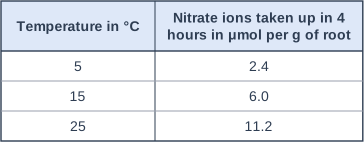
A scientist investigated the uptake of nitrate ions by the roots of barley plants at different temperatures. The concentration of nitrate ions inside the root cells was always higher than in the solution around the roots. The roots were left in the solution for 4 hours.

The table shows the results.

Calculate the mean rate of nitrate uptake at 25 °C, in μmol per g of root per hour.

Explain why the uptake of nitrate ions increased as the temperature increased.

Table with columns "Temperature in °C", "Nitrate ions taken up in 4 hours in μmol per g of root". Temperature in °C: 5; Nitrate ions taken up in 4 hours in μmol per g of root: 2.4 | Temperature in °C: 15; Nitrate ions taken up in 4 hours in μmol per g of root: 6.0 | Temperature in °C: 25; Nitrate ions taken up in 4 hours in μmol per g of root: 11.2.

Model answer

Mean rate at 25 °C = 11.2 ÷ 4 = 2.8 μmol per g of root per hour.

The nitrate ions move into the root cells against their concentration gradient, so they are taken up by active transport, which needs energy from respiration. Respiration is controlled by enzymes. As the temperature rises from 5 °C to 25 °C, the enzyme and substrate molecules have more kinetic energy and collide more often, so respiration is faster and more energy is released each hour for active transport. More nitrate ions are therefore taken up.

Explanation

Mean rate = amount ÷ time, so divide the uptake in 4 hours by 4. The link between temperature and active transport goes through respiration: warmer roots respire faster (enzyme reactions speed up), so more energy is available to pump ions against the gradient. A common error is to explain the increase as faster diffusion, which is ruled out because the ions move against the concentration gradient.

Mark scheme
  1. 1 mark

    (rate =) 11.2 ÷ 4 (1)

    An answer of 2.8 μmol per g of root per hour with no working scores marking points 1 and 2; 4 ÷ 11.2 (0.36) scores 0 for points 1 and 2

  2. 1 mark

    2.8 (μmol per g of root per hour) (1)

    accept 2.80

  3. 1 mark

    nitrate ions are taken up by active transport (against the concentration gradient), which needs energy from respiration (1)

    Points 3, 4 and 5 are for the explanation: max 2 from these three. do not accept diffusion / osmosis

  4. 1 mark

    respiration is controlled by enzymes, and at a higher temperature the (enzyme and substrate) molecules have more kinetic energy / collide more often, so respiration is faster (1)

    accept the rate of respiration increases as temperature increases (up to the optimum); accept the carrier proteins that carry out active transport work faster at a higher temperature

  5. 1 mark

    so more energy is released (per hour) for active transport / to take up nitrate ions (1)

    do not accept 'more energy is made'; ignore 'the ions move faster' (diffusion idea)

Ready to try the rest? Every answer you write is marked against the mark scheme, so you can see exactly where the marks are.

Study Helper Hints first, answers after you try

Stuck on this one? Ask for a hint and I’ll point you in the right direction, without giving the answer away. Once you’ve checked your answer, I’ll show you how the marks are awarded.