
Level:
Correct: 0
Incorrect: 0
Marks: 0/0
Exam Practice
Course:
Topics:
Edexcel GCSE Biology (Paper 2) Smart practice A mixed round aimed at your weak spots
Unit 1
Key concepts in biology
Unit 6
Plant structures and their functions
Unit 7
Animal coordination, control and homeostasis
Unit 8
Exchange and transport in animals
Unit 9
Ecosystems and material cycles
Avg
score:
–
Topics
done:
0/38

Homeostasis and thermoregulation

Practise 16 exam-style questions on Homeostasis and thermoregulation for Edexcel GCSE Biology (Paper 2). Write your answer as you would in the exam and get it marked in seconds against the mark scheme, point by point, with the Study Helper on hand if you get stuck.

  • 16 questions
  • 1–6 marks each
  • Instant marking
  • No sign-up needed
16 questions, marked as you go

Sample questions with model answers

Here are 4 of the questions in this topic, each with a model answer, an explanation of why it earns the marks and the mark scheme an examiner would use.

Question 1

1 mark

Which statement describes vasoconstriction in the skin?

Choose your answer.

  • A capillaries move deeper in the skin
  • B sweat glands stop making sweat
  • C blood vessels to the skin narrow
  • D blood vessels to the skin widen

Model answer

C - blood vessels to the skin narrow.

Explanation

Vasoconstriction means the narrowing of blood vessels. In the skin, the arterioles that supply the capillaries near the surface narrow, so less warm blood flows near the surface and less heat is lost to the surroundings. A common misconception is that the capillaries themselves move up or down in the skin.

Mark scheme
  1. 1 mark

    C / blood vessels to the skin narrow (1)

    The only correct answer is C: the blood vessels (arterioles) supplying the skin capillaries narrow, so less blood flows near the skin surface. A is not correct because capillaries do not move; the amount of blood flowing through them changes. B is not correct because sweating stops when the body is cold, but that is not vasoconstriction. D is not correct because widening of the blood vessels is vasodilation, which happens when the body is too hot. Accept the letter or the option. If more than one option is given, do not award the mark.
Question 2

3 marks

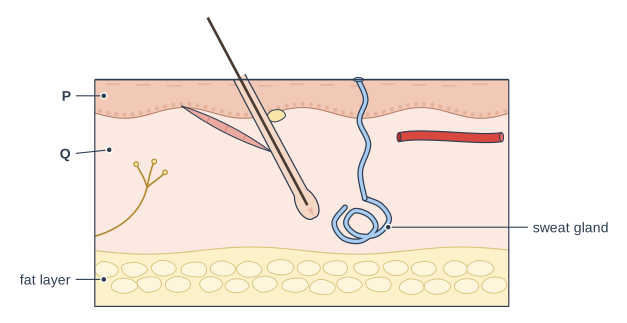
Figure 1 shows a section through human skin.

Name the layers labelled P and Q.

Give one way that layer P is involved in cooling the body when it is too hot.

Diagram of a section through human skin. The skin has three layers: a thin top layer, a thicker middle layer and a bottom layer of rounded cells. A strand grows from a tube-shaped pocket in the middle layer out through the surface; a small band runs from the pocket up to the underside of the top layer, and a small lobed sac sits beside the pocket. A coiled tube deep in the middle layer leads up through a narrow tube to a tiny opening on the surface, and a red tube runs through the middle layer just below the top layer on the right. On the left, fine branching nerve endings lie in the middle layer. Label P points to the thin top layer of the skin; label Q points to the thick middle layer of the skin; the label "sweat gland" points to the coiled tube deep in the middle layer; the label "fat layer" points to the bottom layer of rounded cells.

Model answer

P is the epidermis and Q is the dermis.
Sweat made by the sweat glands in the dermis passes through pores in the epidermis onto the surface of the skin, where it evaporates and transfers heat away from the skin.

Explanation

The epidermis is the thin outer layer of the skin; the dermis below it contains the sweat glands, blood vessels, hair follicles and temperature receptors. The epidermis takes part in cooling because sweat reaches its surface through pores and evaporates there, and heat from blood just beneath it is lost from its surface. A common error is to say the epidermis makes sweat.

Mark scheme
  1. 1 mark

    P: epidermis (1)

    Accept phonetic spellings that are clearly epidermis. Do not accept dermis, skin or outer skin.

  2. 1 mark

    Q: dermis (1)

    Do not accept epidermis or fat layer. Ignore 'inner layer of skin' on its own.

  3. 1 mark

    sweat passes through (pores in) layer P onto the (skin) surface, where it evaporates (and cools the skin) (1)

    Any one from points 3 and 4; max 1 for the role of layer P. Accept 'sweat is released onto the surface of the epidermis and evaporates'. Ignore 'it sweats' with no reference to the surface or evaporation. Do not accept 'the epidermis makes sweat' (the sweat glands are in the dermis).

  4. 1 mark

    heat from the blood flowing just below layer P passes through it and is lost (radiated) from its surface to the surroundings (1)

    Max 1 from points 3 and 4. Accept 'layer P is thin, so heat from the blood vessels under it is easily lost to the air'.

Question 3

3 marks

Mei was climbing a mountain in very cold weather. Her core body temperature stayed at about 37 °C, but the blood flow to her fingers and toes decreased. Her fingers and toes became very cold and were at risk of frostbite (damage caused by the tissue freezing).

Explain why the blood flow to her fingers and toes decreased and why this made frostbite more likely.

Model answer

In the cold, the blood vessels (arterioles) supplying the skin of her fingers and toes constricted (vasoconstriction). This reduced the heat lost from her blood to the cold air and kept warm blood in her core, so her core temperature stayed at about 37 °C. But less warm blood reached her fingers and toes, so less heat was carried to them; their temperature fell until the tissue could freeze.

Explanation

Vasoconstriction is a response that protects the core temperature: less blood flows near the surface, so less heat is lost. The cost is that the skin and extremities receive less heat and cool down, which is why fingers and toes are the first parts to get frostbite. Do not write that blood vessels move away from the skin surface.

Mark scheme
  1. 1 mark

    the blood vessels / arterioles supplying the skin (of her fingers and toes) narrowed / constricted / vasoconstriction (1)

    An explanation linking three from the four points; max 3. Max 2 if the answer does not explain why frostbite is more likely (point 4). Accept 'the capillaries narrowed'. Do not accept 'blood vessels moved away from the surface of the skin'.

  2. 1 mark

    this reduces heat loss from the blood at the skin surface (to the cold air) (1)

    Accept 'less heat is lost to the surroundings'.

  3. 1 mark

    so warm blood is kept in the core / this keeps her core temperature at 37 °C (1)

    Accept 'it protects the vital organs from cooling'.

  4. 1 mark

    less warm blood (so less heat) reaches the fingers and toes, so their temperature falls (until the tissue can freeze) (1)

    Accept 'the fingers and toes are not warmed by the blood, so they cool to the temperature of the air'.

Question 4

4 marks

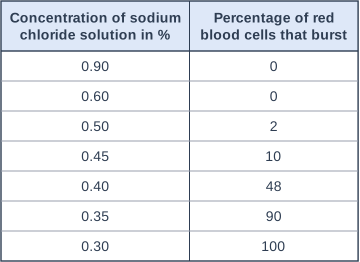
In a hospital laboratory, a scientist added samples of a person's red blood cells to sodium chloride solutions of different concentrations. After 30 minutes, she found the percentage of the red blood cells that had burst in each solution.

Blood plasma has about the same solute concentration as 0.9 % sodium chloride solution.

The table shows the results.

Explain the results shown in the table.

Table with columns "Concentration of sodium chloride solution in %", "Percentage of red blood cells that burst". Concentration of sodium chloride solution in %: 0.90; Percentage of red blood cells that burst: 0 | Concentration of sodium chloride solution in %: 0.60; Percentage of red blood cells that burst: 0 | Concentration of sodium chloride solution in %: 0.50; Percentage of red blood cells that burst: 2 | Concentration of sodium chloride solution in %: 0.45; Percentage of red blood cells that burst: 10 | Concentration of sodium chloride solution in %: 0.40; Percentage of red blood cells that burst: 48 | Concentration of sodium chloride solution in %: 0.35; Percentage of red blood cells that burst: 90 | Concentration of sodium chloride solution in %: 0.30; Percentage of red blood cells that burst: 100.

Model answer

No cells burst at 0.90 %, because this solution has the same solute concentration as the cytoplasm of the red blood cells, so there is no net movement of water. In the more dilute solutions the solute concentration is lower than in the cytoplasm, so water moves into the cells by osmosis across the partially permeable cell membrane. The cells swell and, because animal cells have no cell wall, they burst. The lower the concentration, the more water enters, so the percentage that burst rises from 2 % at 0.50 % to 100 % at 0.30 %.

Explanation

Compare each solution with the cytoplasm: water moves by osmosis from the more dilute solution into the cells. Animal cells have no cell wall, so they burst if they take in too much water, which is why the solute concentration of the blood plasma must be kept constant (osmoregulation). Many answers describe the pattern without explaining it, or forget to name osmosis.

Mark scheme
  1. 1 mark

    the lower the concentration of the solution (below 0.5 %), the greater the percentage of cells that burst / all the cells burst at 0.30 % / no cells burst at 0.90 % (1)

    An explanation linking any four from the six points; max 4. Max 3 if no data from the table are used. Data must be quoted for this point, e.g. '48 % burst at 0.40 % but 100 % at 0.30 %'.

  2. 1 mark

    at 0.9 %, the solution has the same solute concentration as the cytoplasm, so there is no net movement of water (so no cells burst) (1)

    Accept 'the same concentration as plasma, so the cells stay the same size'.

  3. 1 mark

    the more dilute solutions have a lower solute concentration (higher water concentration) than the cytoplasm, so water moves into the cells by osmosis (1)

    Osmosis must be named. Accept 'water moves in across the partially permeable cell membrane'. Do not accept 'salt moves out of the cells' as the explanation.

  4. 1 mark

    the cells swell and burst because animal cells have no cell wall (1)

    Accept 'there is no cell wall to stop them swelling'.

  5. 1 mark

    the more dilute the solution, the steeper the concentration gradient, so more water enters the cells (and more cells burst) (1)

    Accept 'more water moves in, the lower the concentration of the solution'.

  6. 1 mark

    the cells differ in how much they can swell before they burst, so only some burst at 0.40 % to 0.50 % (1)

    Accept 'some cells are more fragile than others'.

Ready to try the rest? Every answer you write is marked against the mark scheme, so you can see exactly where the marks are.

Study Helper Hints first, answers after you try

Stuck on this one? Ask for a hint and I’ll point you in the right direction, without giving the answer away. Once you’ve checked your answer, I’ll show you how the marks are awarded.