
Level:
Correct: 0
Incorrect: 0
Marks: 0/0
Exam Practice
Course:
Topics:
Edexcel GCSE Biology (Paper 2) Smart practice A mixed round aimed at your weak spots
Unit 1
Key concepts in biology
Unit 6
Plant structures and their functions
Unit 7
Animal coordination, control and homeostasis
Unit 8
Exchange and transport in animals
Unit 9
Ecosystems and material cycles
Avg
score:
–
Topics
done:
0/38

Communities, interdependence and abiotic factors

Practise 17 exam-style questions on Communities, interdependence and abiotic factors for Edexcel GCSE Biology (Paper 2). Write your answer as you would in the exam and get it marked in seconds against the mark scheme, point by point, with the Study Helper on hand if you get stuck.

  • 17 questions
  • 1–6 marks each
  • Instant marking
  • No sign-up needed
17 questions, marked as you go

Sample questions with model answers

Here are 4 of the questions in this topic, each with a model answer, an explanation of why it earns the marks and the mark scheme an examiner would use.

Question 1

1 mark

Some species depend on other species to survive.

Which of these is an example of mutualism?

Choose your answer.

  • A ticks feeding on a deer's blood
  • B a fox eating a rabbit
  • C two trees competing for light
  • D bees pollinating apple flowers

Model answer

D - bees pollinating apple flowers.

Explanation

In mutualism both species benefit; in parasitism one species benefits and the other (the host) is harmed. Predation and competition are biotic factors too, but they are not relationships in which both organisms gain.

Mark scheme
  1. 1 mark

    D / bees pollinating apple flowers (1)

    The only correct answer is D: both species benefit - the bees get nectar (food) and the apple trees are pollinated. A is not correct because this is parasitism: the tick benefits and the deer is harmed. B is not correct because this is predation: only the fox benefits. C is not correct because this is competition: neither tree benefits. Accept the letter or the option. If more than one option is given, do not award the mark.
Question 2

2 marks

The plants and animals in a woodland community are interdependent.

Describe two ways in which flowering plants in the woodland depend on animals.

Model answer

Many flowering plants depend on insects such as bees for pollination, as the insects carry pollen from one flower to another. Plants also depend on animals such as birds to disperse their seeds - the birds eat the fruits and pass out the seeds away from the parent plant.

Explanation

Interdependence means each species depends on others in the community for things such as food, shelter, pollination and seed dispersal. The question asks how plants depend on animals, so answers about animals needing plants for food or shelter do not score.

Mark scheme
  1. 1 mark

    pollination: insects / bees / animals carry pollen from flower to flower (1)

    Any two from the five points; max 2. 'Pollination' alone is enough for this mark.

  2. 1 mark

    seed dispersal: animals eat fruits and pass out the seeds elsewhere / carry seeds on their fur (1)

    Accept 'animals spread the seeds (away from the parent plant)'. Accept 'squirrels / jays bury nuts and acorns'.

  3. 1 mark

    animals release carbon dioxide (in respiration), which plants use in photosynthesis (1)

    Do not accept 'animals give plants oxygen'.

  4. 1 mark

    animal droppings / dead animals are decomposed to release mineral ions / nutrients (e.g. nitrates) for plants (1)

    Accept 'animal waste acts as a fertiliser'.

  5. 1 mark

    animals eat the pests / herbivores that damage the plants (e.g. birds eat caterpillars) (1)

    Accept any other valid way, e.g. 'grazing animals stop taller plants out-competing some flowering plants'. Do not accept 'animals provide food for plants' or answers about how animals depend on plants.

Question 3

3 marks

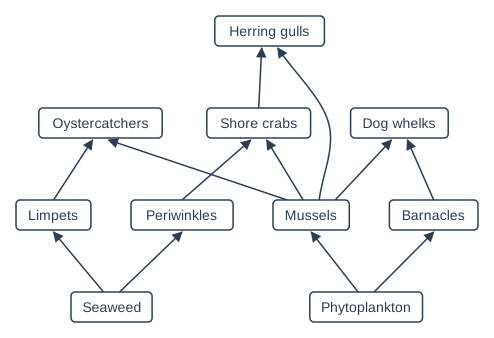
Figure 1 shows part of a food web on a rocky shore.

A disease kills most of the barnacles on the shore.

Explain how this could affect the populations of dog whelks and mussels.

Food web of 10 organisms in 4 rows, joined by arrows. Bottom row (left to right): Seaweed and Phytoplankton. Second row from the bottom (left to right): Limpets, Periwinkles, Mussels and Barnacles. Third row from the bottom (left to right): Oystercatchers, Shore crabs and Dog whelks. Top row: Herring gulls. Arrows point from Seaweed to Limpets and Periwinkles; from Phytoplankton to Mussels and Barnacles; from Limpets to Oystercatchers; from Periwinkles to Shore crabs; from Mussels to Oystercatchers, Shore crabs, Dog whelks and Herring gulls; from Barnacles to Dog whelks; from Shore crabs to Herring gulls.

Model answer

Barnacles are one of the foods of dog whelks, so with fewer barnacles the dog whelks have less food and their population may decrease. The dog whelks are likely to eat more mussels instead, so the mussel population could decrease. However, mussels and barnacles both feed on phytoplankton, so with fewer barnacles there is less competition for food and space on the rocks, which could allow the mussel population to increase.

Explanation

Organisms in a food web are interdependent, so a change in one population affects others through feeding and competition. Here the dog whelks lose a food source and may switch to mussels, while the mussels lose a competitor for phytoplankton and space. Credit is given for any change that is explained using the food web; reading the arrows the wrong way round (arrows point from the food to the feeder) is the most common error.

Mark scheme
  1. 1 mark

    dog whelks have less food / barnacles are food for dog whelks, so the dog whelk population decreases (1)

    An explanation: any three from the five points; max 3. Each mark needs an effect and a reason. Answers must refer to both dog whelks and mussels for 3 marks. Credit any effect that is correctly reasoned from the food web, even if it is in the opposite direction to another point.

  2. 1 mark

    dog whelks eat more mussels instead, so the dog whelk population may not fall much / stays the same (1)

    Accept 'dog whelks switch to mussels'.

  3. 1 mark

    more mussels are eaten by dog whelks, so the mussel population decreases (1)

    Accept 'more predation of mussels'.

  4. 1 mark

    mussels have less competition (from barnacles) for phytoplankton / food / space on the rocks, so the mussel population increases (1)

    Accept 'barnacles and mussels both feed on phytoplankton, so more food for mussels'.

  5. 1 mark

    if the dog whelk population falls, fewer mussels are eaten (by dog whelks), so the mussel population increases (1)

    Accept any other valid reasoned effect, e.g. 'fewer mussels would mean less food for shore crabs, oystercatchers and herring gulls'. Do not accept answers that reverse the direction of feeding (e.g. 'mussels eat dog whelks').

Question 4

4 marks

The large blue is a butterfly. Its caterpillars feed on wild thyme flowers for about three weeks. They then drop to the ground, where red ants find them and carry them into the ants' nest. There the caterpillars feed on the ant grubs until they are ready to become adults. The caterpillars survive well only in the nests of one species of red ant.

This species of red ant can only survive where the grass is very short, so that the soil in which it nests is warm.

In the 1950s the disease myxomatosis killed most of the rabbits in Britain. Rabbits graze on grass. By 1979 the large blue butterfly was extinct in Britain.

Explain how the decrease in the number of rabbits led to the large blue butterfly becoming extinct in Britain.

Model answer

With fewer rabbits there was much less grazing, so the grass grew taller. The taller grass shaded the soil, so the soil became cooler and the red ants, which need warm soil for their nests, could not survive. Without the ants, the large blue caterpillars had no nests to be carried into and no ant grubs to feed on, so they could not develop into adults and reproduce. The large blue population fell until the butterfly became extinct.

Explanation

This is a chain of interdependence: rabbits keep the grass short, short grass keeps the soil warm for the ants, and the caterpillars depend on the ants for food and shelter. The caterpillars feeding on ant grubs is a form of parasitism. Each mark needs a link in the chain; answers that jump straight from 'fewer rabbits' to 'the butterfly died out' score little.

Mark scheme
  1. 1 mark

    with fewer rabbits, there was less grazing, so the grass grew taller (1)

    An explanation linking: any four from the five points; max 4. Accept 'the grass was no longer kept short'.

  2. 1 mark

    the taller grass shaded the soil, so the soil was cooler (1)

    Accept 'the soil was no longer warm enough for the ants'.

  3. 1 mark

    so the (red) ants could not survive / the ant population decreased / the ants died out (1)

    Accept 'other ant species took over' only if linked to fewer of this red ant species.

  4. 1 mark

    the caterpillars had no ant nests to live in / no ant grubs to feed on, so they could not complete their life cycle / become adults (1)

    Accept 'the butterflies could not reproduce, so the population fell until none were left'.

  5. 1 mark

    taller plants also shaded out / out-competed the wild thyme, so there was less food for the young caterpillars (1)

    Accept any other valid link in the chain. Do not accept 'the rabbits ate the butterflies / caterpillars' or 'the butterflies caught myxomatosis'.

Ready to try the rest? Every answer you write is marked against the mark scheme, so you can see exactly where the marks are.

Study Helper Hints first, answers after you try

Stuck on this one? Ask for a hint and I’ll point you in the right direction, without giving the answer away. Once you’ve checked your answer, I’ll show you how the marks are awarded.