
Level:
Correct: 0
Incorrect: 0
Marks: 0/0
Exam Practice
Course:
Topics:
Edexcel GCSE Biology (Paper 2) Smart practice A mixed round aimed at your weak spots
Unit 1
Key concepts in biology
Unit 6
Plant structures and their functions
Unit 7
Animal coordination, control and homeostasis
Unit 8
Exchange and transport in animals
Unit 9
Ecosystems and material cycles
Avg
score:
–
Topics
done:
0/38

Energy transfer between trophic levels

Practise 13 exam-style questions on Energy transfer between trophic levels for Edexcel GCSE Biology (Paper 2). Write your answer as you would in the exam and get it marked in seconds against the mark scheme, point by point, with the Study Helper on hand if you get stuck.

  • 13 questions
  • 1–6 marks each
  • Instant marking
  • No sign-up needed
13 questions, marked as you go

Sample questions with model answers

Here are 4 of the questions in this topic, each with a model answer, an explanation of why it earns the marks and the mark scheme an examiner would use.

Question 1

1 mark

In kelp forests off the coast of Scotland, sea urchins graze on kelp. An ecologist estimated that in one year:
- the kelp in one area of the forest produced new biomass containing 4.5 × 10⁶ kJ of energy
- the sea urchins in the same area produced new biomass containing 1.8 × 10⁵ kJ of energy.

What was the efficiency of energy transfer from the kelp to the sea urchins?

Choose your answer.

  • A 0.4%
  • B 4%
  • C 25%
  • D 40%

Model answer

B - 4%

Explanation

Efficiency = energy transferred to the higher trophic level ÷ energy in the lower trophic level × 100 = 1.8 × 10⁵ ÷ 4.5 × 10⁶ × 100 = 4%. Divide the smaller (higher level) value by the larger (lower level) value. Take care with the powers of ten: 10⁵ ÷ 10⁶ = 0.1.

Mark scheme
  1. 1 mark

    B / 4% (1)

    The only correct answer is B: efficiency = 1.8 × 10⁵ ÷ 4.5 × 10⁶ × 100 = 4%. A is not correct because 0.4% comes from a power of ten error in the standard form; C is not correct because 25 is the energy in the kelp divided by the energy in the sea urchins (the ratio is upside down); D is not correct because 40% comes from a power of ten error in the standard form. Accept the letter or the option. If more than one option is given, do not award the mark.
Question 2

2 marks

Rabbits feed on grass. Stoats feed on rabbits.

Scientists measured the percentage of the energy in the food eaten that passes out of each animal in its faeces:
- rabbit: about 45%
- stoat: about 10%

Suggest why this percentage is much higher for the rabbit than for the stoat.

Model answer

Grass contains a lot of cellulose in its cell walls, which is difficult to digest. So much of the grass the rabbit eats is not digested or absorbed, and passes out in its faeces. The stoat's food is meat, which is mainly protein and fat that are easily digested and absorbed, so very little energy is left in its faeces.

Explanation

Energy in faeces is energy that was eaten but never absorbed, so it is not passed to the animal's biomass. Plant material is harder to digest than animal tissue because of the cellulose in plant cell walls, so herbivores lose a larger share of the energy in their food in faeces. Answers need a reason linked to digestion, not just 'rabbits are herbivores'.

Mark scheme
  1. 1 mark

    grass / plant material contains a lot of cellulose / fibre (in its cell walls), which is difficult to digest (1)

    An explanation linking two from the three points; max 2. accept rabbits cannot make an enzyme to digest cellulose; accept lignin / woody material for cellulose. ignore 'grass is hard to eat / chew'.

  2. 1 mark

    so a lot of the grass is not digested / not absorbed, and passes out in the faeces (1)

    accept so less of the energy in the grass is absorbed into the rabbit's blood / body. do not accept 'rabbits eat more food' or 'rabbits are herbivores' with no reason.

  3. 1 mark

    meat / the stoat's food is mainly protein and fat, which are easily digested / absorbed (1)

    accept most of the meat is digested (so little energy is left in the faeces); accept the stoat's enzymes can digest almost all of its food. ignore references to the stoat not eating fur or bones (these are not eaten, so they are not in its faeces).

Question 3

3 marks

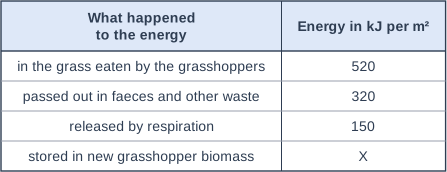
Field grasshoppers feed on grass. An ecologist estimated what happened to the energy in the grass eaten by the grasshoppers in 1 m² of a meadow during one summer.

The table shows the results.

Calculate the efficiency of energy transfer from the grass eaten to new grasshopper biomass.

Table with columns "What happened to the energy", "Energy in kJ per m²". What happened to the energy: in the grass eaten by the grasshoppers; Energy in kJ per m²: 520 | What happened to the energy: passed out in faeces and other waste; Energy in kJ per m²: 320 | What happened to the energy: released by respiration; Energy in kJ per m²: 150 | What happened to the energy: stored in new grasshopper biomass; Energy in kJ per m²: X.

Model answer

Energy stored in new grasshopper biomass, X = 520 − 320 − 150 = 50 kJ per m²

Efficiency = 50 ÷ 520 × 100 = 9.6%

Explanation

First find the energy left for new biomass by subtracting the energy in the faeces and waste and the energy released by respiration from the energy in the food eaten. Then divide by the energy in the grass eaten and multiply by 100. A common error is to divide by the energy absorbed (200 kJ) instead of the energy in the food eaten.

Mark scheme
  1. 1 mark

    (energy in new biomass, X =) 520 − 320 − 150 = 50 (kJ per m²) (1)

    An answer of 9.6% with no working scores 3 marks; so does any answer that rounds to 9.6 (e.g. 9.62). accept 520 − (320 + 150) = 50.

  2. 1 mark

    (efficiency =) 50 ÷ 520 × 100 (1)

    ecf from their value of X. An answer of 25% (50 ÷ 200, using only the energy that was not in the faeces) scores marking point 1 only. An answer of 10.4 (520 ÷ 50, the ratio upside down) scores marking point 1 only.

  3. 1 mark

    9.6 (%) (1)

    allow values that round to 9.6, e.g. 9.62 or 9.615. An answer of 10% with the working shown scores 3 marks. ecf from their value of X.

Question 4

4 marks

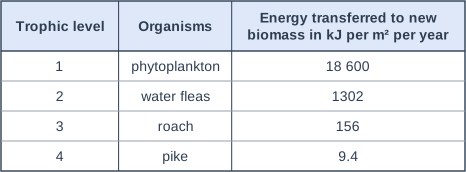
Ecologists estimated the energy transferred to new biomass in each trophic level of a food chain in a lake in one year. The table shows their estimates.

A student said: 'About 10% of the energy is transferred from each trophic level to the next.'

Comment on the student's statement. Use calculations from the table in your answer.

Table with columns "Trophic level", "Organisms", "Energy transferred to new biomass in kJ per m² per year". Trophic level: 1; Organisms: phytoplankton; Energy transferred to new biomass in kJ per m² per year: 18 600 | Trophic level: 2; Organisms: water fleas; Energy transferred to new biomass in kJ per m² per year: 1302 | Trophic level: 3; Organisms: roach; Energy transferred to new biomass in kJ per m² per year: 156 | Trophic level: 4; Organisms: pike; Energy transferred to new biomass in kJ per m² per year: 9.4.

Model answer

Phytoplankton to water fleas: 1302 ÷ 18 600 × 100 = 7.0%
Water fleas to roach: 156 ÷ 1302 × 100 = 12.0%
Roach to pike: 9.4 ÷ 156 × 100 = 6.0%

The statement is only approximately correct. All three efficiencies are fairly close to 10%, but the efficiency is not the same at each level: it is highest from water fleas to roach (12%) and lowest from roach to pike (6%), which is about half as efficient.

Explanation

Calculate each efficiency as energy in the higher trophic level ÷ energy in the level below × 100, then compare each value with 10% and reach a judgement. The efficiencies here range from 6% to 12%, so '10%' is a useful rough figure but not true for every transfer. Answers that only describe the numbers without calculating efficiencies, or that give no judgement, cannot gain full marks.

Mark scheme
  1. 1 mark

    (phytoplankton to water fleas =) 1302 ÷ 18 600 × 100 = 7(.0) (%) (1)

    Five marking points; max 4. Max 3 if no judgement is made about the student's statement. 1 mark for each correct efficiency (marking points 1 to 3). An answer giving all three efficiencies (7%, 12% and 6%) with no working scores marking points 1, 2 and 3. accept the percentage not transferred as an equivalent calculation: 93% for marking point 1, 88% for marking point 2, 94% for marking point 3.

  2. 1 mark

    (water fleas to roach =) 156 ÷ 1302 × 100 = 12 (%) (1)

    accept 11.98 / 12.0 / 12.

  3. 1 mark

    (roach to pike =) 9.4 ÷ 156 × 100 = 6(.0) (%) (1)

    accept 6.03 / 6.0 / 6.

  4. 1 mark

    judgement: the statement is only partly correct / approximately correct, because the efficiency is close to 10% but is not the same at each level (it varies from 6% to 12%) (1)

    accept the statement is not correct because the efficiency is different at each level / only one transfer is above 10%. accept the statement is a reasonable estimate because all the efficiencies are between about 5% and 15%. The judgement must be supported by a comparison of the efficiencies with 10%.

  5. 1 mark

    the efficiency is highest from water fleas to roach and lowest from roach to pike (1)

    accept a correct comparison of two of the calculated efficiencies, e.g. the transfer to pike is only about half as efficient as the transfer to roach.

Ready to try the rest? Every answer you write is marked against the mark scheme, so you can see exactly where the marks are.

Study Helper Hints first, answers after you try

Stuck on this one? Ask for a hint and I’ll point you in the right direction, without giving the answer away. Once you’ve checked your answer, I’ll show you how the marks are awarded.