
Level:
Correct: 0
Incorrect: 0
Marks: 0/0
Exam Practice
Course:
Topics:
Edexcel GCSE Biology (Paper 2) Smart practice A mixed round aimed at your weak spots
Unit 1
Key concepts in biology
Unit 6
Plant structures and their functions
Unit 7
Animal coordination, control and homeostasis
Unit 8
Exchange and transport in animals
Unit 9
Ecosystems and material cycles
Avg
score:
–
Topics
done:
0/38

The urinary system, kidneys and ADH

Practise 18 exam-style questions on The urinary system, kidneys and ADH for Edexcel GCSE Biology (Paper 2). Write your answer as you would in the exam and get it marked in seconds against the mark scheme, point by point, with the Study Helper on hand if you get stuck.

  • 18 questions
  • 1–6 marks each
  • Instant marking
  • No sign-up needed
18 questions, marked as you go

Sample questions with model answers

Here are 4 of the questions in this topic, each with a model answer, an explanation of why it earns the marks and the mark scheme an examiner would use.

Question 1

1 mark

ADH is a hormone that is released into the blood when there is too little water in the blood.

Which of these is an effect of ADH?

Choose your answer.

  • A collecting ducts less permeable
  • B more glucose is reabsorbed
  • C more blood filtered in glomerulus
  • D collecting ducts more permeable

Model answer

D - collecting ducts more permeable.

Explanation

ADH acts on the collecting ducts of the nephrons, making them more permeable to water. More water is reabsorbed into the blood by osmosis, so a smaller volume of more concentrated urine is produced. A common error is to reverse the effect of ADH.

Mark scheme
  1. 1 mark

    D / collecting ducts more permeable (1)

    The only correct answer is D: ADH makes the walls of the collecting ducts more permeable to water, so more water is reabsorbed into the blood. A is not correct because this is what happens when less ADH is released (when the water content of the blood is too high). B is not correct because glucose reabsorption is not controlled by ADH; all the glucose is normally reabsorbed anyway. C is not correct because ADH does not act on the glomerulus. Accept the letter or the option. If more than one option is given, do not award the mark.
Question 2

2 marks

When the water content of the blood falls, more ADH is released into the blood.

Explain why the control of the water content of the blood by ADH is an example of negative feedback.

Model answer

In negative feedback, a change from the normal level causes a response that reverses the change. When the water content of the blood falls, more ADH is released, so more water is reabsorbed from the collecting ducts and the water content of the blood rises back towards normal. When it is back to normal, less ADH is released, so it does not rise too far.

Explanation

Negative feedback means the response opposes the change that caused it. Here a low water content triggers ADH release, which raises the water content, and the release of ADH then falls. Answers that only describe what ADH does, without saying that the response reverses the change, are not complete.

Mark scheme
  1. 1 mark

    a change in the water content of the blood causes a response that reverses the change / brings the water content back to normal (1)

    Any two from the three points; max 2. Ignore 'it keeps conditions constant' with no reference to reversing a change.

  2. 1 mark

    (a fall in water content leads to more ADH, so) more water is reabsorbed (in the collecting ducts), so the water content of the blood rises (1)

    Accept the reverse: a rise in water content leads to less ADH, less water reabsorbed, so the water content falls.

  3. 1 mark

    when the water content returns to normal, less ADH is released (so the water content does not rise too far) (1)

    Accept 'ADH release is reduced once the water content is back to normal'.

Question 3

3 marks

Yusuf has arginine vasopressin (AVP) deficiency, a condition previously called cranial diabetes insipidus. His body releases little or no ADH. Without treatment he can pass as much as 15 dm³ of very dilute urine in a day.

He is treated with desmopressin, a drug that has the same effect on the kidneys as ADH.

Explain how desmopressin reduces the volume of urine that Yusuf produces.

Model answer

Desmopressin is carried in the blood to the kidneys. Like ADH, it makes the walls of the collecting ducts more permeable to water, so more water is reabsorbed from the collecting ducts into the blood by osmosis. As a result, Yusuf produces a smaller volume of more concentrated urine.

Explanation

Without ADH the collecting ducts stay only slightly permeable to water, so little water is reabsorbed and large volumes of dilute urine are produced. A drug that copies ADH increases the permeability of the collecting ducts, so more water returns to the blood. The examiners' reports for this topic note that weaker answers do not mention the change in permeability of the collecting duct.

Mark scheme
  1. 1 mark

    desmopressin is carried in the blood to the kidneys / acts on the collecting ducts (1)

    An explanation linking any three from the four points; max 3. Accept 'it acts on the nephrons'.

  2. 1 mark

    it makes the (walls of the) collecting ducts more permeable to water (1)

    Accept 'it opens (more) water channels in the collecting ducts'. Do not accept 'less permeable'. Ignore 'makes the kidney more permeable' (the collecting duct, or the nephron, must be named).

  3. 1 mark

    so more water is reabsorbed (from the collecting ducts) into the blood (by osmosis) (1)

    Do not accept 'more water is filtered'. Ignore 'the body keeps more water' with no reference to reabsorption.

  4. 1 mark

    so a smaller volume of more concentrated urine is produced (1)

    Both a smaller volume and more concentrated are needed for this mark.

Question 4

4 marks

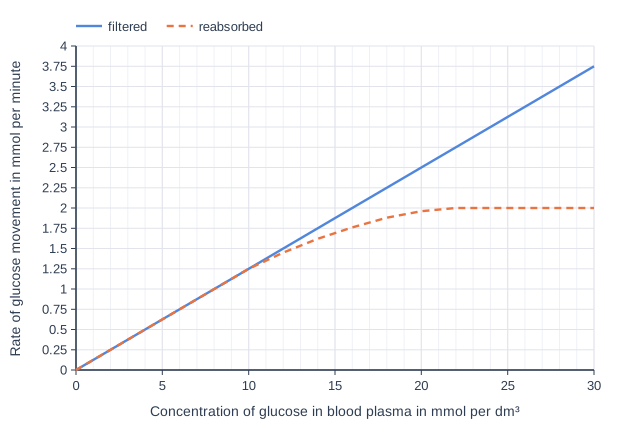
The graph shows the rate at which glucose is filtered from the blood into the nephrons, and the rate at which glucose is reabsorbed into the blood, at different concentrations of glucose in the blood plasma.

Huw has untreated diabetes. His blood glucose concentration is 25 mmol per dm³.

Calculate the rate at which glucose is lost in Huw's urine.

Explain why glucose is found in the urine of a person whose blood glucose concentration is above about 10 mmol per dm³, but not in the urine of a person whose blood glucose concentration is normal (about 5 mmol per dm³).

Line graph of rate of glucose movement in mmol per minute (y-axis, 0 to 4) against concentration of glucose in blood plasma in mmol per dm³ (x-axis, 0 to 30). "filtered" joins the points (0, 0), (5, 0.625), (10, 1.25), (15, 1.875), (20, 2.5), (25, 3.125), (30, 3.75). "reabsorbed" (dashed) joins the points (0, 0), (10, 1.25), (12, 1.45), (14, 1.62), (16, 1.76), (18, 1.88), (20, 1.96), (22, 2), (25, 2), (30, 2).

Model answer

At 25 mmol per dm³, glucose is filtered at 3.125 mmol per minute and reabsorbed at 2.0 mmol per minute.
Rate lost in urine = 3.125 - 2.0 = 1.1 mmol per minute

At a normal blood glucose concentration, all of the glucose filtered into the nephrons is selectively reabsorbed into the blood by active transport, so none is left in the urine. Above about 10 mmol per dm³, glucose is filtered faster than the cells of the tubule can reabsorb it: reabsorption reaches a maximum of 2.0 mmol per minute. The extra glucose stays in the filtrate and is lost in the urine.

Explanation

Glucose lost in the urine is the difference between the rate of filtration and the rate of reabsorption at the same blood concentration. Reabsorption of glucose by active transport has a maximum rate, so when the blood (and filtrate) glucose concentration is very high, not all of it can be reabsorbed. This is why glucose in the urine is a sign of diabetes.

Mark scheme
  1. 1 mark

    (rate lost =) 3.125 - 2.0 (1)

    An answer of 1.1 (mmol per minute) with no working scores marking points 1 and 2. Accept a value from 3.0 to 3.2 for the rate of filtration read from the graph, minus 2.0.

  2. 1 mark

    1.1 (mmol per minute) (1)

    Accept 1.125 or any value from 1.0 to 1.2. Allow ecf for one incorrect reading. Do not award this mark for 3.1 or 2.0 on its own.

  3. 1 mark

    at a normal blood glucose concentration, all of the filtered glucose is (selectively) reabsorbed (by active transport) (1)

    Accept 'at 5 mmol per dm³ the filtered and reabsorbed lines are the same'.

  4. 1 mark

    above about 10 mmol per dm³, glucose is filtered faster than it can be reabsorbed / reabsorption reaches a maximum rate (2.0 mmol per minute), so the extra glucose stays in the filtrate and is lost in the urine (1)

    Accept 'the cells cannot reabsorb glucose any faster' or 'the carrier proteins are all being used'. Do not accept 'the kidneys stop reabsorbing glucose'.

Ready to try the rest? Every answer you write is marked against the mark scheme, so you can see exactly where the marks are.

Study Helper Hints first, answers after you try

Stuck on this one? Ask for a hint and I’ll point you in the right direction, without giving the answer away. Once you’ve checked your answer, I’ll show you how the marks are awarded.