
Level:
Correct: 0
Incorrect: 0
Marks: 0/0
Exam Practice
Course:
Topics:
Edexcel GCSE Biology (Paper 2) Smart practice A mixed round aimed at your weak spots
Unit 1
Key concepts in biology
Unit 6
Plant structures and their functions
Unit 7
Animal coordination, control and homeostasis
Unit 8
Exchange and transport in animals
Unit 9
Ecosystems and material cycles
Avg
score:
–
Topics
done:
0/38

Indicator species and the rate of decomposition

Practise 17 exam-style questions on Indicator species and the rate of decomposition for Edexcel GCSE Biology (Paper 2). Write your answer as you would in the exam and get it marked in seconds against the mark scheme, point by point, with the Study Helper on hand if you get stuck.

  • 17 questions
  • 1–6 marks each
  • Instant marking
  • No sign-up needed
17 questions, marked as you go

Sample questions with model answers

Here are 4 of the questions in this topic, each with a model answer, an explanation of why it earns the marks and the mark scheme an examiner would use.

Question 1

1 mark

Food kept in a freezer at −18 °C decomposes very slowly.

Which statement explains why?

Choose your answer.

  • A the cold kills all microorganisms
  • B microorganisms' enzymes are denatured
  • C there is no oxygen in a freezer
  • D most water in the food is frozen

Model answer

D - most water in the food is frozen

Explanation

Decomposers need liquid water to grow and for their enzymes to work, and in a freezer most of the water in food is turned to ice. The low temperature also makes their enzymes work very slowly. Freezing does not kill all microorganisms or denature their enzymes, which is why thawed food decomposes quickly.

Mark scheme
  1. 1 mark

    D / most water in the food is frozen (1)

    The only correct answer is D: most of the water in the food is frozen, so microorganisms cannot use it to grow and reproduce or for their enzymes to work (the low temperature also makes their enzymes work very slowly). A is not correct because freezing does not kill all microorganisms - many become active again when the food thaws; B is not correct because enzymes are denatured by high temperatures, not low ones - at low temperatures they work very slowly but are not damaged; C is not correct because there is air, containing oxygen, in a freezer. Accept the letter or the option. If more than one option is given, do not award the mark.
Question 2

2 marks

Soup is sealed in a can and then heated to about 120 °C for several minutes. The canned soup can be stored for years at room temperature without decomposing.

Explain why the soup does not decompose until the can is opened.

Model answer

Heating the sealed can to 120 °C kills all the microorganisms in the soup, including their spores, by denaturing their enzymes. Because the can is sealed, no new microorganisms can get in, so there is nothing to decompose the soup until the can is opened.

Explanation

Canning combines a high temperature, which kills the decomposers already in the food, with a sealed container that stops new ones (and oxygen) getting in. Once the can is opened, microorganisms from the air can enter, so the soup must then be kept cold and used quickly. Saying only 'it is airtight' does not explain why there were no microorganisms inside to start with.

Mark scheme
  1. 1 mark

    the high temperature kills (all) the microorganisms (and their spores) in the soup / denatures their enzymes (1)

    An explanation linking two from the three points; max 2. accept the soup is sterilised. ignore 'heating kills germs' unless microorganisms / bacteria / fungi are named somewhere in the answer.

  2. 1 mark

    the can is sealed, so no (new) microorganisms can get in (1)

    accept airtight for sealed.

  3. 1 mark

    no oxygen can get into the can, so aerobic decomposers cannot respire (1)

    accept there is little oxygen in the sealed can.

Question 3

3 marks

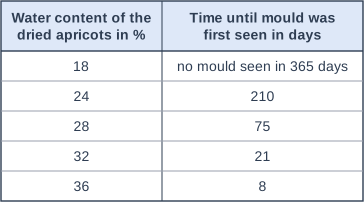
A food scientist investigated how the water content of dried apricots affects how long they can be stored before they start to decompose.

She dried batches of apricots to different water contents, put each batch in a closed plastic box and kept all the boxes at 20 °C. She checked the apricots every day for one year and recorded when mould was first seen.

The table shows her results.

Explain the relationship shown in the table.

Table with columns "Water content of the dried apricots in %", "Time until mould was first seen in days". Water content of the dried apricots in %: 18; Time until mould was first seen in days: no mould seen in 365 days | Water content of the dried apricots in %: 24; Time until mould was first seen in days: 210 | Water content of the dried apricots in %: 28; Time until mould was first seen in days: 75 | Water content of the dried apricots in %: 32; Time until mould was first seen in days: 21 | Water content of the dried apricots in %: 36; Time until mould was first seen in days: 8.

Model answer

The lower the water content of the apricots, the longer they could be stored before mould grew: mould appeared after only 8 days at 36 % water, but none was seen in 365 days at 18 % water. Mould and other decomposers need water to grow and reproduce, and their enzymes need water to digest the apricot and to dissolve the digested food so that it can be absorbed. With less water, the microorganisms grow and digest the apricots more slowly, so the apricots decompose more slowly and keep for longer.

Explanation

Decomposers such as moulds need water to grow and for their enzymes to work, so removing water from food slows its decomposition. The table shows that the drier the apricots, the longer they keep. A full answer describes the trend and explains it in terms of the decomposers; saying only that 'water makes food go off' does not explain the result.

Mark scheme
  1. 1 mark

    the lower the water content, the longer the apricots could be stored before mould was seen (1)

    An explanation linking three from the four points; max 3. accept ORA; accept a correct use of the data, e.g. mould after 8 days at 36 % water but none in 365 days at 18 % water; ignore 'the water content affects the time' with no direction

  2. 1 mark

    moulds / fungi / microorganisms / decomposers need water to grow / reproduce (1)

    accept the mould spores need water to germinate; accept bacteria for fungi; do not accept 'the mould needs water for photosynthesis'

  3. 1 mark

    (water is needed) for the enzymes of the microorganisms to digest the apricot / for the digested food to dissolve so that it can be absorbed (1)

    accept enzymes do not work without water; ignore 'water is needed for decomposition' with no reference to the microorganisms or their enzymes

  4. 1 mark

    so with less water the microorganisms grow / digest the apricots more slowly, so the apricots decompose more slowly / keep for longer (1)

    accept with so little water, water moves out of the microorganisms' cells by osmosis, so they cannot grow; ignore 'drying kills all the microorganisms'

Question 4

4 marks

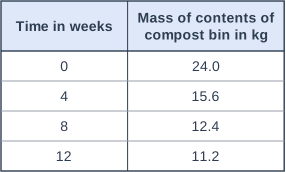
A gardener weighed the contents of her compost bin every 4 weeks. Nothing was added to the bin during this time. The table shows the results.

Calculate the percentage decrease in the mean rate of decay from weeks 0-4 to weeks 8-12.

Suggest one reason why the rate of decay decreased.

Table with columns "Time in weeks", "Mass of contents of compost bin in kg". Time in weeks: 0; Mass of contents of compost bin in kg: 24.0 | Time in weeks: 4; Mass of contents of compost bin in kg: 15.6 | Time in weeks: 8; Mass of contents of compost bin in kg: 12.4 | Time in weeks: 12; Mass of contents of compost bin in kg: 11.2.

Model answer

Rate in weeks 0-4 = (24.0 − 15.6) ÷ 4 = 2.1 kg per week
Rate in weeks 8-12 = (12.4 − 11.2) ÷ 4 = 0.3 kg per week
Percentage decrease = (2.1 − 0.3) ÷ 2.1 × 100 = 85.7%

The rate decreased because the soft material that is easy to decompose was broken down first, leaving tougher material such as woody stems that decomposes slowly.

Explanation

Calculate each rate as the decrease in mass ÷ the time, then the percentage decrease as (first rate − second rate) ÷ first rate × 100. A common error is dividing by the second rate instead of the first. Decay slows over time because the easily digested material is used up first and conditions in the bin, such as oxygen and temperature, may also change.

Mark scheme
  1. 1 mark

    (rate in weeks 0-4 =) (24.0 − 15.6) ÷ 4 = 2.1 (kg per week) (1)

    Marking points 1 to 3 are for the calculation. An answer of 85.7% with no working scores marking points 1, 2 and 3; so does an answer of 86%.

  2. 1 mark

    (rate in weeks 8-12 =) (12.4 − 11.2) ÷ 4 = 0.3 (kg per week) (1)

    accept the decreases in mass (8.4 kg and 1.2 kg) used instead of the rates, as both periods are 4 weeks long, for marking points 1 and 2.

  3. 1 mark

    (2.1 − 0.3) ÷ 2.1 × 100 = 85.7 (%) (1)

    accept 86 / 85.7. ecf from their rates. An answer of 600% (dividing by 0.3) scores marking points 1 and 2 only.

  4. 1 mark

    one reason, e.g. the material that is easy to decompose has already been broken down, leaving material that is harder to decompose (e.g. woody stems / cellulose) / there is less material left to decompose / less oxygen in the bin / the bin became colder (1)

    accept any valid reason linked to the decomposers or their conditions. ignore 'the bacteria died' with no reason.

Ready to try the rest? Every answer you write is marked against the mark scheme, so you can see exactly where the marks are.

Study Helper Hints first, answers after you try

Stuck on this one? Ask for a hint and I’ll point you in the right direction, without giving the answer away. Once you’ve checked your answer, I’ll show you how the marks are awarded.