
Level:
Correct: 0
Incorrect: 0
Marks: 0/0
Exam Practice
Course:
Topics:
Edexcel GCSE Biology (Paper 2) Smart practice A mixed round aimed at your weak spots
Unit 1
Key concepts in biology
Unit 6
Plant structures and their functions
Unit 7
Animal coordination, control and homeostasis
Unit 8
Exchange and transport in animals
Unit 9
Ecosystems and material cycles
Avg
score:
–
Topics
done:
0/38

Core practical: light intensity and photosynthesis

Practise 17 exam-style questions on Core practical: light intensity and photosynthesis for Edexcel GCSE Biology (Paper 2). Write your answer as you would in the exam and get it marked in seconds against the mark scheme, point by point, with the Study Helper on hand if you get stuck.

  • 17 questions
  • 1–6 marks each
  • Instant marking
  • No sign-up needed
17 questions, marked as you go

Sample questions with model answers

Here are 4 of the questions in this topic, each with a model answer, an explanation of why it earns the marks and the mark scheme an examiner would use.

Question 1

1 mark

Algal balls can be placed at different distances from a lamp to find out how light intensity affects photosynthesis.

Give one reason why this investigation should be carried out in a darkened room.

Model answer

In a darkened room the only light reaching the algal balls comes from the lamp, so the light intensity at each bottle depends only on its distance from the lamp. Sunlight or room lights would add extra, uncontrolled light.

Explanation

The light intensity is changed by moving the lamp, so any other light would add to it by different amounts at different bottles. This makes the light intensity at each bottle unknown. 'To make it fair' does not say what the problem is, so it is not enough.

Mark scheme
  1. 1 mark

    light from other sources (such as sunlight or room lights) would also reach the algal balls, so the light intensity would not depend only on the distance from the lamp (1)

    accept so that the only light reaching the algal balls comes from the lamp; accept other light would change the light intensity at each distance / would be an uncontrolled variable; ignore 'to make it a fair test' on its own; do not accept 'so that the algae cannot photosynthesise'
Question 2

2 marks

A lamp gives light to some algal balls. At a distance of 15 cm from the lamp, the light intensity is 64 arbitrary units.

Use the inverse square law to calculate the light intensity at a distance of 40 cm from the lamp.

Model answer

Light intensity ∝ 1/d², so light intensity × d² is constant.
64 × 15² = 14 400
Light intensity at 40 cm = 14 400 ÷ 40² = 14 400 ÷ 1600 = 9.0 arbitrary units

Explanation

With the inverse square law, light intensity × distance² stays the same, so find this constant at 15 cm and divide it by 40². Check: the distance is 2.67 times greater, so the light intensity should be 2.67² = 7.1 times smaller, and 64 ÷ 7.1 = 9.0. Multiplying by 15 ÷ 40 without squaring gives 24, which is wrong.

Mark scheme
  1. 1 mark

    (64 ×) (15 ÷ 40)² / 64 × 15² ÷ 40² / 14 400 ÷ 1600 (1)

    An answer of 9 / 9.0 (arbitrary units) with no working scores 2 marks. accept 64 ÷ (40 ÷ 15)² / 64 × 0.141; accept 64 ÷ (1/15²) = 14 400 then 14 400 × 1/40² ; 64 × 15 ÷ 40 = 24 (the distance ratio not squared, so the inverse square law has not been used) is a wrong method and scores 0

  2. 1 mark

    9 / 9.0 (arbitrary units) (1)

    accept 9.00

Question 3

3 marks

Algal balls are made by mixing a culture of single-celled algae with sodium alginate solution and dripping the mixture into calcium chloride solution. Each drop becomes a small jelly ball with algae trapped inside.

Explain the advantages of using algal balls, rather than a suspension of free algae in water, to compare the rate of photosynthesis at different light intensities.

Model answer

The drops are all about the same size, so each algal ball contains about the same number of algae. This means the same quantity of algae can be put into each bottle just by counting the balls, so any difference in the rate of photosynthesis is caused by the light intensity and not by different amounts of algae. Also, because the algae are trapped inside the balls, the indicator stays clear, so its colour can be judged accurately or measured with a colorimeter.

Explanation

The rate of photosynthesis depends on how much photosynthesising material there is, so this must be controlled. Counting algal balls is an easy way to control it, and trapping the algae keeps the indicator clear. Answers that say only 'it is a fair test' need to say why.

Mark scheme
  1. 1 mark

    each ball contains about the same number / volume of algae (because the drops are the same size) (1)

    An explanation linking three from the four points; max 3. accept the balls are all the same size so contain the same amount of algae

  2. 1 mark

    so the same quantity of algae can be put in each bottle by counting the balls (1)

    accept easy to measure out / transfer the same amount of algae

  3. 1 mark

    so any difference in the rate (of photosynthesis) is caused by the light intensity / it is a fair comparison (1)

    must be linked to the same amount of algae in each bottle

  4. 1 mark

    the algae are trapped in the balls, so the indicator / liquid stays clear (not cloudy), so its colour can be judged / measured with a colorimeter (1)

    accept the algal cells do not interfere with judging the colour of the indicator

Question 4

4 marks

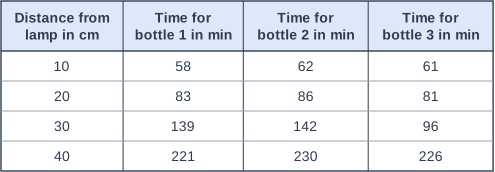
A student placed bottles of algal balls in hydrogencarbonate indicator at four distances from an LED lamp, with three bottles at each distance. She recorded the time taken for the indicator in each bottle to change from red to the same purple colour as a standard bottle.

The table shows her results. One result is anomalous.

Calculate the mean time at 30 cm, and the rate of photosynthesis at 30 cm using:

rate = 1000 ÷ mean time

Suggest one reason for the anomalous result.

Table with columns "Distance from lamp in cm", "Time for bottle 1 in min", "Time for bottle 2 in min", "Time for bottle 3 in min". Distance from lamp in cm: 10; Time for bottle 1 in min: 58; Time for bottle 2 in min: 62; Time for bottle 3 in min: 61 | Distance from lamp in cm: 20; Time for bottle 1 in min: 83; Time for bottle 2 in min: 86; Time for bottle 3 in min: 81 | Distance from lamp in cm: 30; Time for bottle 1 in min: 139; Time for bottle 2 in min: 142; Time for bottle 3 in min: 96 | Distance from lamp in cm: 40; Time for bottle 1 in min: 221; Time for bottle 2 in min: 230; Time for bottle 3 in min: 226.

Model answer

The anomalous result is 96 minutes.
Mean time at 30 cm = (139 + 142) ÷ 2 = 140.5 minutes
Rate = 1000 ÷ 140.5 = 7.12

The indicator in the anomalous bottle changed colour much faster than in the others, so that bottle may have contained more algal balls than the others.

Explanation

Leave out the anomalous result (96 min is much shorter than 139 and 142 min) before calculating the mean, then use the mean in the rate equation; the rate is higher when the time is shorter. A reason for an anomaly must fit its direction: here the colour changed too quickly, so a reason that gives faster photosynthesis or less carbon dioxide to remove fits. 'Human error' is too vague.

Mark scheme
  1. 1 mark

    (mean =) (139 + 142) ÷ 2 (1)

    Answers of 140.5 or 141 min (mean) and 7.12 or 7.1 (rate) with no working score marking points 1, 2 and 3; the anomalous result is 96 min; a mean that includes it (125.7 min) is wrong and scores 0 for points 1 and 2, but allow ecf for point 3 (1000 ÷ 125.7 = 7.96)

  2. 1 mark

    140.5 (min) (1)

    accept 141 (min)

  3. 1 mark

    (rate = 1000 ÷ 140.5 =) 7.12 (1)

    accept values that round to 7.1, e.g. 7.117; allow ecf from an incorrect mean

  4. 1 mark

    the bottle had more algal balls / larger algal balls / more algae (1)

    Points 4 to 7: any one reason that would make the colour change faster; max 1 for the reason. accept any other valid reason that would give a shorter time, e.g. the end point was judged too early / the colour was misjudged, so the timer was stopped too soon; ignore 'human error' / 'mistake' on its own

  5. 1 mark

    the bottle was placed closer to the lamp than 30 cm (1)

    accept the bottle was moved / not measured to 30 cm accurately (so it received more light)

  6. 1 mark

    the bottle contained less indicator (1)

    accept a smaller volume of indicator

  7. 1 mark

    the bottle was warmer than the others (1)

    accept the temperature was higher; do not accept reasons that would make the change slower, e.g. fewer algal balls or the bottle further from the lamp

Ready to try the rest? Every answer you write is marked against the mark scheme, so you can see exactly where the marks are.

Study Helper Hints first, answers after you try

Stuck on this one? Ask for a hint and I’ll point you in the right direction, without giving the answer away. Once you’ve checked your answer, I’ll show you how the marks are awarded.