
Level:
Correct: 0
Incorrect: 0
Marks: 0/0
Exam Practice
Course:
Topics:
Edexcel GCSE Biology (Paper 2) Smart practice A mixed round aimed at your weak spots
Unit 1
Key concepts in biology
Unit 6
Plant structures and their functions
Unit 7
Animal coordination, control and homeostasis
Unit 8
Exchange and transport in animals
Unit 9
Ecosystems and material cycles
Avg
score:
–
Topics
done:
0/38

Food tests and calorimetry

Practise 15 exam-style questions on Food tests and calorimetry for Edexcel GCSE Biology (Paper 2). Write your answer as you would in the exam and get it marked in seconds against the mark scheme, point by point, with the Study Helper on hand if you get stuck.

  • 15 questions
  • 1–6 marks each
  • Instant marking
  • No sign-up needed
15 questions, marked as you go

Sample questions with model answers

Here are 4 of the questions in this topic, each with a model answer, an explanation of why it earns the marks and the mark scheme an examiner would use.

Question 1

1 mark

The label on a packet of oatcakes says that 100 g of oatcakes contains 1890 kJ of energy.

What is the energy content of the oatcakes in J/g?

Choose your answer.

  • A 18.9 J/g
  • B 189 J/g
  • C 1890 J/g
  • D 18 900 J/g

Model answer

D - 18 900 J/g (1890 kJ ÷ 100 = 18.9 kJ/g = 18 900 J/g).

Explanation

Divide by 100 to get the energy in one gram, then multiply by 1000 to change kJ into J. Food labels give energy per 100 g, but calorimetry results are usually in J/g, so this conversion is needed to compare them. The usual mistake is to stop at 18.9 and forget to convert kJ to J.

Mark scheme
  1. 1 mark

    D / 18 900 J/g (1)

    The only correct answer is D: 1890 kJ ÷ 100 g = 18.9 kJ/g, and 18.9 × 1000 = 18 900 J/g. A is not correct because 18.9 is the energy content in kJ/g, not J/g (it has not been multiplied by 1000); B is not correct because 189 J/g would mean only 18.9 kJ in 100 g; C is not correct because 1890 J/g would mean only 189 kJ in 100 g (it treats the label value as the energy in one gram without converting kJ to J). Accept the letter or the option. If more than one option is given, do not award the mark.
Question 2

2 marks

Kofi burned a small piece of dried mango under a boiling tube containing 20 cm³ of water.

When the mango had stopped burning, Kofi noticed that the thermometer gave different readings when its bulb was at different depths in the water.

Explain why Kofi should stir the water before he records the highest temperature.

Model answer

The readings are different at different depths, so the water is not all at the same temperature: the energy from the burning mango has not spread evenly through it. Stirring mixes the water so that it is all at the same temperature, so the thermometer then shows the temperature of all 20 g of water. The energy content is calculated using the mass of all of the water, so a reading from one part of the water could make the temperature rise, and so the energy content, too high or too low.

Explanation

The energy content is calculated from the temperature rise of the whole mass of water, so the reading must be the temperature of all of the water. Stirring mixes the warmer and cooler water so that one reading gives that temperature. Answers that only say stirring makes the result 'more accurate' need to say why.

Mark scheme
  1. 1 mark

    the water is not all at the same temperature / the energy (heat) from the burning mango has not spread evenly through the water (1)

    An explanation linking two from the three points; max 2. accept some parts of the water are hotter than others; ignore 'to make it a fair test' or 'to make the result accurate / reliable' without a reason; do not accept 'stirring heats the water' or 'stirring makes the mango burn better'

  2. 1 mark

    stirring mixes the water so that it is all at the same temperature / so that the reading is the temperature of all of the water (1)

    accept stirring spreads the heat evenly through the water; accept so the reading is the mean / average temperature of the water

  3. 1 mark

    the energy content is calculated using the mass of all of the water, so the temperature rise of all of the water is needed / a reading from one part of the water would make the temperature rise, and so the energy content, too high or too low (1)

    accept the calculated energy content would be inaccurate, if this is linked to the reading not being the temperature of all of the water; ignore 'the results would be wrong' without a reason

Question 3

3 marks

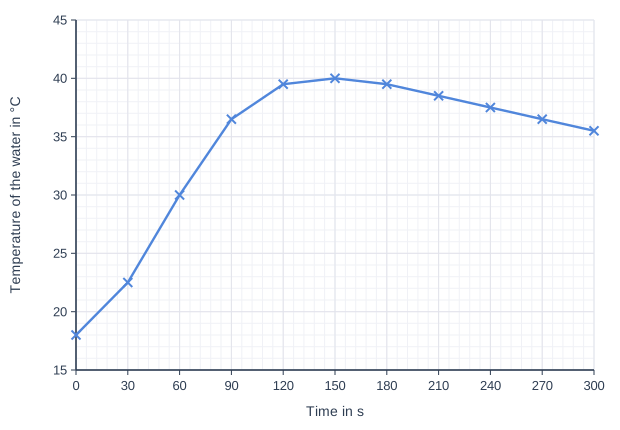
A student burned a dried banana chip under a boiling tube containing 20 cm³ of water. The banana chip burned for about two minutes. She recorded the temperature of the water every 30 seconds for 5 minutes.

The graph shows her results.

Explain why the temperature of the water decreased after 150 s.

Explain why the student should use the highest temperature, and not the temperature at 300 s, to calculate the energy content of the banana chip.

Line graph of temperature of the water in °C (y-axis, 15 to 45) against time in s (x-axis, 0 to 300). The line joins the points (0, 18), (30, 22.5), (60, 30), (90, 36.5), (120, 39.5), (150, 40), (180, 39.5), (210, 38.5), (240, 37.5), (270, 36.5), (300, 35.5).

Model answer

After about 150 s the banana chip had stopped burning, so no more energy was being transferred to the water. The warm water then transferred energy to the cooler air around it, so its temperature fell. The highest temperature, 40.0 °C, shows the temperature rise caused by the energy from the food (22.0 °C). The temperature at 300 s, 35.5 °C, has been lowered by the heat lost after burning stopped, so it would give a smaller rise of only 17.5 °C and the energy content would be underestimated.

Explanation

While the food burns, energy is transferred to the water faster than the water loses it, so the temperature rises; once the flame has gone out, the water only loses energy to the surroundings. The highest temperature is therefore the best measure of the energy received from the food. Using a later reading makes the temperature rise, and the calculated energy content, too small.

Mark scheme
  1. 1 mark

    the banana chip had stopped burning, so no more energy / heat was transferred to the water (1)

    An explanation linking three from the four points; max 3. accept the food had burned completely / gone out, so it was no longer heating the water

  2. 1 mark

    energy / heat was transferred from the (warm) water to the (cooler) surroundings / air (1)

    accept the water lost heat to the air / to the boiling tube and clamp; accept the water cooled down because heat was lost; ignore 'the water evaporated' on its own

  3. 1 mark

    the highest temperature (40.0 °C) shows the temperature rise caused by the energy released from the food / using 35.5 °C (at 300 s) gives a smaller temperature rise (17.5 °C instead of 22.0 °C) (1)

    accept the temperature at 300 s has been lowered by heat lost after the food stopped burning; accept a smaller rise / a lower final temperature without the values

  4. 1 mark

    so using the temperature at 300 s would underestimate the energy content (even more) (1)

    accept the energy content calculated would be too low / less accurate; this point needs a reference to the energy content or the calculation

Question 4

4 marks

Pecan nuts contain about 29 kJ of energy per gram.

Sam is going to burn a 0.40 g piece of pecan nut under a boiling tube containing 25 cm³ of water. 1 cm³ of water has a mass of 1 g.

With this simple apparatus, only about 30 % of the energy released by the burning nut is transferred to the water.

Calculate the temperature rise of the water that Sam should expect.

Use the equation:

energy transferred to the water (J) = mass of water (g) × temperature rise (°C) × 4.2

Model answer

energy released by the nut = 29 × 1000 × 0.40 = 11 600 J
energy transferred to the water = 11 600 × 0.30 = 3480 J
temperature rise = 3480 ÷ (25 × 4.2) = 3480 ÷ 105 = 33.1 °C
Sam should expect a temperature rise of about 33 °C.

Explanation

First find the total energy in the piece of nut (convert kJ to J and multiply by the mass), then take 30 % of it, then rearrange the equation to give temperature rise = energy ÷ (mass of water × 4.2). Leaving out the 30 % gives an impossible rise of 110 °C, which would take the water far above its boiling point. Forgetting to convert kJ to J is the other common error.

Mark scheme
  1. 1 mark

    (energy released by the nut =) 29 × 1000 × 0.40 = 11 600 (J) (1)

    An answer of 33 °C with no working scores 4 marks (also 33.1 or 33.14 °C). accept 11.6 kJ for this mark; the steps may be done in a different order, e.g. 29 000 × 0.30 = 8700 J per g, then 8700 × 0.40 = 3480 J (marking points 1 and 2)

  2. 1 mark

    (energy transferred to the water =) 11 600 × 0.30 = 3480 (J) (1)

    accept 3.48 kJ; allow ecf from an incorrect energy released

  3. 1 mark

    (temperature rise =) 3480 ÷ (25 × 4.2) (1)

    for rearranging the equation and substituting; allow ecf from their energy transferred to the water, e.g. 11 600 ÷ (25 × 4.2) = 110 °C if the 30 % has not been used (this scores marking points 1 and 3 only, 2 marks). If the energy is left in kJ (3.48 ÷ (25 × 4.2) = 0.033), award marking points 1, 2 and 3 but not marking point 4: an answer of 0.033 °C is a power of ten error and scores 3 marks

  4. 1 mark

    33 (°C) (1)

    accept values that round to 33 (e.g. 33.1, 33.14)

Ready to try the rest? Every answer you write is marked against the mark scheme, so you can see exactly where the marks are.

Study Helper Hints first, answers after you try

Stuck on this one? Ask for a hint and I’ll point you in the right direction, without giving the answer away. Once you’ve checked your answer, I’ll show you how the marks are awarded.