
Level:
Correct: 0
Incorrect: 0
Marks: 0/0
Exam Practice
Course:
Topics:
Edexcel GCSE Biology (Paper 2) Smart practice A mixed round aimed at your weak spots
Unit 1
Key concepts in biology
Unit 6
Plant structures and their functions
Unit 7
Animal coordination, control and homeostasis
Unit 8
Exchange and transport in animals
Unit 9
Ecosystems and material cycles
Avg
score:
–
Topics
done:
0/38

Leaf adaptations, extreme environments and plant hormones

Practise 20 exam-style questions on Leaf adaptations, extreme environments and plant hormones for Edexcel GCSE Biology (Paper 2). Write your answer as you would in the exam and get it marked in seconds against the mark scheme, point by point, with the Study Helper on hand if you get stuck.

  • 20 questions
  • 1–6 marks each
  • Instant marking
  • No sign-up needed
20 questions, marked as you go

Sample questions with model answers

Here are 4 of the questions in this topic, each with a model answer, an explanation of why it earns the marks and the mark scheme an examiner would use.

Question 1

1 mark

A bean seedling was placed in the dark with its root horizontal. After a few hours, the root had started to bend downwards. This response to gravity is controlled by auxin.

Where did the auxin collect in the root, and what was its effect on the cells there?

Choose your answer.

  • A upper side, more cell elongation
  • B upper side, less cell elongation
  • C lower side, more cell elongation
  • D lower side, less cell elongation

Model answer

D - lower side, less cell elongation.

Explanation

In a horizontal root, auxin collects on the lower side. In roots, auxin inhibits cell elongation, so the upper side grows faster and the root bends downwards (positive gravitropism). Option C is the shoot response, the most common confusion.

Mark scheme
  1. 1 mark

    D / lower side, less cell elongation (1)

    The only correct answer is D. A is not correct because auxin collects on the lower side of a horizontal root, not the upper side. B is not correct because auxin collects on the lower side, and less elongation on the upper side would make the root bend upwards. C is not correct because in roots auxin inhibits cell elongation; more elongation on the lower side happens in shoots and would make the root bend upwards. Accept the letter or the option. If more than one option is given, do not award the mark.
Question 2

2 marks

A grower sprays a solution of gibberellin onto the flowers of tomato plants in a glasshouse. The grower makes sure that none of the flowers are pollinated.

The flowers develop into tomatoes that have no seeds.

Explain why the tomatoes formed, and why they have no seeds.

Model answer

The gibberellin stimulates the flowers to develop into fruit even though they have not been pollinated. Because there is no pollination, the egg cells in the ovules are not fertilised, so no seeds develop inside the fruit.

Explanation

Normally fruit only develops after fertilisation, and the fertilised ovules become seeds. Gibberellins can make fruit form without fertilisation, so the fruit is seedless - a commercial use of gibberellins. Saying 'they were not pollinated' only repeats the question; the answer must link this to fertilisation.

Mark scheme
  1. 1 mark

    gibberellin stimulates the fruit to form / develop (without pollination) (1)

    Accept 'gibberellin makes the flower / ovary grow into a fruit'.

  2. 1 mark

    no fertilisation (of the ovules / egg cells) takes place, so no seeds form (1)

    Do not accept 'because they were not pollinated' on its own, as it repeats the question. Do not accept 'gibberellin kills / destroys the seeds'.

Question 3

3 marks

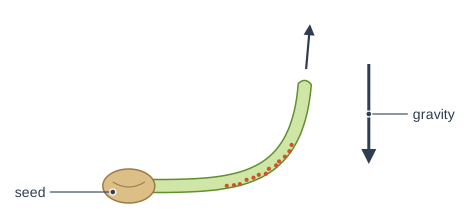
A seedling was left lying on its side in the dark for two days. Figure 1 shows the seedling at the end of the two days. The dots show where auxin collected in the shoot.

Explain how auxin caused the shoot to grow upwards.

Diagram of a seed lying on its side, with a young shoot growing from it. A seed lies on its side, and a young shoot grows out of it sideways, then bends upwards. Dots, representing a plant hormone, are concentrated on the lower side of the shoot where it bends. A large arrow on the right points straight down, and an arrow beyond the shoot tip points upwards, the direction of growth. The label "seed" points to the bean-shaped object on the left; the label "gravity" points to the large arrow pointing downwards on the right.

Model answer

Gravity made the auxin collect on the lower side of the shoot. In shoots, auxin causes cell elongation, so the cells on the lower side elongated more than the cells on the upper side. The lower side grew faster, so the shoot curved upwards.

Explanation

This is negative gravitropism. Auxin collects on the lower side of a horizontal shoot, and in shoots it stimulates cell elongation, so the lower side grows faster and the shoot bends up. Answers must say auxin makes the cells elongate; 'the shoot elongates' is not enough.

Mark scheme
  1. 1 mark

    auxin collects on the lower side (of the shoot) (1)

    An explanation linking three points. Accept 'gravity makes auxin move to the lower side'.

  2. 1 mark

    auxin causes cell elongation (in shoots) (1)

    Accept 'auxin makes the cells grow longer / stimulates the cells to elongate'. Do not accept 'auxin makes the shoot elongate' or 'auxin makes the shoot grow' without reference to cells.

  3. 1 mark

    (so) the lower side grows faster than the upper side, so the shoot bends / curves upwards (1)

    Accept 'cells on the lower side become longer than those on the upper side, so the shoot turns upwards'. Ignore 'negative gravitropism' on its own (it names the response but does not explain it).

Question 4

4 marks

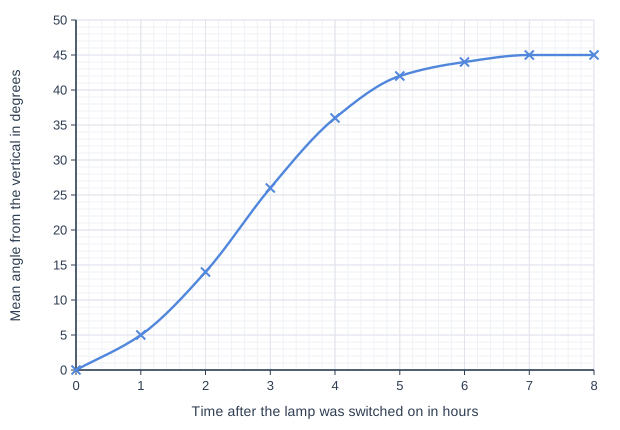
A student grew radish seedlings in the dark until their shoots were 3 cm tall. She then switched on a lamp. Its light reached the shoots from one side, at an angle of 45° to the vertical.

Every hour, she measured the angle between the tip of each shoot and the vertical, and calculated the mean angle. The graph shows her results.

Calculate the mean rate at which the angle increased from 2 hours to 4 hours, in degrees per hour.

The angle stopped increasing at about 45°. Explain why.

Line graph of mean angle from the vertical in degrees (y-axis, 0 to 50) against time after the lamp was switched on in hours (x-axis, 0 to 8). The line is a smooth curve through (0, 0), (1, 5), (2, 14), (3, 26), (4, 36), (5, 42), (6, 44), (7, 45), (8, 45).

Model answer

Rate = (36 − 14) ÷ 2 = 22 ÷ 2 = 11 degrees per hour.

At 45° the shoot tip is pointing straight at the light, so light falls equally on all sides of the tip. Auxin no longer moves to one side, so it is evenly distributed and the cells on all sides elongate at the same rate. The shoot keeps growing, but towards the light, so it does not bend any further.

Explanation

The rate is the change in angle divided by the time: 22° in 2 hours. Bending only happens while one side of the shoot is shaded and has more auxin; once the tip points along the light, there is no shaded side and growth is equal all round. A common error is to think the shoot has stopped growing.

Mark scheme
  1. 1 mark

    (rate =) (36 − 14) ÷ 2 / 22 ÷ 2 (1)

    MP1-MP2 for the calculation and any two from MP3-MP5 for the explanation; max 4 in total. An answer of 11 (degrees per hour) with no working scores marking points 1 and 2. Do not award for 36 ÷ 4 = 9 (using only the angle at 4 hours) or for 22 with no division by the time.

  2. 1 mark

    11 (degrees per hour) (1)

    Accept 11 °/h.

  3. 1 mark

    the shoot tip points (straight) towards the light / light falls evenly on all sides of the tip (1)

    Any two from MP3-MP5 for the explanation; max 2 for this part. Accept 'the shoot is now lined up with the light'.

  4. 1 mark

    (so) auxin is evenly distributed / no longer moves to the shaded side (1)

    Accept 'there is no longer a shaded side, so auxin does not collect on one side'.

  5. 1 mark

    (so) the cells on all sides elongate at the same rate / no side grows faster (1)

    Ignore 'the shoot has stopped growing' (it is still growing, but straight).

Ready to try the rest? Every answer you write is marked against the mark scheme, so you can see exactly where the marks are.

Study Helper Hints first, answers after you try

Stuck on this one? Ask for a hint and I’ll point you in the right direction, without giving the answer away. Once you’ve checked your answer, I’ll show you how the marks are awarded.