
Level:
Correct: 0
Incorrect: 0
Marks: 0/0
Exam Practice
Course:
Topics:
Edexcel GCSE Biology (Paper 2) Smart practice A mixed round aimed at your weak spots
Unit 1
Key concepts in biology
Unit 6
Plant structures and their functions
Unit 7
Animal coordination, control and homeostasis
Unit 8
Exchange and transport in animals
Unit 9
Ecosystems and material cycles
Avg
score:
–
Topics
done:
0/38

Heart rate, stroke volume and cardiac output

Practise 13 exam-style questions on Heart rate, stroke volume and cardiac output for Edexcel GCSE Biology (Paper 2). Write your answer as you would in the exam and get it marked in seconds against the mark scheme, point by point, with the Study Helper on hand if you get stuck.

  • 13 questions
  • 1–6 marks each
  • Instant marking
  • No sign-up needed
13 questions, marked as you go

Sample questions with model answers

Here are 4 of the questions in this topic, each with a model answer, an explanation of why it earns the marks and the mark scheme an examiner would use.

Question 1

1 mark

Which of these could be the cardiac output of an adult at rest?

Choose your answer.

  • A 70 beats per minute
  • B 70 cm³
  • C 70 cm³ per beat
  • D 5.0 dm³ per minute

Model answer

D 5.0 dm³ per minute

Explanation

Cardiac output = stroke volume × heart rate, so its unit is (cm³ per beat) × (beats per minute) = cm³ per minute, often converted to dm³ per minute (1 dm³ = 1000 cm³). A typical adult at rest has a stroke volume of about 70 cm³ and a heart rate of about 70 beats per minute, giving about 4900 cm³, or 5 dm³, per minute. Options A and C are realistic values, but of heart rate and stroke volume, not cardiac output.

Mark scheme
  1. 1 mark

    D / 5.0 dm³ per minute (1)

    The only correct answer is D. A is not correct because beats per minute is the unit of heart rate (70 is a typical resting heart rate); B is not correct because cm³ is a volume only, with no time, so it cannot be an output per minute; C is not correct because cm³ per beat is the unit of stroke volume (70 cm³ is a typical resting stroke volume). Accept the letter or the option. If more than one option is given, do not award the mark.
Question 2

2 marks

An electrocardiogram (ECG) records the electrical activity of the heart.

On a patient's ECG, the time from the start of one heartbeat to the start of the next heartbeat is 0.75 s.

Calculate the patient's heart rate in beats per minute.

Model answer

Number of beats in one minute = 60 ÷ 0.75 = 80
Heart rate = 80 beats per minute

Explanation

One beat takes 0.75 s, so the number of beats in 60 s is 60 ÷ 0.75 = 80. A common error is to multiply 0.75 by 60, which gives 45: check that a shorter time between beats gives a higher heart rate.

Mark scheme
  1. 1 mark

    60 ÷ 0.75 (1)

    An answer of 80 (beats per minute) with no working scores 2 marks. Accept 1 ÷ 0.75 = 1.33 (beats per second) for this mark.

  2. 1 mark

    80 (beats per minute) (1)

    Award 1 mark for 1.33 (beats per second, not converted to beats per minute). Do not award either mark for 0.75 × 60 = 45 (a wrong method).

Question 3

3 marks

A newborn baby has a heart rate of 140 beats per minute and a cardiac output of 0.70 dm³ per minute.

cardiac output = stroke volume × heart rate

Calculate the baby's stroke volume in cm³.

Model answer

0.70 dm³ = 700 cm³
stroke volume = cardiac output ÷ heart rate = 700 ÷ 140 = 5.0 cm³

Explanation

Rearrange the equation to stroke volume = cardiac output ÷ heart rate, and convert dm³ to cm³ by multiplying by 1000. A newborn's heart is tiny, so each beat pumps only about 5 cm³ (compared with about 70 cm³ in an adult at rest); its high heart rate keeps the cardiac output up. Check the answer is sensible: a stroke volume of 0.005 cm³ or 98 000 cm³ is impossible.

Mark scheme
  1. 1 mark

    0.70 dm³ = 700 (cm³) (1)

    An answer of 5.0 (cm³) with no working scores 3 marks.

  2. 1 mark

    (stroke volume =) 700 ÷ 140 (1)

    Accept 0.70 ÷ 140 for this mark. Do not award this mark or marking point 3 for 140 ÷ 700 or 700 × 140 (a wrong rearrangement).

  3. 1 mark

    5.0 (cm³) (1)

    Accept 5. Award 2 marks for 0.005 (the answer in dm³, not converted to cm³).

Question 4

4 marks

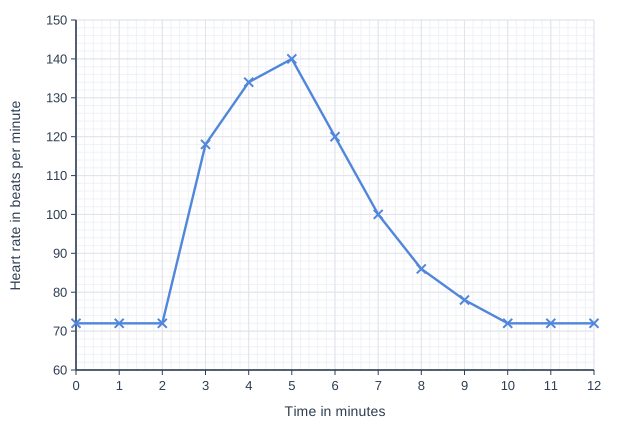
Ella measured her heart rate before, during and after a step test. She stepped on and off a step from 2 minutes to 5 minutes, and then sat down.

The graph shows her results.

A sports scientist also measured Ella's stroke volume. It was 70 cm³ at rest and 95 cm³ at 5 minutes.

cardiac output = stroke volume × heart rate

Calculate how many times greater Ella's cardiac output was at 5 minutes than at rest.

Use the graph to estimate Ella's heart rate 1.5 minutes after she stopped exercising.

Line graph of heart rate in beats per minute (y-axis, 60 to 150) against time in minutes (x-axis, 0 to 12). The line joins the points (0, 72), (1, 72), (2, 72), (3, 118), (4, 134), (5, 140), (6, 120), (7, 100), (8, 86), (9, 78), (10, 72), (11, 72), (12, 72).

Model answer

From the graph: resting heart rate = 72 beats per minute; heart rate at 5 minutes = 140 beats per minute
Cardiac output at rest = 70 × 72 = 5040 cm³ per minute
Cardiac output at 5 minutes = 95 × 140 = 13 300 cm³ per minute
13 300 ÷ 5040 = 2.6, so her cardiac output was 2.6 times greater at 5 minutes than at rest.
She stopped exercising at 5 minutes, so 1.5 minutes later is 6.5 minutes: heart rate = 110 beats per minute.

Explanation

Read both heart rates from the graph, use the equation twice, then divide the larger cardiac output by the smaller. Both heart rate (1.9 times) and stroke volume (1.4 times) increased, so the cardiac output increased by more than either of them alone. For the reading, add 1.5 minutes to the time exercise stopped (5 minutes) and read halfway between the points at 6 and 7 minutes; a common error is to read the graph at 1.5 minutes on the time axis.

Mark scheme
  1. 1 mark

    (cardiac output at rest =) 70 × 72 = 5040 (cm³ per minute) (1)

    An answer of 2.6 times with no working scores marking points 1, 2 and 3. The heart rates come from the graph: 72 beats per minute at rest and 140 beats per minute at 5 minutes. Accept cardiac outputs in dm³ per minute (5.04 and 13.3). Accept the alternative method: 140 ÷ 72 = 1.94 (1) and 95 ÷ 70 = 1.36 (1), then 1.94 × 1.36 = 2.6 (1).

  2. 1 mark

    (cardiac output at 5 minutes =) 95 × 140 = 13 300 (cm³ per minute) (1)

    Do not award marking point 1 or 2 for a stroke volume divided by a heart rate, or a heart rate divided by a stroke volume.

  3. 1 mark

    13 300 ÷ 5040 = 2.6 (times) (1)

    Accept values that round to 2.6 (e.g. 2.64 / 2.639). Allow ecf from their cardiac outputs. Do not award this mark for the division the wrong way round (5040 ÷ 13 300 = 0.38) or for the difference (8260 / 8.26) instead of a ratio.

  4. 1 mark

    110 (beats per minute) (1)

    Accept values from 108 to 112. This is the reading at 6.5 minutes (exercise stopped at 5 minutes), halfway between the points at 6 minutes (120) and 7 minutes (100). Do not accept 120 / 100, or 72 (the reading at 1.5 minutes on the time axis).

Ready to try the rest? Every answer you write is marked against the mark scheme, so you can see exactly where the marks are.

Study Helper Hints first, answers after you try

Stuck on this one? Ask for a hint and I’ll point you in the right direction, without giving the answer away. Once you’ve checked your answer, I’ll show you how the marks are awarded.