
Level:
Correct: 0
Incorrect: 0
Marks: 0/0
Exam Practice
Course:
Topics:
Edexcel GCSE Biology (Paper 2) Smart practice A mixed round aimed at your weak spots
Unit 1
Key concepts in biology
Unit 6
Plant structures and their functions
Unit 7
Animal coordination, control and homeostasis
Unit 8
Exchange and transport in animals
Unit 9
Ecosystems and material cycles
Avg
score:
–
Topics
done:
0/38

Eukaryotic and prokaryotic cells

Practise 13 exam-style questions on Eukaryotic and prokaryotic cells for Edexcel GCSE Biology (Paper 2). Write your answer as you would in the exam and get it marked in seconds against the mark scheme, point by point, with the Study Helper on hand if you get stuck.

  • 13 questions
  • 1–6 marks each
  • Instant marking
  • No sign-up needed
13 questions, marked as you go

Sample questions with model answers

Here are 4 of the questions in this topic, each with a model answer, an explanation of why it earns the marks and the mark scheme an examiner would use.

Question 1

1 mark

A scientist kept a plant in the light and supplied it with carbon dioxide containing a radioactive form of carbon, so that she could follow where the carbon atoms went.

In which structure of a palisade cell would the radioactive carbon first become part of a glucose molecule?

Choose your answer.

  • A cell wall
  • B mitochondrion
  • C chloroplast
  • D vacuole

Model answer

C chloroplast

Explanation

Carbon dioxide is used in photosynthesis, which takes place in the chloroplasts, where chlorophyll absorbs the light energy needed to make glucose. The commonest wrong answer is the mitochondrion: mitochondria release energy by breaking glucose down in respiration, so they give out carbon dioxide rather than using it to build glucose.

Mark scheme
  1. 1 mark

    C / chloroplast (1)

    The only correct answer is C: chloroplasts contain chlorophyll, which absorbs light energy for photosynthesis, in which carbon dioxide and water are used to make glucose. A is not correct because carbon dioxide passes through the cellulose cell wall, which strengthens the cell but does not make glucose; B is not correct because mitochondria break down glucose in aerobic respiration, which releases carbon dioxide rather than using it to make glucose; D is not correct because the vacuole contains cell sap, which can store sugars made elsewhere in the cell, but no glucose is made there. Accept the letter or the option. If more than one option is given, do not award the mark.
Question 2

2 marks

Some disinfectants used to clean hospital surfaces kill bacteria by damaging the bacterial cell membrane. The bacterial cell wall is not damaged.

Explain why damaging the cell membrane kills the bacteria.

Model answer

The cell membrane controls which substances enter and leave the bacterial cell. When it is damaged, substances such as enzymes and ions leak out of the cytoplasm and harmful substances can get in, so the cell can no longer keep the conditions it needs for its reactions, and it dies.

Explanation

In bacteria, as in eukaryotic cells, the partially permeable cell membrane controls what moves into and out of the cell. The cell wall gives strength and shape but lets most substances through, so it cannot do the job of a damaged membrane; answers that describe the cell wall controlling what enters the cell score no marks.

Mark scheme
  1. 1 mark

    the cell membrane controls which substances enter and leave the cell (1)

    An explanation linking two from the four points; max 2. accept the membrane is partially permeable; do not accept answers that give this function to the cell wall.

  2. 1 mark

    (so when it is damaged) substances leak out of the cell / the contents of the cell leak out (1)

    accept named substances leak out, e.g. enzymes / proteins / ions / sugars / cytoplasm; ignore 'the cell bursts' (the cell wall is not damaged).

  3. 1 mark

    harmful substances / the disinfectant can enter the cell (freely) (1)

    accept the cell cannot stop unwanted substances getting in.

  4. 1 mark

    the cell can no longer keep the right conditions / concentrations of substances inside it (so its reactions stop) (1)

    accept the cell cannot keep the substances it needs for respiration / growth; accept the enzymes in the cell can no longer work. ignore 'the cell dies' alone (given in the question).

Question 3

3 marks

The cells of beetroot contain a red pigment, which is stored in the large permanent vacuole of each cell.

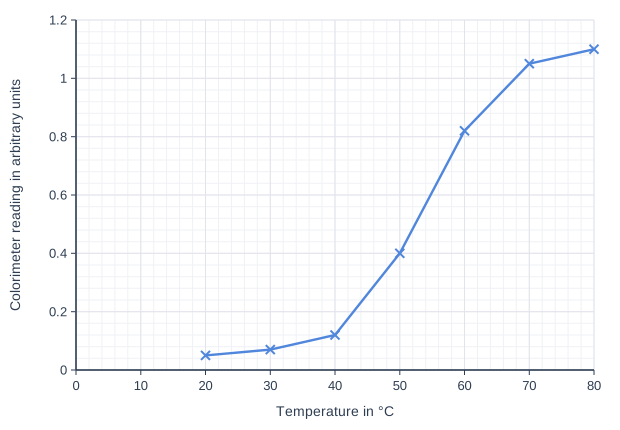
A student cut cubes of beetroot of the same size and rinsed them in water. She placed one cube in a tube of water at each of seven temperatures for 30 minutes. She then removed the cubes and measured the intensity of the red colour of the water with a colorimeter. A higher reading means that more pigment has leaked out of the cells into the water.

The graph shows her results.

Explain the results shown in the graph.

Line graph of colorimeter reading in arbitrary units (y-axis, 0 to 1.2) against temperature in °C (x-axis, 0 to 80). The line joins the points (20, 0.05), (30, 0.07), (40, 0.12), (50, 0.4), (60, 0.82), (70, 1.05), (80, 1.1).

Model answer

Very little pigment leaked out of the cubes at temperatures up to 40 °C, but above 40 °C the colorimeter reading rose steeply, reaching 1.10 at 80 °C. The pigment is kept inside the vacuoles by the membranes, which control what leaves the cells. Temperatures above 40 °C damage the cell membranes, so they can no longer keep the pigment in and it leaks out into the water.

Explanation

The cell membrane, and the membrane around the vacuole, control what passes into and out of each cell, so at low temperatures the pigment stays inside. High temperatures damage the membranes, so the pigment leaks out. A common error is to say that the cell wall keeps the pigment in: the cellulose cell wall lets most substances through.

Mark scheme
  1. 1 mark

    little pigment leaked out at temperatures up to 40 °C, but much more leaked out above 40 °C (1)

    An explanation linking three from the five points; max 3. This point is for describing the pattern: accept the reading stayed low (0.12 or less) up to 40 °C and then rose steeply (to 1.10 at 80 °C); accept a description using correct data. 'As the temperature increases, more pigment leaks out' alone does not gain this mark, as it does not describe the pattern.

  2. 1 mark

    the cell membrane controls what leaves / enters the cell (1)

    accept the membranes (of the cell / vacuole) are partially permeable; do not accept the cell wall controls what leaves the cell.

  3. 1 mark

    at low temperatures the membranes keep the pigment inside the cells / vacuoles (1)

    accept the pigment cannot pass through an undamaged membrane.

  4. 1 mark

    high temperatures / temperatures above 40 °C damage the cell membranes (1)

    accept the membranes are destroyed / broken down; accept the proteins in the membranes are denatured; ignore 'the cells are denatured'; do not accept the cell wall is damaged as the only reason.

  5. 1 mark

    so pigment passes out through the damaged membranes into the water (1)

    accept the damaged membranes can no longer control what leaves the cells.

Question 4

5 marks

A scientist investigated two strains of a bacterium found in the human gut. Strain F has flagella. Strain N is a mutant strain with no flagella.

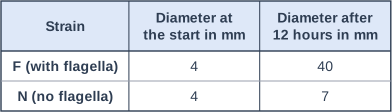
She placed a small drop of each strain at the centre of a separate dish of very soft agar jelly containing nutrients, and kept both dishes at 30 °C. She measured the diameter of the circular area covered by the bacteria at the start and again after 12 hours.

The table shows her results.

Calculate the mean rate at which the edge of the area covered by strain F moved outwards, in mm per hour.

Explain why strain F spread much further than strain N.

Table with columns "Strain", "Diameter at the start in mm", "Diameter after 12 hours in mm". Strain: F (with flagella); Diameter at the start in mm: 4; Diameter after 12 hours in mm: 40 | Strain: N (no flagella); Diameter at the start in mm: 4; Diameter after 12 hours in mm: 7.

Model answer

Increase in diameter = 40 - 4 = 36 mm
The edge moves out by half of this: 36 ÷ 2 = 18 mm
Rate = 18 ÷ 12 = 1.5 mm per hour

Strain F has flagella, which rotate and make the bacteria swim through the soft agar, so they can move outwards into areas that still have plenty of nutrients, where they grow and divide. Strain N has no flagella, so it cannot swim and can only spread slowly as its cells grow and divide.

Explanation

The edge of a circle moves outwards by the change in its radius, which is half the change in diameter, so the 36 mm increase means the edge moved 18 mm in 12 hours. Dividing 36 by 12 is the most common error. Flagella let bacteria swim, so a strain with flagella can reach fresh nutrients, while a strain with no flagella spreads only as its cells divide.

Mark scheme
  1. 1 mark

    (increase in diameter =) 40 - 4 = 36 (mm) (1)

    An answer of 1.5 mm per hour with no working scores marking points 1, 2 and 3. Alternative method: radius at the start = 2 mm and radius after 12 hours = 20 mm for this mark. Marking points 4 to 6 are for the explanation: any two from the three; max 2. Total max 5.

  2. 1 mark

    (distance moved by the edge =) 36 ÷ 2 = 18 (mm) (1)

    alternative method: 20 - 2 = 18 (mm).

  3. 1 mark

    (rate = 18 ÷ 12 =) 1.5 (mm per hour) (1)

    accept 1.5 mm/h; ecf from an incorrect distance moved by the edge. 3 / 3.0 (36 ÷ 12, using the change in diameter instead of the distance moved by the edge) scores marking point 1 only. 1.7 (20 ÷ 12, not subtracting the starting radius) scores marking point 1 only if both radii (2 mm and 20 mm) are seen, otherwise 0.

  4. 1 mark

    flagella rotate / move to make the bacteria swim / move (1)

    accept flagella move the bacteria through the (soft) agar / jelly; accept 'strain F can use its flagella to move'.

  5. 1 mark

    strain N can only spread by growing and dividing / cannot swim, so it stays near the centre (1)

    accept strain N cannot move by itself.

  6. 1 mark

    strain F can move (outwards) to areas with fresh / more nutrients, so it grows and reproduces there (1)

    accept moves away from where the nutrients have been used up / moves towards food.

Ready to try the rest? Every answer you write is marked against the mark scheme, so you can see exactly where the marks are.

Study Helper Hints first, answers after you try

Stuck on this one? Ask for a hint and I’ll point you in the right direction, without giving the answer away. Once you’ve checked your answer, I’ll show you how the marks are awarded.