Item A
Calderwick Precision Engineering Ltd
Calderwick Precision Engineering Ltd is a private limited company in Sheffield. It makes metal parts, such as gears and shafts, for manufacturers of farm machinery across the UK, and it has 58 employees. Its customers expect every part to be made to exact measurements, because one faulty part can stop a customer's production line.
Last year Calderwick replaced its old machines with 12 new computer-controlled machines, costing £1.4 million in total. Instead of being set by hand, the new machines are programmed using software. The first six machine operators were sent on a five-day off the job course run by the machine manufacturer at its training centre in Coventry. The course cost £1 150 per operator, plus travel and hotel costs, and Calderwick paid other staff overtime to keep production going while the six operators were away.
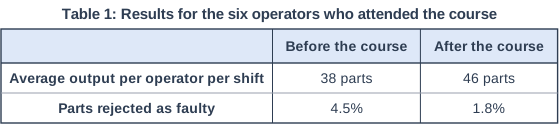
Table 1 shows the results for the six operators who attended the course.
Calderwick now needs to train another 18 operators. The production manager, Callum, has suggested that the six trained operators could train the others on the job, at the machines, during normal shifts. This would cost much less, but output would be slower for several weeks while the trained operators show the others what to do. None of the six has trained other people before. The manufacturer's course leads to a certificate and also covers features of the software that Calderwick's operators have not yet used.
Calderwick has just won a large order from a new customer, which must be delivered in three months.
Calderwick needs to train another 18 operators to use the new machines.
Recommend whether Calderwick should send the 18 operators on the manufacturer's off the job course or train them on the job, using the six trained operators. Give reasons for your recommendation.
Model answer
I recommend that Calderwick sends the 18 operators on the manufacturer's off the job course.
The main reason is quality. Calderwick's customers need parts made to exact measurements, and one faulty part can stop a customer's production line. Table 1 shows that after the course the share of parts rejected as faulty fell from 4.5% to 1.8%. If the other 18 operators reach the same standard, Calderwick will waste less metal and fewer faulty parts will reach customers, which protects its reputation and its repeat orders.
The course also raises productivity. Average output rose from 38 to 46 parts per operator per shift, an increase of 21.05%. Across 18 more operators that is 144 extra parts per shift, which will help Calderwick deliver the large order for its new customer within three months. The manufacturer's trainers are specialists and cover software features Calderwick has not used yet, so the operators will get the full benefit of the £1.4 million machines.
On the job training would be much cheaper, and operators would keep producing while they learn on Calderwick's own machines. However, none of the six trained operators has trained anyone before, so they may miss things or pass on mistakes. Their own output would also be slower for several weeks, just when Calderwick needs to make the large order.
The course is not cheap: 18 × £1 150 = £20 700 in fees, plus travel, hotels and overtime. But this is small compared with the £1.4 million spent on the machines, and the lower fault rate and higher output should soon cover it.
Overall, off the job training is the better choice, as long as Calderwick sends the operators in small groups so that production continues and the new order is not put at risk. This depends on the manufacturer being able to run the courses quickly; if it cannot, Calderwick could combine the two methods.