
Level:
Correct: 0
Incorrect: 0
Marks: 0/0
Exam Practice
Course:
Topics:
Avg
score:
–
Topics
done:
0/21

Globalisation

Practise 17 exam-style questions on Globalisation for AQA GCSE Business (Paper 1). Write your answer as you would in the exam and get it marked in seconds against the mark scheme, point by point, with the Study Helper on hand if you get stuck.

  • 17 questions
  • 1–12 marks each
  • Instant marking
  • No sign-up needed
17 questions, marked as you go

Sample questions with model answers

Here are 4 of the questions in this topic, each with a model answer, an explanation of why it earns the marks and the mark scheme an examiner would use.

Question 1

1 mark

Which one of the following best describes globalisation?

Choose your answer.

  • Businesses and economies around the world becoming more closely linked through trade
  • A business opening more branches across the UK
  • The government limiting the products that can be imported into the UK
  • A business choosing to sell only to customers in its local area

Model answer

Businesses and economies around the world becoming more closely linked through trade

Explanation

Globalisation is the process by which the world's businesses and economies become more connected, as goods, services, money and people move between countries. It means UK businesses can buy from suppliers and sell to customers anywhere, but also face competition from businesses anywhere. Opening more branches in the UK is growth, not globalisation, and limiting imports works against it.

Mark scheme
  1. 1 mark

    Businesses and economies around the world becoming more closely linked through trade

    Accept a clear shortened form, eg 'economies becoming more closely linked through trade'. If more than one option is given, 0 marks.
Question 2

2 marks

Explain one way globalisation may affect the workforce of a UK manufacturer.

Model answer

Globalisation may lead to UK jobs being lost. This is because the manufacturer may move some production to a country where wages are much lower, so that it can compete with cheaper imported products.

Explanation

Globalisation affects workers in both directions: it can create jobs when a business sells more abroad, or cost jobs when production moves overseas or cheaper imports take sales. The explanation mark needs the reason, such as lower overseas wages or higher export demand. A vague statement that 'workers will be affected' scores nothing.

Mark scheme
  1. 1 mark

    Identifies an effect on the workforce: jobs may be lost / redundancies / more jobs may be created / staff may need new skills or training / staff can be recruited from other countries / pressure on pay

    Answers may include: production moved to countries with lower wages, so UK jobs are lost; competition from low-cost imports forces cost cutting and redundancies; selling abroad increases demand, creating jobs; staff need language skills or training to deal with overseas customers or suppliers; businesses can recruit skilled workers from other countries; pressure to keep wages down to compete.

  2. 1 mark

    Explains why or how: eg because production moves abroad where wages are lower / because cheaper imports reduce its sales / because exports increase demand for its products / so staff can deal with overseas customers and suppliers

    Examples of developed answers: UK jobs may be lost (1) as the manufacturer moves production to a country where wages are lower (1). More staff may be needed (1) because selling to customers abroad increases demand for its products (1). Staff may need training (1) so they can communicate with overseas suppliers or customers (1). Do not accept 'staff are affected' without saying how.

Question 3

4 marks

Item A
Brightwater Dinghies Ltd

Brightwater Dinghies Ltd builds small racing sailing boats, called dinghies, at a boatyard in Cowes on the Isle of Wight. It employs 35 people, including two designers and 24 skilled boat builders, many of whom joined the business as apprentices. Each dinghy is built by hand to the customer's choice of colours and fittings, and takes about three weeks to complete.

Brightwater exports 65% of its dinghies to sailing clubs and dealers in Europe, the USA and Australia. Its dinghies sell for about 20% more than similar boats made in Asia, but its hull designs have won several international design awards and its dinghies have won races at world championships. Every hull carries a ten-year guarantee, and each dinghy is tested on the water before it is shipped.

Competition is increasing. Last year a manufacturer in Asia launched a dinghy that looks very similar to Brightwater's best-selling model, at a much lower price. Some overseas dealers have complained that it takes too long to get spare parts from the UK, and the cost of shipping dinghies to Australia has risen sharply. Changes in exchange rates also mean that the prices overseas customers pay in their own currencies can change from month to month.

The managing director, Priya, is considering using lighter materials and new moulding equipment to make each dinghy faster to build, and opening a small spare-parts warehouse in the Netherlands.

Explain one way Brightwater Dinghies Ltd competes in international markets.

You should use the information in Item A in your answer.

Model answer

Brightwater competes on design and quality rather than price. Its hull designs have won several international design awards and its dinghies have won races at world championships, so serious racers abroad see them as the best boats to buy. This allows Brightwater to charge about 20% more than similar boats made in Asia. Quality is protected because each dinghy is built by hand by skilled boat builders, many trained as apprentices, and every boat is tested on the water and carries a ten-year guarantee. This gives overseas clubs and dealers confidence that the extra price is worth paying, which helps Brightwater sell 65% of its dinghies abroad.

Explanation

Level 2 needs one way of competing - better design or higher quality - explained and supported with Brightwater's evidence, such as the design awards, the hand building or the ten-year guarantee. UK businesses often compete internationally on design and quality because they cannot match the low costs of some overseas producers. Saying Brightwater competes on price is wrong, as its dinghies cost about 20% more.

Mark scheme
  1. 4 marks

    Levels of response (4 marks). AO1 = 2, AO2 = 2.
    Level 2 (3-4 marks): Sound understanding and application of the topics. Applies knowledge and understanding to the context sufficiently. A sound understanding of one or more business concepts and issues.
    Level 1 (1-2 marks): Basic understanding and application of the topics. Applies basic knowledge and understanding to the context. A basic understanding of one or more business concepts.
    0 marks: nothing to reward.

    Indicative content (not a checklist; credit other valid points): Knowledge and application: better design - two designers, hull designs that have won several international design awards, dinghies that have won races at world championships, so racers abroad see them as the best and pay about 20% more than for Asian-made boats; higher quality - each dinghy built by hand by 24 skilled boat builders, many trained as apprentices, tested on the water before shipping and covered by a ten-year hull guarantee, so customers trust the boats and the price is worth paying; customisation - each dinghy is built to the customer's choice of colours and fittings, which mass-produced rivals may not offer. Brightwater does not compete on price. Level 2 needs a sound explanation of one way, applied to Brightwater using the case. An answer not applied to Brightwater cannot go above Level 1. An answer that says Brightwater competes with low prices is not credited.

Question 4

9 marks

Item A
Marsh Lane Cycles Ltd

Marsh Lane Cycles Ltd assembles electric bikes (e-bikes) in a small factory in Peterborough. It employs 26 people and makes about 3 000 e-bikes a year, which it sells to bike shops across the UK for an average of £1 650 each. Its frames and most other parts are made in the UK, but its battery packs and motors are bought from a supplier in Taiwan, which sets its prices in US dollars.

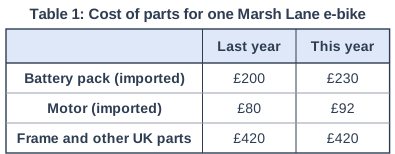
The value of the pound has fallen against the US dollar this year, so the imported parts now cost Marsh Lane more in pounds, as shown in Table 1. Marsh Lane does not want to raise its selling price, because e-bikes imported from Asia are already cheaper than its own.

The parts from Taiwan travel by sea and take seven weeks to arrive, so Marsh Lane holds about ten weeks of battery packs and motors in stock. Last year 1.5% of the Taiwanese battery packs were faulty and had to be returned.

A new UK business in Coventry has offered to make battery packs for Marsh Lane for £235 each, priced in pounds. It could deliver within one week and would design the packs to fit Marsh Lane's frames, but it can only make 2 000 packs a year for its first two years. Its packs have not yet been tested over a long period. If Marsh Lane switches, two warehouse staff would need training to check the new packs, and the business could hold far less stock.

Marsh Lane is deciding where to buy its battery packs.

Recommend whether Marsh Lane Cycles Ltd should switch to the UK supplier for its battery packs. Give reasons for your recommendation.

Table 1: Cost of parts for one Marsh Lane e-bike. Table with columns (row headings), "Last year", "This year". Battery pack (imported); Last year: £200; This year: £230 | Motor (imported); Last year: £80; This year: £92 | Frame and other UK parts; Last year: £420; This year: £420.

Model answer

Marsh Lane should switch part of its battery supply to the UK supplier, rather than all of it.

The main reason to switch is the exchange rate. The Taiwanese supplier sets its prices in US dollars, so the fall in the pound has raised the cost of a battery pack from £200 to £230. Marsh Lane cannot pass this on, because imported e-bikes are already cheaper, so the extra cost comes straight out of its profit. The UK packs are priced in pounds at £235, so their cost will not change if the pound falls further. Delivery within one week instead of seven also means Marsh Lane would no longer need to hold ten weeks of stock, so less cash would be tied up in batteries and less storage space would be needed. Packs designed to fit Marsh Lane's frames could also improve quality, compared with the 1.5% of Taiwanese packs that were faulty.

However, the UK packs are £5 more than the Taiwanese packs at today's prices, which would add about £10 000 a year to costs for 2 000 packs. If the pound recovers, the Taiwanese packs could become cheaper again - last year they cost only £200. The UK supplier is also new and its packs have not been tested over a long period, and a faulty battery in an e-bike could damage Marsh Lane's reputation with bike shops and lead to costly returns. In any case, the UK supplier can only make 2 000 packs a year, so Marsh Lane would still need about 1 000 packs from Taiwan.

On balance, Marsh Lane should buy 2 000 packs from the UK supplier and keep the Taiwanese supplier for the rest. This reduces its exposure to changes in the exchange rate and the amount of stock it holds, while keeping a back-up supplier if the new packs have quality problems. The decision depends on how well the UK packs perform in testing and on what happens to the value of the pound.

Explanation

The top level needs a recommendation that weighs the exchange rate risk of buying in US dollars against the higher price, limited capacity and untested quality of the UK supplier, using figures from the case and Table 1. Strong answers notice that the UK supplier cannot meet the whole order and that the Taiwanese packs could become cheaper again if the pound recovers. Answers that discuss UK and overseas suppliers in general, without Marsh Lane's evidence, cannot go above Level 2.

Mark scheme
  1. 9 marks

    Levels of response (9 marks). AO2 = 3, AO3 = 6.
    Level 3 (7-9 marks): Detailed analysis and evaluation of topics based on the context. Sustained line of reasoning, which is coherent, relevant, substantiated with a focused conclusion that is fully justified. Business areas are fully analysed. Applies knowledge and understanding to the context sufficiently.
    Level 2 (4-6 marks): Sound analysis and evaluation of topics based on the context. A line of reasoning, with a conclusion that has some justification. Business areas are partially analysed. Applies some knowledge and understanding to the context.
    Level 1 (1-3 marks): Basic analysis and evaluation of topics based on the context. Basic line of reasoning with a conclusion. Basic analysis of business areas. Basic knowledge and understanding is applied to the context.
    0 marks: nothing to reward.

    Indicative content (not a checklist; credit other valid points): Application: the Taiwanese supplier sets its prices in US dollars and the pound has fallen, so a battery pack has risen from £200 to £230 and a motor from £80 to £92 (Table 1); Marsh Lane cannot raise its £1 650 selling price because imported e-bikes are cheaper; seven-week delivery by sea and about ten weeks of stock held; 1.5% of Taiwanese packs faulty; the UK supplier offers packs at £235 priced in pounds, delivery within one week, designed to fit Marsh Lane's frames, but only 2 000 packs a year for two years (Marsh Lane makes about 3 000 e-bikes) and not tested over a long period; two warehouse staff need training. Analysis (for switching): prices in pounds remove the risk that a further fall in the pound raises costs again, so costs are more certain; one-week delivery means much less stock, freeing cash and storage space and letting Marsh Lane react faster to demand; packs designed for its frames may improve quality and reduce returns. Analysis (against switching): at today's prices the UK pack is £5 dearer, adding about £10 000 a year for 2 000 packs, which reduces profit when the selling price cannot rise; if the pound recovers, the Taiwanese packs could become cheaper again (they were £200 last year); untested packs are a quality and safety risk that could damage Marsh Lane's reputation with bike shops; the UK supplier cannot meet all of Marsh Lane's needs, so about 1 000 packs must still come from Taiwan. Evaluation - what does it depend on?: what happens to the value of the pound; how the UK packs perform in testing; whether the UK supplier can grow; whether using both suppliers spreads the risk. Accept any well-argued recommendation, including a partial switch. Level 3 needs a recommendation fully justified using the case. A generic answer that does not use the case cannot go above Level 2, however well developed.

Ready to try the rest? Every answer you write is marked against the mark scheme, so you can see exactly where the marks are.

Study Helper Hints first, answers after you try

Stuck on this one? Ask for a hint and I’ll point you in the right direction, without giving the answer away. Once you’ve checked your answer, I’ll show you how the marks are awarded.