Level:
Correct: 0
Incorrect: 0
Marks: 0/0
Exam Practice
Course:
Topics:
Avg
score:
–
Topics
done:
0/21

Good customer services

Practise 26 exam-style questions on Good customer services for AQA GCSE Business (Paper 1). Write your answer as you would in the exam and get it marked in seconds against the mark scheme, point by point, with the Study Helper on hand if you get stuck.

  • 26 questions
  • 1–12 marks each
  • Instant marking
  • No sign-up needed
20 questions, marked as you go

Sample questions with model answers

Here are 4 of the questions in this topic, each with a model answer, an explanation of why it earns the marks and the mark scheme an examiner would use.

Question 1

1 mark

A hair salon surveyed 250 customers. 40 of them said they were dissatisfied with the time they had to wait.

What percentage of the customers surveyed were dissatisfied with the waiting time?

Choose your answer.

  • 6.25%
  • 16%
  • 40%
  • 84%

Model answer

16%

Explanation

The percentage is 40 ÷ 250 × 100 = 16%. 6.25% comes from dividing the wrong way round (250 ÷ 40), 40% confuses the number of customers with a percentage, and 84% is the percentage who were not dissatisfied. Always divide the part by the whole.

Mark scheme
  1. 1 mark

    16%

    If more than one option is given, 0 marks.

Question 2

2 marks

Explain one way good customer service can increase the profitability of a business.

Model answer

Good customer service makes customers more loyal, so they come back to buy again. This increases revenue without the business having to spend extra on advertising to attract new customers, so profit rises.

Explanation

The first mark is for a clear benefit such as loyalty, increased spend or being able to charge a higher price, and the second for explaining how it raises profit, not just sales. Profit depends on costs as well as revenue, so the best answers mention a cost that is avoided or a margin that rises. Simply writing 'more customers, more profit' is too general for both marks.

Mark scheme
  1. 1 mark

    Identifies a way: customer loyalty / repeat purchases / customers spend more (increased spend) / the business can charge a higher price / positive word of mouth or good reviews attract new customers / fewer complaints, returns or refunds

    Max 2. A general statement such as 'more sales so more profit' scores 1 at most.

  2. 1 mark

    Explains how this increases profit, e.g. more revenue without the cost of advertising to attract new customers / a higher price increases the profit made on each sale / fewer refunds reduce costs

    Examples of developed answers: Customers are more loyal and return to buy again (1) so revenue rises without the business spending more on advertising (1). Customers are willing to pay a higher price for good service (1) so the profit on each item sold is higher (1). Fewer complaints and returns (1) so the business spends less on refunds and replacements (1).

Question 3

4 marks

Item E: Tidy Paws

Tidy Paws Ltd is an online retailer of pet food and pet care products based in Swansea. It sells only through its website and employs 30 staff, including a customer service team of six.

Tidy Paws uses ICT in many ways to look after its customers. Its website has a 'find the right food' tool, where customers enter their pet's type, age and weight and are shown suitable products, as well as feeding guides and short videos from a qualified vet nurse. Customers can order 24 hours a day, track their delivery online and set up repeat orders so that they never run out of food. The business also has 85 000 followers on social media, where the customer service team answers questions and complaints, usually within one hour, between 8 am and 8 pm.

At the moment customers can also phone a help line from 9 am to 5 pm on weekdays. The help line receives about 1 200 calls a month, many from older customers and from people whose pets have reacted badly to a new food. Each call lasts about eight minutes on average.

To reduce costs, the operations director, Lowri, is considering closing the help line and moving the two staff who answer calls to a new live chat service on the website. The live chat would be open from 8 am to 8 pm every day. Lowri estimates that this would save £22 000 a year.

Explain one way Tidy Paws uses ICT to provide good customer service.

You should use the information in Item E in your answer.

Model answer

Tidy Paws uses its website to give customers product knowledge without them needing to speak to anyone. The 'find the right food' tool asks for the pet's type, age and weight and then shows suitable products, and there are feeding guides and videos from a qualified vet nurse. This means a customer can get expert advice at any time of the day or night, even though Tidy Paws has no shop. Because customers are confident they are choosing the right food for their pet, they are more likely to be satisfied with their purchase and to set up repeat orders, which makes them loyal customers of Tidy Paws.

Explanation

To reach Level 2, name a way ICT is used, such as the website tool, e-commerce with tracking and repeat orders, or social media replies, and explain how it helps Tidy Paws' customers using details from Item E. Describing ICT in general without the case limits the answer to Level 1. One way explained well is better than a list of several.

Mark scheme
  1. 4 marks

    Levels of response (4 marks). AO1 = 2, AO2 = 2.
    Level 2 (3-4 marks): Sound understanding and application of the topics. Applies knowledge and understanding to the context sufficiently. A sound understanding of one or more business concepts and issues.
    Level 1 (1-2 marks): Basic understanding and application of the topics. Applies basic knowledge and understanding to the context. A basic understanding of one or more business concepts.
    0 marks: nothing to reward.

    Indicative content (not a checklist; credit other valid points): Knowledge: advances in ICT such as websites, e-commerce and social media let businesses give product information at any time, take orders 24 hours a day and respond to customers quickly. Application: the website's 'find the right food' tool, where customers enter their pet's type, age and weight and are shown suitable products (product knowledge online); feeding guides and short videos from a qualified vet nurse; ordering 24 hours a day, online delivery tracking and repeat orders so customers never run out of food (e-commerce); 85 000 social media followers, with questions and complaints usually answered within one hour between 8 am and 8 pm. Example of a Level 2 answer: Tidy Paws uses social media to give customers quick help. The customer service team answers questions and complaints on social media, usually within one hour, between 8 am and 8 pm. This means customers get a fast reply without having to phone, so problems are sorted out before they become dissatisfied, which keeps them buying from Tidy Paws. An answer not applied to Tidy Paws cannot go above Level 1. Level 2 needs a correct understanding of how ICT improves customer service, applied to Tidy Paws with some explanation. The phone help line is not an advance in ICT for this question.

Question 4

9 marks

Item B: Lough Bean Coffee

Lough Bean Coffee Ltd runs three coffee shops in Belfast. Its owners, Ciara and Tom, built the business on a reputation for friendly staff who learn regular customers' names and usual orders. Many new customers find the shops through online review sites, and Ciara replies personally to every review.

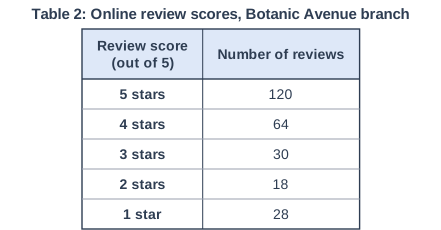
Eight months ago Lough Bean opened its third branch, on Botanic Avenue, near a university and a busy railway station. Between 7.30 am and 9.30 am the queue often reaches the door, and the average wait for a drink is 11 minutes. Six new staff were recruited quickly to run the branch and were given one day of training. Table 2 shows the online review scores for the Botanic Avenue branch. Each of the other two branches has a mean review score of 4.6 out of 5.

Recent reviews for Botanic Avenue include 'great coffee but I missed my train', 'staff seemed stressed and got my order wrong' and 'lovely relaxed atmosphere in the afternoons'.

A software company has offered Lough Bean an order-ahead app. Customers would order and pay on their phones and collect their drink from a separate counter at a time they choose. The app would cost £6 500 to set up, plus 3% of the value of each app order. Ciara thinks the app would cut the morning queue. Tom is worried that it would reduce the friendly contact with customers that the business is known for, and that the real problem is that the new staff have not been fully trained.

Recommend whether Lough Bean Coffee should introduce the order-ahead app at its Botanic Avenue branch.

Give reasons for your recommendation.

Table 2: Online review scores, Botanic Avenue branch. Table with columns "Review score (out of 5)", "Number of reviews". Review score (out of 5): 5 stars; Number of reviews: 120 | Review score (out of 5): 4 stars; Number of reviews: 64 | Review score (out of 5): 3 stars; Number of reviews: 30 | Review score (out of 5): 2 stars; Number of reviews: 18 | Review score (out of 5): 1 star; Number of reviews: 28.

Model answer

I recommend that Lough Bean introduces the order-ahead app at Botanic Avenue, but only alongside better training for the new staff.

The main problem at Botanic Avenue is the speed of service in the morning. Between 7.30 am and 9.30 am the queue reaches the door and customers wait 11 minutes on average, which is too long for commuters, as the review 'great coffee but I missed my train' shows. Because the branch is next to a railway station and a university, many of its customers are in a hurry and are used to ordering on their phones. With the app they could order and pay on the way and collect their drink at a set time, so they would not need to queue. This would make their experience much better, which should raise the mean review score from 3.9 towards the 4.6 of the other branches. As many new customers find Lough Bean through review sites, better reviews would bring in more customers. The set-up cost of £6 500 is small compared with the sales that could be lost if commuters go elsewhere.

However, the app has drawbacks. Lough Bean is known for friendly staff who learn customers' names and orders, and customers who order on an app have less contact with staff, so the business could lose the customer engagement that makes it different from chain coffee shops. The 3% charge on every app order also reduces the profit made on each drink. The reviews also say staff 'seemed stressed and got my order wrong', which suggests that the six new staff, who had only one day of training, do not yet know the menu or the business's way of serving customers. The app would not solve this, and extra app orders could even add to their stress.

On balance, the queue is the problem that is costing Lough Bean customers every morning, so the app is worth introducing. However, its success depends on the staff being able to cope, so Lough Bean should also give the new staff full training in the menu and in the friendly service the business is known for. The app deals with speed, while training protects Lough Bean's reputation, so together they should raise the branch's review scores.

Explanation

Top answers weigh the queue and the 11-minute wait against the risk to Lough Bean's friendly reputation and the app's costs, and use the 3.9 review score or the review comments as evidence. The conclusion must give a clear decision and explain what it depends on, such as whether the real problem is speed or staff training. Repeating earlier points in the conclusion adds little.

Mark scheme
  1. 9 marks

    Levels of response (9 marks). AO2 = 3, AO3 = 6.
    Level 3 (7-9 marks): Detailed analysis and evaluation of topics based on the context. Sustained line of reasoning, which is coherent, relevant, substantiated with a focused conclusion that is fully justified. Business areas are fully analysed. Applies knowledge and understanding to the context sufficiently.
    Level 2 (4-6 marks): Sound analysis and evaluation of topics based on the context. A line of reasoning, with a conclusion that has some justification. Business areas are partially analysed. Applies some knowledge and understanding to the context.
    Level 1 (1-3 marks): Basic analysis and evaluation of topics based on the context. Basic line of reasoning with a conclusion. Basic analysis of business areas. Basic knowledge and understanding is applied to the context.
    0 marks: nothing to reward.

    Indicative content (not a checklist; credit other valid points): Application and analysis - for the app: between 7.30 am and 9.30 am the queue often reaches the door and the average wait is 11 minutes; the branch is near a railway station and a university, so many customers are commuters and students in a hurry who are likely to use phone apps; a review says 'great coffee but I missed my train'; the app lets customers order and pay in advance and collect at a time they choose, so they do not have to queue, which is faster and more convenient service; staff can spread the making of drinks over time, which may reduce the stress that leads to wrong orders; the branch's mean review score is 3.9 (from Table 2) compared with 4.6 at the other branches, and new customers find Lough Bean through review sites, so better reviews could bring in more customers; the set-up cost of £6 500 is fairly low. Against the app: the business's reputation is built on friendly staff who learn customers' names and orders, so the app reduces customer engagement, which is what makes Lough Bean different; the app costs £6 500 plus 3% of each app order, which reduces the profit on every drink sold through it; reviews also mention stressed staff and wrong orders, and six new staff had only one day of training, so the real cause may be a lack of training, which the app does not fix; app orders could add to the pressure on staff at peak times if they are also serving the queue; customers like the relaxed atmosphere in the afternoons, when the app is less needed. Evaluation - what does it depend on? How many customers would use the app; whether the main cause of the poor reviews is waiting time or poorly trained staff; whether full training would cost less than the app; whether the app could be used only during the morning rush; whether training and the app could be combined, so that the app cuts the queue while training keeps the friendly service. Accept any well-justified recommendation. Level 3 needs a sustained line of reasoning using the case and a fully justified conclusion. A generic answer that does not use the case cannot go above Level 2, however well developed.

Ready to try the rest? Every answer you write is marked against the mark scheme, so you can see exactly where the marks are.

Study Helper Hints first, answers after you try

Stuck on this one? Ask for a hint and I’ll point you in the right direction, without giving the answer away. Once you’ve checked your answer, I’ll show you how the marks are awarded.