Level:
Correct: 0
Incorrect: 0
Marks: 0/0
Exam Practice
Course:
Topics:
Avg
score:
–
Topics
done:
0/21

Business location

Practise 17 exam-style questions on Business location for AQA GCSE Business (Paper 1). Write your answer as you would in the exam and get it marked in seconds against the mark scheme, point by point, with the Study Helper on hand if you get stuck.

  • 17 questions
  • 1–12 marks each
  • Instant marking
  • No sign-up needed
17 questions, marked as you go

Sample questions with model answers

Here are 4 of the questions in this topic, each with a model answer, an explanation of why it earns the marks and the mark scheme an examiner would use.

Question 1

1 mark

A manufacturer moves its factory to an area with high unemployment.

Which one of the following is the most likely benefit to the manufacturer?

Choose your answer.

  • It will be easier to recruit workers
  • Local customers will spend more
  • Its raw materials will be cheaper
  • It will face less competition

Model answer

It will be easier to recruit workers

Explanation

High unemployment means many people in the area are looking for work, so the business can fill vacancies more easily and may not need to offer high wages. Local customers are likely to spend less, not more, when unemployment is high. Unemployment has no direct effect on the price of raw materials or on the number of competitors.

Mark scheme
  1. 1 mark

    It will be easier to recruit workers

    If more than one option is given, 0 marks.

Question 2

2 marks

Explain one reason why a manufacturer may choose to locate close to the suppliers of its raw materials.

Model answer

The manufacturer will have lower transport costs. If its raw materials are heavy or bulky, carrying them a short distance costs much less, so the cost of making each product falls.

Explanation

Locating near raw materials matters most when they are bulky, heavy or perishable. The explanation mark needs a consequence for the business, such as lower costs, better quality or fewer production delays. Saying only that the supplier is 'close' repeats the question.

Mark scheme
  1. 1 mark

    Identifies a reason, eg lower transport costs (especially for heavy or bulky raw materials) / raw materials are fresher (perishable materials) / quicker or more reliable deliveries / less stock needs to be held

    1 mark for identifying a reason and 1 mark for explaining it.

  2. 1 mark

    Explains the reason, eg lower costs mean higher profit or lower prices / fresher materials give a higher quality product / production is less likely to stop because of late deliveries / less money is tied up in stock

    Examples of developed answers: Lower transport costs (1) because heavy raw materials do not have to be carried far, so unit costs fall (1). Raw materials stay fresh (1), so the finished product is of higher quality (1). Deliveries are quicker and more reliable (1), so the production line is less likely to stop (1). Do not credit 'it is closer' or 'convenient' without a reason.

Question 3

4 marks

Item E
Ridgeway Workwear Ltd

Ridgeway Workwear Ltd makes uniforms and protective clothing, such as high-visibility jackets and chefs' jackets, at a factory in Leicester. Its customers include NHS trusts, councils and building firms. Many orders are urgent, and Ridgeway promises delivery within five working days, often with the customer's logo added. Its website says 'Made in Leicester'.

The business employs 140 sewing machinists, most of whom are highly skilled and have worked for Ridgeway for many years. The factory building is old and expensive to heat, and the lease ends in 18 months. Rival suppliers that make their workwear abroad are winning contracts on price, and Ridgeway's profit fell from £1.1 million to £0.6 million last year.

The directors are considering two options.

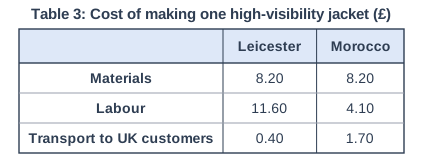
Option 1: move production to a partner factory in Morocco, where wages are much lower. Table 3 compares the cost of making one high-visibility jacket. Lorries would take about four days to bring finished goods to the UK. Most of the Leicester machinists would be made redundant, but 20 staff would be kept to add logos and handle urgent orders.

Option 2: move to a new, energy-efficient factory on a business park on the edge of Leicester, near the M1 motorway. The rent would be 30% higher than the current lease, but heating costs would fall, and lorries could reach the motorway in five minutes instead of 25. All staff would keep their jobs, although some live on the other side of the city and would face a longer journey to work. A city bus route stops at the business park.

Using Table 3, calculate the percentage fall in the cost of making one high-visibility jacket if production moves to Morocco.

Give your answer to one decimal place. Show your workings.

Table 3: Cost of making one high-visibility jacket (£). Table with columns (row headings), "Leicester", "Morocco". Materials; Leicester: 8.20; Morocco: 8.20 | Labour; Leicester: 11.60; Morocco: 4.10 | Transport to UK customers; Leicester: 0.40; Morocco: 1.70.

Model answer

Cost in Leicester = £8.20 + £11.60 + £0.40 = £20.20
Cost in Morocco = £8.20 + £4.10 + £1.70 = £14.00
Fall = £20.20 − £14.00 = £6.20
Percentage fall = £6.20 ÷ £20.20 × 100 = 30.7%

Explanation

Percentage change = (change ÷ original value) × 100, and the original value here is the Leicester cost of £20.20. The labour saving is partly offset by the higher transport cost, so you must total each column first. The most common errors are dividing by the new cost (£14.00) or comparing only the labour costs.

Mark scheme
  1. 1 mark

    Cost in Leicester: £8.20 + £11.60 + £0.40 = £20.20

    Correct answer with no working scores full marks (4).

  2. 1 mark

    Cost in Morocco: £8.20 + £4.10 + £1.70 = £14.00

    Apply the own figure rule (OFR): an error is penalised once; later steps using the wrong figure correctly earn their marks.

  3. 1 mark

    Fall in cost: £20.20 − £14.00 = £6.20 (or labour £7.50 lower and transport £1.30 higher, so £6.20 lower)

    OFR.

  4. 1 mark

    Percentage fall: £6.20 ÷ £20.20 × 100 = 30.7%

    OFR. Answer = 30.7% (4). Accept 30.69%. 31% (not to one decimal place) scores 3. 44.3% (dividing by the Morocco cost of £14.00) scores 3. 64.7% (labour costs only: £7.50 ÷ £11.60 × 100) scores 2. Ignore a minus sign.

Question 4

9 marks

Item A
Severn Mix Concrete Ltd

Severn Mix Concrete Ltd makes ready-mixed concrete at a plant on the edge of Gloucester. Cement, sand and gravel are mixed with water at the plant and taken in mixer lorries to building sites, where the concrete must be poured within two hours of mixing or it starts to set and has to be thrown away. Because of this, the business only accepts orders from sites within about 25 miles. It employs 30 people, including 18 lorry drivers.

Severn Mix has been asked to supply concrete for a new hospital being built near Hereford, about 30 miles away. The contract would last two years and be worth about £3 million in sales. On a good day the journey takes 55 minutes, but traffic on the main road often adds another 30 minutes or more.

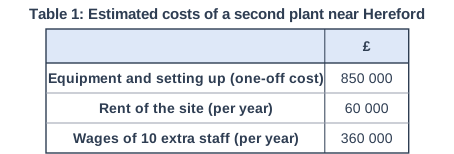
The directors are considering opening a second, smaller plant on an industrial estate near Hereford. Table 1 shows the estimated costs. A rival concrete company already has a plant on the other side of Hereford and supplies most local builders. Sand and gravel would come from a quarry 8 miles from the Hereford site, but cement would still come from the supplier that delivers to Gloucester.

The new plant would need eight lorry drivers and two plant operators. Drivers with the right licence are in short supply, and Severn Mix has struggled to fill vacancies in Gloucester. The managing director thinks it could take three months to recruit and train the staff, and the hospital builders want the first deliveries in four months.

Recommend whether Severn Mix Concrete Ltd should open a second plant near Hereford. Give reasons for your recommendation.

Table 1: Estimated costs of a second plant near Hereford. Table with columns (row headings), "£". Equipment and setting up (one-off cost); £: 850 000 | Rent of the site (per year); £: 60 000 | Wages of 10 extra staff (per year); £: 360 000.

Model answer

Opening a plant near Hereford would put Severn Mix close to its market for the hospital contract. Concrete must be poured within two hours of mixing, and from Gloucester the 30-mile journey takes 55 minutes on a good day and often 30 minutes more in traffic. A local plant would make deliveries short and reliable, so no loads would be wasted and the builders would get concrete when they need it. Sand and gravel would come from a quarry only 8 miles away, keeping raw material costs low. The contract is worth about £3 million, and once the plant is open Severn Mix could also sell to other builders in the Hereford area.

However, the plant is expensive. Table 1 shows setting up costs of £850 000, plus £60 000 rent and £360 000 wages every year, so about £1.69 million over two years before paying for cement, sand and gravel. This uses up more than half of the contract's sales. There is also strong competition: a rival plant already supplies most local builders, so when the hospital is finished the new plant may not have enough work to cover its costs. Labour is another problem. Severn Mix needs eight drivers and two operators, drivers are in short supply, and recruitment could take three of the four months before deliveries start.

I recommend that Severn Mix should open the second plant, but only if it can secure the drivers it needs. Delivering from Gloucester risks wasted loads and late deliveries on an important contract, which could damage its reputation. The plant also gives it a base to compete in a new area for many years, not just for two. To reduce the labour risk, it could move some experienced drivers from Gloucester to Hereford and recruit replacements in Gloucester, where it has more time. The decision depends on the profit margin on the contract; if it is very low, the costs and the strong local competition might make the plant unprofitable.

Explanation

The best answers use several location factors from Item A - proximity to the market, costs, competition, labour and raw materials - and weigh them to reach a clear decision. Using the figures in Table 1, such as the total cost over two years compared with the £3 million contract, strengthens the judgement. Answers that only describe the factors without deciding, or ignore the case, stay in Level 2 or below.

Mark scheme
  1. 9 marks

    Levels of response (9 marks). AO2 = 3, AO3 = 6.
    Level 3 (7-9 marks): Detailed analysis and evaluation of topics based on the context. Sustained line of reasoning, which is coherent, relevant, substantiated with a focused conclusion that is fully justified. Business areas are fully analysed. Applies knowledge and understanding to the context sufficiently.
    Level 2 (4-6 marks): Sound analysis and evaluation of topics based on the context. A line of reasoning, with a conclusion that has some justification. Business areas are partially analysed. Applies some knowledge and understanding to the context.
    Level 1 (1-3 marks): Basic analysis and evaluation of topics based on the context. Basic line of reasoning with a conclusion. Basic analysis of business areas. Basic knowledge and understanding is applied to the context.
    0 marks: nothing to reward.

    Indicative content (not a checklist; credit other valid points): Application: hospital contract worth about £3 million over two years; Table 1 - setting up £850 000 (one-off), rent £60 000 a year, wages of 10 extra staff £360 000 a year, so about £1.69 million over two years before materials; concrete must be poured within two hours; Hereford is 30 miles away, 55 minutes plus 30 minutes or more in traffic; a rival plant in Hereford supplies most local builders; sand and gravel from a quarry 8 miles from the site, but cement from the Gloucester supplier; eight drivers and two plant operators needed, drivers in short supply; recruitment could take three months and first deliveries are needed in four. Analysis - for: a plant near the market means short journeys, so concrete arrives well within the two-hour limit and no loads are wasted; reliable deliveries protect Severn Mix's reputation with the hospital builders; the nearby quarry keeps the cost of sand and gravel low; after the contract the plant could win other work in Hereford, raising long-term sales. Analysis - against: high costs take more than half of the contract's sales before materials, reducing profit; the rival already supplies most local builders, so the plant may have little work after two years; the shortage of drivers means Severn Mix may not have staff in time, risking the first deliveries; cement still has to travel from the Gloucester supplier. Evaluation - what does it depend on? the profit margin on the contract after all costs; whether drivers can be recruited or moved from Gloucester in time; whether Severn Mix can win customers from the rival after the contract; whether deliveries from Gloucester could be timed to avoid traffic instead. Accept any well-argued recommendation. Level 3 needs a sustained line of reasoning using the case and a conclusion that is fully justified. A generic answer that does not use the case cannot go above Level 2, however well developed.

Ready to try the rest? Every answer you write is marked against the mark scheme, so you can see exactly where the marks are.

Study Helper Hints first, answers after you try

Stuck on this one? Ask for a hint and I’ll point you in the right direction, without giving the answer away. Once you’ve checked your answer, I’ll show you how the marks are awarded.