Level:
Correct: 0
Incorrect: 0
Marks: 0/0
Exam Practice
Course:
Topics:
Avg
score:
–
Topics
done:
0/21

Setting business aims and objectives

Practise 17 exam-style questions on Setting business aims and objectives for AQA GCSE Business (Paper 1). Write your answer as you would in the exam and get it marked in seconds against the mark scheme, point by point, with the Study Helper on hand if you get stuck.

  • 17 questions
  • 1–12 marks each
  • Instant marking
  • No sign-up needed
17 questions, marked as you go

Sample questions with model answers

Here are 4 of the questions in this topic, each with a model answer, an explanation of why it earns the marks and the mark scheme an examiner would use.

Question 1

1 mark

Which one of the following best describes the objective of increasing shareholder value?

Choose your answer.

  • Increasing the share price and the dividends paid to shareholders
  • Increasing the number of people who own shares
  • Increasing the business's share of the market
  • Increasing the wages of employees who own shares

Model answer

Increasing the share price and the dividends paid to shareholders

Explanation

Shareholder value is the return the owners of a company get, through a rising share price and higher dividends, so a company aiming to increase it focuses on raising profit. A common mix-up is with market share, which is the business's sales as a percentage of all sales in the market. Having more shareholders does not by itself make each share worth more.

Mark scheme
  1. 1 mark

    Increasing the share price and the dividends paid to shareholders

    Accept 'increasing the share price and dividends'. If more than one option is given, 0 marks.

Question 2

2 marks

Explain one way setting objectives can help a production manager to run a factory.

Model answer

An objective such as 'reduce faulty products to 1% this year' gives the production manager a clear target. She can then plan resources to achieve it, for example by putting more staff time into training and quality checks, and can compare each month's results with the target to see whether further action is needed.

Explanation

One mark is for a way objectives help, such as giving a target, providing a measure of performance or guiding decisions, and the second is for explaining how that helps in the factory. Giving an example of an objective alone does not answer the question. If you use motivation, explain how the objective creates it rather than describing what motivated staff do.

Mark scheme
  1. 1 mark

    Identifies a way: objectives give a clear target or direction / they can be broken down into targets for teams or workers / performance can be measured against them / they help the manager make decisions / they help coordinate different teams or departments

    Accept examples of targets such as 'produce 2 000 units a week' or 'cut waste to 2%' if linked to running the factory.

  2. 1 mark

    Explains how this helps run the factory, eg resources such as staff, machines and materials can be planned to meet the target / everyone works towards the same goal / the manager can see when output or quality falls short and take action / decisions can be judged by whether they help meet the objective

    Examples of developed answers: An objective gives a clear target, such as cutting faulty products to 1% (1), so the manager can focus training and quality checks on achieving it (1). Objectives can be turned into weekly output targets for each team (1), so staff know what they are aiming for and shifts can be planned (1). The manager can measure actual output against the objective (1) and take action, such as adding overtime, if the factory is falling behind (1). If motivation is given as the reason, the explanation must show how the objective leads to it (eg a target to aim for), not just describe the benefits of motivated staff.

Question 3

4 marks

Item A
Corran Candle Company Ltd

Isla started the Corran Candle Company in Fort William in 2019, making soy wax candles by hand in her kitchen. In its first two years her only objective was survival: to sell enough candles to cover her costs and keep the business going. At times she came close to giving up.

The business is now a private limited company with 38 employees and a small factory on an industrial estate. It supplies 300 gift shops across the UK, and its online shop sells to customers in 14 countries. Sales revenue has grown every year and reached £2.1 million last year.

Two large candle manufacturers have recently launched their own ranges of soy candles, which are sold in supermarkets at lower prices. Many of Corran's customers say they choose its candles because they are handmade in Scotland from natural materials.

Isla has now set three new objectives for the next three years:
- to start selling through department stores in Germany and France
- to become the largest maker of handmade candles in Scotland
- to cut the factory's waste by half and use only recyclable packaging.

She has recruited an export manager and is training production staff to work in teams, so that output can rise without lowering the quality of each candle.

Explain one reason why the Corran Candle Company's objectives have changed.

You should use the information in Item A in your answer.

Model answer

One reason Corran's objectives have changed is that the business has grown and its original objective of survival has been achieved. In 2019 Isla was making candles in her kitchen and only aimed to cover her costs, but the business is now a private limited company with 38 employees, a factory and sales revenue of £2.1 million. As it is now established, survival is no longer the main challenge, so Isla has set more ambitious objectives, such as selling through department stores in Germany and France and becoming the largest maker of handmade candles in Scotland. Its online sales to customers in 14 countries show there is already demand abroad, which makes international growth a realistic next objective.

Explanation

A Level 2 answer gives a reason objectives change, such as growth in size, achieving the original objective, new competition or changing customer expectations, and backs it with Item A, for example the move from a kitchen to a factory with 38 staff. Simply listing the new objectives does not explain why they changed. Answers that do not use Corran's details stay in Level 1.

Mark scheme
  1. 4 marks

    Levels of response (4 marks). AO1 = 2, AO2 = 2.
    Level 2 (3-4 marks): Sound understanding and application of the topics. Applies knowledge and understanding to the context sufficiently. A sound understanding of one or more business concepts and issues.
    Level 1 (1-2 marks): Basic understanding and application of the topics. Applies basic knowledge and understanding to the context. A basic understanding of one or more business concepts.
    0 marks: nothing to reward.

    Indicative content (not a checklist; credit other valid points): Knowledge: objectives change as businesses evolve - when the original objectives have been achieved, as the business grows in size, or because of changes in competition or customers' expectations; larger established businesses may aim for international expansion, market dominance and ethical and environmental objectives. Application: started in 2019 in Isla's kitchen with survival as the only objective; now a private limited company with 38 employees, a factory, 300 gift shops and online sales in 14 countries; revenue of £2.1 million; new objectives: department stores in Germany and France (international growth), the largest maker of handmade candles in Scotland (dominance), halving waste and using recyclable packaging (environmental); two large manufacturers now sell cheaper soy candles in supermarkets, so more competition; customers value candles handmade from natural materials (environmental expectations). Level 2 needs one reason, explained and applied to Corran using evidence from Item A. An answer that is not applied to the Corran Candle Company cannot go above Level 1. Only one reason is needed; if more than one is given, credit the best.

Question 4

9 marks

Item A
Pennywell Laundry Services Ltd

Pennywell Laundry Services Ltd is a commercial laundry in Exeter. It washes and irons bed linen, towels and uniforms for 70 hotels, care homes and restaurants in Devon, and employs 85 staff, many of them part-time.

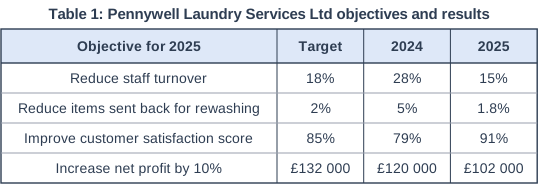
At the start of 2025 the business was losing customers. Staff turnover was high, so many workers were new and still learning, and 5% of items were sent back by customers because they had not been washed or ironed properly. The directors set four objectives for 2025. Table 1 shows the targets and the results.

To achieve the objectives, the directors raised pay for all production staff, introduced a training programme for new workers and spent £60 000 on two new ironing machines. These changes were the main reason that net profit fell in 2025. The pay rise alone has increased the wage bill by £45 000 a year, and this cost will continue in future years.

No customers left Pennywell during 2025, and by the end of the year it had won six new hotel contracts, which start in 2026. The directors expect net profit to rise to about £140 000 in 2026.

Evaluate whether 2025 was a successful year for Pennywell Laundry Services Ltd. Give reasons for your answer.

Table 1: Pennywell Laundry Services Ltd objectives and results. Table with columns "Objective for 2025", "Target", "2024", "2025". Objective for 2025: Reduce staff turnover; Target: 18%; 2024: 28%; 2025: 15% | Objective for 2025: Reduce items sent back for rewashing; Target: 2%; 2024: 5%; 2025: 1.8% | Objective for 2025: Improve customer satisfaction score; Target: 85%; 2024: 79%; 2025: 91% | Objective for 2025: Increase net profit by 10%; Target: £132 000; 2024: £120 000; 2025: £102 000.

Model answer

In many ways 2025 was a successful year for Pennywell, because it met all three of its non-financial objectives. Staff turnover fell from 28% to 15%, beating the target of 18%. This matters because, at the start of the year, many workers were new and still learning, which was one reason so many items were sent back. With more experienced staff and the new training programme, items sent back for rewashing fell from 5% to 1.8%, better than the 2% target. As a result, customer satisfaction rose from 79% to 91%, well above the 85% target. These results show that the business has fixed the problem that was making it lose customers: no customers left during 2025, and it has won six new hotel contracts starting in 2026.

However, Pennywell missed its profit objective badly. It aimed to increase net profit by 10% to £132 000, but net profit fell from £120 000 to £102 000, a fall of 15%. Higher pay, the training programme and the £60 000 spent on two new ironing machines all increased costs, and the pay rise will keep adding £45 000 a year to the wage bill. If profit kept falling, the business would have less money to reinvest, and the owners might lose confidence in the directors.

Overall, I think 2025 was a successful year. The fall in profit was caused mainly by decisions to invest in staff and machines, which are the reasons the other objectives were met. The machines have now been paid for, lower staff turnover reduces recruitment and training costs, and the six new contracts will bring in extra revenue from 2026, which is why the directors expect profit to rise to about £140 000. Success can be measured in other ways than profit, and Pennywell is in a much stronger position than a year ago. This judgement depends on the new contracts delivering that higher profit despite the permanent rise in wages. If profit does not recover in 2026, the 2025 results would look much less successful.

Explanation

Top-level answers judge success against each objective in Table 1, explain how the results are linked (lower staff turnover led to fewer items sent back, which raised satisfaction and won contracts) and weigh this against the 15% fall in profit and the lasting £45 000 rise in wages. The conclusion must follow from that weighing and say what it depends on. Answers that only list which targets were met, without analysis or a justified judgement, stay in Level 1 or 2.

Mark scheme
  1. 9 marks

    Levels of response (9 marks). AO2 = 3, AO3 = 6.
    Level 3 (7-9 marks): Detailed analysis and evaluation of topics based on the context. Sustained line of reasoning, which is coherent, relevant, substantiated with a focused conclusion that is fully justified. Business areas are fully analysed. Applies knowledge and understanding to the context sufficiently.
    Level 2 (4-6 marks): Sound analysis and evaluation of topics based on the context. A line of reasoning, with a conclusion that has some justification. Business areas are partially analysed. Applies some knowledge and understanding to the context.
    Level 1 (1-3 marks): Basic analysis and evaluation of topics based on the context. Basic line of reasoning with a conclusion. Basic analysis of business areas. Basic knowledge and understanding is applied to the context.
    0 marks: nothing to reward.

    Indicative content (not a checklist; credit other valid points): Application: Table 1 - staff turnover fell from 28% to 15% (target 18%, met); items sent back fell from 5% to 1.8% (target 2%, met); customer satisfaction rose from 79% to 91% (target 85%, met); net profit fell from £120 000 to £102 000, a fall of 15% (target £132 000, missed by £30 000); the pay rise, training programme and £60 000 on two ironing machines caused most of the fall; the pay rise adds £45 000 a year to the wage bill permanently; no customers left in 2025; six new hotel contracts start in 2026; the directors expect net profit of about £140 000 in 2026. Analysis - successful: three of the four objectives were met or beaten; lower staff turnover means more experienced staff and lower recruitment and training costs, which led to fewer items sent back and higher customer satisfaction, so the business stopped losing customers and won six contracts, which should raise revenue and profit in 2026; success can be measured in ways other than profit. Analysis - not successful: the profit objective was badly missed, a 15% fall instead of a 10% rise; the extra £45 000 a year in wages continues, so costs stay higher; lower profit leaves less to reinvest or pay to the owners; the 2026 profit is only a forecast. Evaluation - what does it depend on? whether the new contracts deliver the forecast profit; how much of the fall in profit was one-off (machines, training) and how much is lasting (higher pay); which objectives matter most to the owners; whether the improvements last. Accept any well-argued judgement. Level 3 needs a sustained line of reasoning using the data in Table 1 and Item A, with a conclusion that is fully justified. A generic answer that does not use the case cannot go above Level 2, however well developed.

Ready to try the rest? Every answer you write is marked against the mark scheme, so you can see exactly where the marks are.

Study Helper Hints first, answers after you try

Stuck on this one? Ask for a hint and I’ll point you in the right direction, without giving the answer away. Once you’ve checked your answer, I’ll show you how the marks are awarded.