Level:
Correct: 0
Incorrect: 0
Marks: 0/0
Exam Practice
Course:
Topics:
Avg
score:
–
Topics
done:
0/21

Competitive environment

Practise 17 exam-style questions on Competitive environment for AQA GCSE Business (Paper 1). Write your answer as you would in the exam and get it marked in seconds against the mark scheme, point by point, with the Study Helper on hand if you get stuck.

  • 17 questions
  • 1–12 marks each
  • Instant marking
  • No sign-up needed
17 questions, marked as you go

Sample questions with model answers

Here are 4 of the questions in this topic, each with a model answer, an explanation of why it earns the marks and the mark scheme an examiner would use.

Question 1

1 mark

A printing firm faces a new competitor that sells similar products at lower prices.

Which one of the following is the most likely impact on the printing firm?

Choose your answer.

  • It can raise its prices without losing customers
  • It will need to find ways to reduce its costs of production
  • Its market share is certain to increase
  • It can lower the quality of its products without losing sales

Model answer

It will need to find ways to reduce its costs of production

Explanation

When a rival offers similar products for less, a business must become more efficient so that it can match the price, or offer better quality or service, without losing its profit. Raising prices or lowering quality would drive customers to the rival, and a new competitor usually reduces a firm's market share rather than increasing it. Competition therefore puts pressure on costs, quality and efficiency.

Mark scheme
  1. 1 mark

    It will need to find ways to reduce its costs of production

    Accept 'it needs to reduce its costs'. If more than one option is given, 0 marks.

Question 2

2 marks

Explain one reason why all businesses face uncertainty.

Model answer

The economic climate can change in ways a business cannot predict, for example unemployment may rise. This means customers may have less money to spend, so the business cannot be sure what its future sales will be.

Explanation

All businesses work in a changing environment: the economy, technology, laws, competitors and customer tastes can all change without warning. The first mark is for naming one such source of change and the second for showing its effect on the business, such as falling demand or rising costs. 'The future is unknown' on its own is too vague to earn a mark.

Mark scheme
  1. 1 mark

    Identifies a source of change that cannot be predicted: changes in the economic climate (eg interest rates, unemployment, consumer spending) / changes in technology / changes in legislation / actions of competitors (eg a new rival opening) / changes in consumer tastes or fashions / changing environmental expectations / problems with suppliers / key staff leaving

    Do not accept 'the future is unknown' or 'things change' on their own: a specific reason must be identified.

  2. 1 mark

    Explains how this creates uncertainty for the business, eg demand or sales may fall unexpectedly / costs may rise / production methods or products may become out of date / the business may need to retrain staff or buy new equipment

    Examples of developed answers: 'The economic climate can change, eg unemployment may rise (1), so customers may spend less and the business cannot be sure what its sales will be (1).' 'A competitor may open nearby (1), which could take customers and reduce the business's revenue (1).' 'New laws may be introduced (1), such as safety rules that mean the business must pay to train its staff (1).' Max 2.

Question 3

4 marks

Item A
Strathcairn Turbine Care Ltd

Strathcairn Turbine Care Ltd, based in Thurso in the far north of Scotland, inspects, services and repairs wind turbines. Its customers are the owners of 14 onshore wind farms across Caithness and Sutherland, which have 310 turbines between them. Each owner has a five-year service contract, which requires Strathcairn to reach a broken turbine within 48 hours. If it is late, it pays the owner £500 for each extra day, because a stopped turbine loses about £1 500 of electricity sales a day.

Strathcairn is the only business in the north of Scotland approved by the manufacturer of these turbines to service them. Gaining approval took three years, and every technician must hold the manufacturer's certificate. The nearest other approved business is in Glasgow, more than 250 miles away. Strathcairn also owns the only crane in the area that can lift a turbine's gearbox, which cost £1.2 million.

Strathcairn employs 42 technicians. They must hold working-at-height and rescue certificates, and training a new technician takes 18 months and costs about £25 000. Last year two experienced technicians retired and three left for jobs on offshore wind farms that pay about 20% more. Nine of the 42 technicians are over 55.

The work is dangerous. Last winter a technician was injured when a strong gust of wind struck while he was working at the top of a turbine, and the Health and Safety Executive investigated. Snow and storms can make some sites impossible to reach for several days. The turbine manufacturer has announced that it will set up its own service team in Scotland from 2028, and the contracts for six of the 14 wind farms come up for renewal next year.

Explain one reason why Strathcairn Turbine Care Ltd faces minimal competition.

You should use the information in Item A in your answer.

Model answer

Strathcairn faces minimal competition because it is the only business in the north of Scotland approved by the turbine manufacturer to service these turbines. Gaining approval took three years and every technician needs the manufacturer's certificate, so a new rival could not start competing quickly. The nearest other approved business is more than 250 miles away in Glasgow, which would make it very hard to reach a broken turbine within the 48 hours the contracts require, especially in winter. A stopped turbine loses its owner about £1 500 of electricity sales a day, so owners need a contractor close by. Strathcairn also owns the only crane in the area that can lift a gearbox, a £1.2 million barrier to any new rival.

Explanation

The top level needs a reason why rivals cannot or do not compete, explained with evidence from the case, such as the manufacturer's approval, the distance to the nearest approved rival or the £1.2 million crane. Simply saying 'it has no competitors' describes the situation rather than explaining it. One well-explained reason is enough for full marks.

Mark scheme
  1. 4 marks

    Levels of response (4 marks). AO1 = 2, AO2 = 2.
    Level 2 (3-4 marks): Sound understanding and application of the topics. Applies knowledge and understanding to the context sufficiently. A sound understanding of one or more business concepts and issues.
    Level 1 (1-2 marks): Basic understanding and application of the topics. Applies basic knowledge and understanding to the context. A basic understanding of one or more business concepts.
    0 marks: nothing to reward.

    Indicative content (not a checklist; credit other valid points): Knowledge: businesses face minimal or no competition when rivals are prevented from entering the market (eg by an approval, licence or patent), when it is very expensive or slow to set up, when the business is far from any rival, or when the market is too small to support more than one business. Application: Strathcairn is the only business in the north of Scotland approved by the turbine manufacturer - approval took three years and every technician needs the manufacturer's certificate, so a rival cannot start quickly; the nearest other approved business is in Glasgow, more than 250 miles away, so it would struggle to reach a broken turbine within the 48 hours the contracts require, especially when snow and storms block access; late arrival costs £500 a day in penalties and owners lose about £1 500 of electricity sales a day, so owners want a contractor close by; Strathcairn owns the only crane in the area that can lift a gearbox, which cost £1.2 million - a huge cost for a new business to enter; skilled technicians take 18 months and about £25 000 each to train, so building a rival workforce is slow and expensive; the market is small (14 wind farms, 310 turbines), so there may not be enough work for two contractors. Level 2 (3-4 marks): one reason is clearly explained, using evidence from Item A, and linked to why rivals cannot or do not compete. Level 1 (1-2 marks): a basic reason (eg 'it is the only approved business') with little explanation, or a generic reason not linked to the case. An answer not applied to Strathcairn cannot go above Level 1. Do not credit 'it has no competitors' on its own as a reason, as this restates the situation.

Question 4

9 marks

Item A
Tidemark Linen Services Ltd

Tidemark Linen Services Ltd is a private limited company in Blackpool. It collects, washes, dries and irons bed linen and towels for hotels and guest houses. It employs 35 staff, most of whom work a day shift from 7am to 3pm. Its washing machines are 12 years old, and laundry is returned to customers within 48 hours of collection.

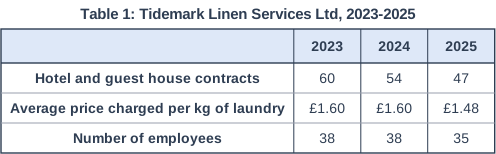
Until 2023 Tidemark was the only commercial laundry in the area. In 2024 a large national laundry group opened a highly automated plant in Preston, 18 miles away. The new rival offers next-day delivery and charges lower prices, because its machines need fewer workers. Several hotel owners told Tidemark that they had moved because they could not wait two days for clean sheets in the busy summer season. Table 1 shows information about Tidemark from 2023 to 2025.

The managing director, Gareth, wants to win back customers. He is considering a same-day service for laundry collected before 10am. This would need an evening shift of eight new employees, who would be paid an extra £1.50 an hour for working late, and two faster drying machines costing £60 000 in total. Gareth would pay for the machines from the company's savings of £75 000.

Two supervisors have warned that recruiting an evening shift could be difficult, because local hotels, bars and restaurants also need evening staff. Most of Tidemark's customers are busiest from May to September, and many guest houses close between November and February.

Recommend whether Tidemark Linen Services Ltd should introduce the same-day service. Give reasons for your recommendation.

Table 1: Tidemark Linen Services Ltd, 2023-2025. Table with columns (row headings), "2023", "2024", "2025". Hotel and guest house contracts; 2023: 60; 2024: 54; 2025: 47 | Average price charged per kg of laundry; 2023: £1.60; 2024: £1.60; 2025: £1.48 | Number of employees; 2023: 38; 2024: 38; 2025: 35.

Model answer

A same-day service would give Tidemark a clear advantage over its rival. Hotels left because they could not wait 48 hours for clean sheets in the summer, and the Preston plant only offers next-day delivery. If Tidemark can return laundry on the same day, it would be faster than its competitor, so it would no longer have to compete only on price. This could win back some of the 13 contracts it lost between 2023 and 2025, and it might be able to stop cutting its price, which has already fallen from £1.60 to £1.48 per kg. More contracts would mean more revenue to cover its costs.

However, the service is expensive and risky. The two drying machines cost £60 000, which would use 80% of the company's £75 000 savings, leaving only £15 000 if something goes wrong, such as a breakdown or a further fall in sales. Tidemark would also have to pay eight new employees an extra £1.50 an hour. The supervisors' warning matters too: local hotels, bars and restaurants also want evening staff, so Tidemark may struggle to recruit. If the evening shift is short-staffed, the same-day promise will be broken and Tidemark's reputation will be damaged further.

Demand is also seasonal. Customers are busiest from May to September, but many guest houses close from November to February, so in winter the evening shift may have little to do while still being paid, which would raise Tidemark's costs.

I recommend that Tidemark should introduce the same-day service, but only in the busy season at first. Speed is the reason hotels gave for leaving, so this tackles the real cause of the lost contracts, whereas cutting prices further is a battle the lower-cost rival will win. To reduce the risk, Gareth could recruit the evening staff on seasonal or part-time contracts from May to September, so wage costs fall in winter. The decision depends on whether enough hotels would come back, so Gareth should ask his former customers before spending the £60 000.

Explanation

Top-level answers weigh the benefit of competing on speed against the costs and risks shown in the case - the £60 000 from savings, recruitment problems and seasonal demand - and reach a clear decision that follows from that argument. A useful approach is to say what the decision depends on and how the risks could be reduced, such as seasonal contracts. Answers that discuss same-day services in general without Tidemark's figures cannot reach Level 3.

Mark scheme
  1. 9 marks

    Levels of response (9 marks). AO2 = 3, AO3 = 6.
    Level 3 (7-9 marks): Detailed analysis and evaluation of topics based on the context. Sustained line of reasoning, which is coherent, relevant, substantiated with a focused conclusion that is fully justified. Business areas are fully analysed. Applies knowledge and understanding to the context sufficiently.
    Level 2 (4-6 marks): Sound analysis and evaluation of topics based on the context. A line of reasoning, with a conclusion that has some justification. Business areas are partially analysed. Applies some knowledge and understanding to the context.
    Level 1 (1-3 marks): Basic analysis and evaluation of topics based on the context. Basic line of reasoning with a conclusion. Basic analysis of business areas. Basic knowledge and understanding is applied to the context.
    0 marks: nothing to reward.

    Indicative content (not a checklist; credit other valid points): Application: the rival offers next-day delivery and lower prices; Tidemark takes 48 hours; hotels left because they could not wait two days in summer; contracts fell from 60 to 47 and the average price was cut from £1.60 to £1.48 per kg; the same-day service needs an evening shift of eight new employees paid an extra £1.50 an hour, and two drying machines costing £60 000 paid from savings of £75 000 (80% of the savings, leaving £15 000); supervisors warn that recruiting evening staff will be difficult because hotels, bars and restaurants also need evening staff; demand is busiest May to September and many guest houses close November to February. Analysis (for): same-day would be faster than the rival's next-day service, so Tidemark competes on speed rather than price, which a rival with lower costs can always beat; this could win back some of the 13 lost contracts and stop further price cuts, raising revenue; using savings avoids interest on a loan; faster dryers increase capacity. Analysis (against): the machines use most of the savings, leaving little cash if sales fall further or a machine breaks; eight extra wages plus the evening premium raise costs; if the shift cannot be recruited the same-day promise is broken and reputation suffers further; in winter the evening shift may be idle but still paid, raising costs per kg; the rival may respond with its own same-day service. Evaluation - what does it depend on?: how many former customers would return or pay more for same-day; whether evening staff can be recruited (eg higher pay, seasonal or part-time contracts); whether the service could run only from May to September; how the rival responds. Either recommendation is acceptable if justified, eg introduce it for the summer season only on seasonal contracts, or do not introduce it because the savings and recruitment risks are too great. Level 3 needs a sustained, balanced argument using the case evidence and a justified recommendation. A generic answer that does not use the case cannot go above Level 2, however well developed; AQA's June 2023 examiners' report for 8132/1 says generic answers 'even if fully developed will only be awarded sound'.

Ready to try the rest? Every answer you write is marked against the mark scheme, so you can see exactly where the marks are.

Study Helper Hints first, answers after you try

Stuck on this one? Ask for a hint and I’ll point you in the right direction, without giving the answer away. Once you’ve checked your answer, I’ll show you how the marks are awarded.