Level:
Correct: 0
Incorrect: 0
Marks: 0/0
Exam Practice
Course:
Topics:
Avg
score:
–
Topics
done:
0/21

Stakeholders

Practise 17 exam-style questions on Stakeholders for AQA GCSE Business (Paper 1). Write your answer as you would in the exam and get it marked in seconds against the mark scheme, point by point, with the Study Helper on hand if you get stuck.

  • 17 questions
  • 1–12 marks each
  • Instant marking
  • No sign-up needed
17 questions, marked as you go

Sample questions with model answers

Here are 4 of the questions in this topic, each with a model answer, an explanation of why it earns the marks and the mark scheme an examiner would use.

Question 1

1 mark

A food factory plans to add a night shift so that it can produce 24 hours a day.

Which stakeholder group is most likely to object to this plan because of noise?

Choose your answer.

  • Shareholders
  • Suppliers
  • Local community
  • Customers

Model answer

Local community

Explanation

People who live near the factory want to minimise its environmental impact, including noise from machinery and lorries at night. Shareholders, suppliers and customers are likely to welcome extra output, because it can mean more profit, more orders for supplies and more products available to buy.

Mark scheme
  1. 1 mark

    Local community

    If more than one option is given, 0 marks.

Question 2

2 marks

Explain the meaning of the term 'stakeholder' using an example.

Model answer

A stakeholder is any individual or group that has an interest in a business or is affected by what it does. For example, the employees of a factory are stakeholders because their pay and job security depend on the business.

Explanation

The description earns one mark and the example earns the other. The most common mistake is to confuse a stakeholder with a shareholder: shareholders are stakeholders, but so are employees, customers, suppliers and the local community.

Mark scheme
  1. 1 mark

    A description: an individual or group with an interest in a business / who is affected by the activities of a business / who can affect (or influence) the business

    Do not accept 'a person who owns shares in a business' - that is a shareholder, which is only one type of stakeholder.

  2. 1 mark

    A valid example: owners / shareholders / employees / customers / suppliers / the local community / the government / lenders such as banks / pressure groups

    Only one example is needed. Accept a specific example, eg 'the workers in a factory' or 'people living next to a factory'.

Question 3

4 marks

Item C
Thornwell Brickworks Ltd

Thornwell Brickworks Ltd has made bricks in the village of Coleby Moor, Leicestershire, for more than 100 years. It digs clay from its own quarry next to the works and fires the bricks in two gas kilns. It employs 85 people, and about two-thirds of them live within five miles of the works.

Demand from housebuilders has risen and the order book is full for the next 18 months. The directors want to extend the quarry onto a neighbouring field and build a third kiln that would run 24 hours a day. This would create 22 new jobs and increase output by 40%. The plan needs planning permission from the district council, which will consider residents' views before it decides.

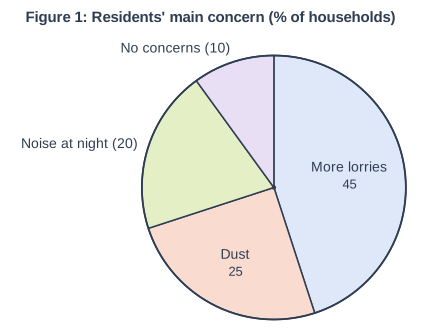
Lorries already make about 60 trips a day through the village, past the primary school. At a public meeting, many residents said the works had always been a good neighbour but that the village could not take more lorries. Figure 1 shows the results of a survey of 240 households carried out by the parish council.

To reduce the impact on the village, the directors have offered to build a new access road so that lorries avoid the village centre. The road would cost £650 000. Most of the shareholders are retired former managers and their families, who rely on the dividend for part of their income. Paying for the road would mean no dividend for at least one year.

Explain one way in which the local community could influence Thornwell Brickworks Ltd's plan.

You should use the information in Item C in your answer.

Figure 1: Residents' main concern (% of households). Pie chart. A circle divided into sectors, drawn clockwise from the top (12 o'clock): More lorries (45 printed in it), 162°; Dust (25 printed in it), 90°; Noise at night (20 printed in it), 72°; No concerns (10 printed in it), 36°. (Angles are not printed on the chart; these are the drawn sizes, which can be measured with a protractor.)

Model answer

The local community could influence the plan by objecting to the planning application. The extension needs planning permission from the district council, which will consider residents' views before it decides. Figure 1 shows that 90% of the 240 households surveyed have a concern about the plan, and 45% say their main concern is more lorries, which already make about 60 trips a day past the primary school. If many residents object, the council could refuse permission or set conditions, such as limits on lorry trips or night working at the new kiln. This pressure has already influenced the directors, who have offered to build a £650 000 access road.

Explanation

To reach Level 2, explain how the community's views could change what the business does and support it with evidence from Item C, such as the planning permission, the survey results or the offer of an access road. A general statement such as 'residents could complain' is only Level 1. Remember the question is about the community influencing the business, not the business affecting the community.

Mark scheme
  1. 4 marks

    Levels of response (4 marks). AO1 = 2, AO2 = 2.
    Level 2 (3-4 marks): Sound understanding and application of the topics. Applies knowledge and understanding to the context sufficiently. A sound understanding of one or more business concepts and issues.
    Level 1 (1-2 marks): Basic understanding and application of the topics. Applies basic knowledge and understanding to the context. A basic understanding of one or more business concepts.
    0 marks: nothing to reward.

    Indicative content (not a checklist; credit other valid points): Knowledge and application: the local community wants to minimise the environmental impact of the works (lorries, dust, noise). Objecting to the planning application: the plan needs planning permission and the district council will consider residents' views; Figure 1 shows 90% of the 240 households surveyed have a concern, with 45% most worried about more lorries; the council could refuse permission or attach conditions, eg limits on lorry trips or night working. Pressure and publicity: the public meeting and the parish council survey put pressure on the directors, who have already offered a £650 000 access road; lorries pass the primary school, which makes the issue more serious. Recruitment: about two-thirds of the 85 employees live within five miles, so bad local relations could make it harder to recruit the 22 new workers. Level 2 needs one way, explained and applied to Thornwell Brickworks using evidence from Item C. An answer that is not applied to Thornwell Brickworks cannot go above Level 1. Only one way is needed; if more than one is given, credit the best.

Question 4

9 marks

Item A
Penhallow Pasties Ltd

Penhallow Pasties Ltd is a family-owned private limited company in Redruth, Cornwall. It makes handmade pasties using beef, potatoes and swede bought from farms within 30 miles of its bakery. It employs 64 production workers, most of whom live in the town, and the bakery works from Monday to Friday, 6 am to 4 pm.

Two years ago a supermarket chain began selling Penhallow's pasties in 40 of its stores in the South West. The bakery is now working at full capacity. The supermarket has asked for an extra 6 000 pasties each weekend, when its sales of pasties are highest, and has said it may look for another supplier if Penhallow cannot help.

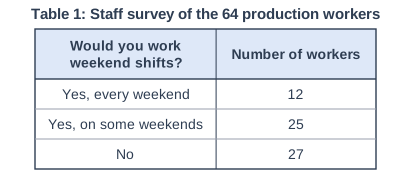
The managing director, Morwenna, is considering opening the bakery on Saturdays and Sundays. Weekend shifts would be paid at time-and-a-half, and workers would choose whether to take them. Table 1 shows the results of a staff survey. If not enough staff volunteer, Penhallow would need to recruit and train new bakers, which takes about six weeks.

The bakery is on a small industrial estate next to a housing estate. Delivery lorries currently arrive and leave only on weekdays. Some residents have already complained to the local council about lorries parking on their street early in the morning.

The farms that supply Penhallow have said they can provide the extra ingredients, but the potato grower wants to be paid within 14 days instead of the current 30 days.

The shareholders, who are all members of Morwenna's family, received no dividend last year because the profit was used to buy a second oven.

Recommend whether Penhallow Pasties Ltd should open the bakery at weekends. Give reasons for your recommendation.

Table 1: Staff survey of the 64 production workers. Table with columns "Would you work weekend shifts?", "Number of workers". Would you work weekend shifts?: Yes, every weekend; Number of workers: 12 | Would you work weekend shifts?: Yes, on some weekends; Number of workers: 25 | Would you work weekend shifts?: No; Number of workers: 27.

Model answer

Opening at weekends would help Penhallow keep its most important customer. The supermarket sells its pasties in 40 stores and wants an extra 6 000 pasties each weekend, when its sales are highest. The bakery is already at full capacity on weekdays, so weekend production is the only way to meet this demand. If Penhallow refuses, the supermarket may find another supplier, and Penhallow could lose not just the weekend order but possibly the whole contract, which would put jobs at risk. Extra sales would raise revenue and profit, which matters to the family shareholders because they received no dividend last year.

Weekend shifts would also meet the objectives of many employees. Table 1 shows that 37 of the 64 workers are willing to work weekends, and time-and-a-half pay would increase their earnings.

However, there are drawbacks. Time-and-a-half wages raise the labour cost of each weekend pasty, so the profit on each one will be lower than on a weekday. Only 12 workers will work every weekend and 27 will not work weekends at all, so Penhallow may have to recruit and train new bakers, which takes six weeks and adds cost. Residents already complain about lorries parking on their street, and weekend deliveries could lead to more complaints to the council. The potato grower also wants to be paid in 14 days instead of 30, which would put pressure on cash flow.

Overall, I recommend that Penhallow should open at weekends. The risk of losing a customer that sells its pasties in 40 stores is greater than the extra costs, and even at time-and-a-half the extra 6 000 pasties a weekend should add to profit and allow a dividend. However, this depends on enough staff volunteering. Penhallow should start with the 37 volunteers, recruit a few weekend bakers, and agree delivery times with residents, such as lorries waiting on the industrial estate, so that conflict with the local community is kept low.

Explanation

Top-level answers weigh the benefits for some stakeholders (the supermarket, the shareholders and the workers who want extra pay) against the costs and the conflict with others (unwilling staff, residents and the potato grower), using the figures in Item A. The recommendation must follow from that weighing and say what it depends on. Answers that list advantages and disadvantages without reaching a justified decision stay in Level 2.

Mark scheme
  1. 9 marks

    Levels of response (9 marks). AO2 = 3, AO3 = 6.
    Level 3 (7-9 marks): Detailed analysis and evaluation of topics based on the context. Sustained line of reasoning, which is coherent, relevant, substantiated with a focused conclusion that is fully justified. Business areas are fully analysed. Applies knowledge and understanding to the context sufficiently.
    Level 2 (4-6 marks): Sound analysis and evaluation of topics based on the context. A line of reasoning, with a conclusion that has some justification. Business areas are partially analysed. Applies some knowledge and understanding to the context.
    Level 1 (1-3 marks): Basic analysis and evaluation of topics based on the context. Basic line of reasoning with a conclusion. Basic analysis of business areas. Basic knowledge and understanding is applied to the context.
    0 marks: nothing to reward.

    Indicative content (not a checklist; credit other valid points): Application: the supermarket sells Penhallow's pasties in 40 stores and wants an extra 6 000 pasties each weekend; it may look for another supplier; the bakery is at full capacity on weekdays; weekend shifts at time-and-a-half; Table 1: 37 of 64 workers willing (only 12 every weekend), 27 not willing; recruiting and training new bakers takes about six weeks; residents have complained to the council about lorries parking early in the morning; the potato grower wants payment in 14 days instead of 30; the family shareholders received no dividend last year. Analysis - for: extra sales raise revenue and profit, so the family shareholders could receive a dividend; meeting the customer's needs protects the supermarket contract and the jobs that depend on it; employees who volunteer earn more, meeting their objective of maximising pay; local farms (suppliers) sell more ingredients. Analysis - against: time-and-a-half wages raise the cost of each weekend pasty, reducing the profit on each one; with only 12 workers willing every weekend and 27 refusing, Penhallow may need to recruit and train staff, adding cost and delay; tired staff could lower the quality of handmade pasties; weekend lorries could increase conflict with the local community and lead to more complaints to the council; paying the potato grower in 14 days puts pressure on cash flow. Evaluation - what does it depend on? whether enough workers volunteer for every weekend; whether the extra revenue covers the time-and-a-half wages; how much of Penhallow's sales come from the supermarket and how likely it is to switch supplier; whether delivery times can be arranged to avoid disturbing residents. Accept any well-argued recommendation. Level 3 needs a sustained line of reasoning using the case and a conclusion that is fully justified, for example weighing the risk of losing the supermarket against higher wage costs and stakeholder conflict. A generic answer that does not use the case cannot go above Level 2, however well developed.

Ready to try the rest? Every answer you write is marked against the mark scheme, so you can see exactly where the marks are.

Study Helper Hints first, answers after you try

Stuck on this one? Ask for a hint and I’ll point you in the right direction, without giving the answer away. Once you’ve checked your answer, I’ll show you how the marks are awarded.