Level:
Correct: 0
Incorrect: 0
Marks: 0/0
Exam Practice
Course:
Topics:
Avg
score:
–
Topics
done:
0/21

Expanding a business

Practise 17 exam-style questions on Expanding a business for AQA GCSE Business (Paper 1). Write your answer as you would in the exam and get it marked in seconds against the mark scheme, point by point, with the Study Helper on hand if you get stuck.

  • 17 questions
  • 1–12 marks each
  • Instant marking
  • No sign-up needed
17 questions, marked as you go

Sample questions with model answers

Here are 4 of the questions in this topic, each with a model answer, an explanation of why it earns the marks and the mark scheme an examiner would use.

Question 1

1 mark

As a business grows, which one of the following is most likely to cause diseconomies of scale?

Choose your answer.

  • Messages passing through more layers of management
  • Buying raw materials in bulk
  • Using faster automated machinery
  • Spreading fixed costs over more units

Model answer

Messages passing through more layers of management

Explanation

Diseconomies of scale are rises in average unit costs caused by a business becoming too large, and poor communication is one of the main causes: messages passed through more layers are slower and more likely to be misunderstood. Buying in bulk and using faster machinery are purchasing and technical economies of scale, and spreading fixed costs over more units lowers average unit costs. A common mistake is to think that any growth must raise unit costs.

Mark scheme
  1. 1 mark

    Messages passing through more layers of management

    Accept a clear shortened form, e.g. 'more layers of management'. If more than one option is given, 0 marks.

Question 2

2 marks

Explain one way that coordination problems can increase a business's average unit costs as it grows.

Model answer

As a business grows, its departments may not coordinate their work. For example, the production department may plan a large run without the purchasing department ordering enough materials, so machines and workers stand idle while still being paid. Costs are paid but fewer units are made, so the average unit cost rises.

Explanation

Coordination issues are one of the causes of diseconomies of scale: as a business gets larger it becomes harder to make sure all its parts work together. To gain the second mark, the answer must explain how this pushes up the cost of each unit, not just say the business becomes 'less efficient'.

Mark scheme
  1. 1 mark

    Identifying a coordination problem caused by growth: departments, sites or shifts do not know what each other are doing / work is duplicated / production is not matched to deliveries of materials or to orders / different sites use different methods or standards / one department's decisions conflict with another's

    Max 1. It must be a coordination problem, not just 'the business gets bigger'. Poor communication can be credited if it is used to show activities not being coordinated.

  2. 1 mark

    Explaining how this raises costs per unit: the same work is done twice, so more labour or materials are used per unit / machines and workers stand idle while still being paid / products have to be remade / extra managers must be employed to coordinate, so costs rise faster than output

    Max 1. The second mark needs a link to higher costs per unit, or to costs rising faster than output; 'the business becomes less efficient' alone is not enough. Examples of developed answers: Two departments may order the same materials without knowing (1), so money is wasted and the cost of each unit rises (1). Production may not be matched to deliveries of materials (1), so workers are paid while machines stand idle, which raises the cost per unit (1).

Question 3

4 marks

Item B
Rivelin & Shaw Print Ltd

Rivelin & Shaw Print Ltd is a printing company in Sheffield. It prints leaflets, catalogues and cardboard packaging for other businesses. In 2021 it had 18 employees who all worked on one day shift, and the founder, Gareth, knew every worker by name and spoke to them each morning.

After winning contracts with two national retailers, the business has grown quickly. In 2023 it bought a new digital press for £650 000. The press is four times faster than the old machines, can be run by one operator, and checks colours automatically, so far less paper and ink is wasted at the start of each job. The factory now runs 24 hours a day on three shifts and Rivelin & Shaw employs 75 staff.

Gareth now spends most of his time meeting customers. He has appointed three shift managers, who report to a new operations director. Changes to customers' orders are emailed to the shift managers, who pass them on to their teams. Last month two large orders were printed with out-of-date artwork because the night shift did not hear about a change to the order in time. Both orders had to be printed again at Rivelin & Shaw's cost.

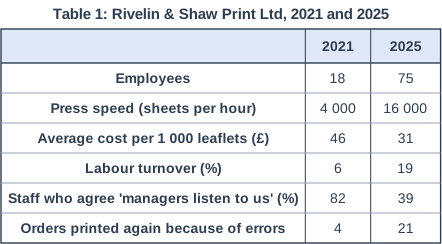
Table 1 shows information about Rivelin & Shaw Print Ltd in 2021 and 2025.

Explain one technical economy of scale that Rivelin & Shaw Print Ltd has gained as it has grown.

You should use the information in Item B in your answer.

Table 1: Rivelin & Shaw Print Ltd, 2021 and 2025. Table with columns (row headings), "2021", "2025". Employees; 2021: 18; 2025: 75 | Press speed (sheets per hour); 2021: 4 000; 2025: 16 000 | Average cost per 1 000 leaflets (£); 2021: 46; 2025: 31 | Labour turnover (%); 2021: 6; 2025: 19 | Staff who agree 'managers listen to us' (%); 2021: 82; 2025: 39 | Orders printed again because of errors; 2021: 4; 2025: 21.

Model answer

A technical economy of scale is a fall in average unit cost that comes from a large business being able to use bigger or more advanced equipment. Because Rivelin & Shaw Print has grown, it could afford a £650 000 digital press. The press prints 16 000 sheets an hour, four times as many as the old machines, and needs only one operator, so the labour cost of each job is spread over far more leaflets. It also checks colours automatically, so less paper and ink are wasted. As a result, Rivelin & Shaw's average cost per 1 000 leaflets has fallen from £46 to £31, so it can make more profit on each order or offer lower prices to win contracts.

Explanation

Level 2 needs a clear technical economy (better equipment lowering the cost per unit) applied to Rivelin & Shaw's press, ideally using the fall from £46 to £31 per 1 000 leaflets as evidence. A common pitfall is to describe bulk buying, which is a purchasing economy, or to list the case facts without explaining how they lower the cost of each unit.

Mark scheme
  1. 4 marks

    Levels of response (4 marks). AO1 = 2, AO2 = 2.
    Level 2 (3-4 marks): Sound understanding and application of the topics. Applies knowledge and understanding to the context sufficiently. A sound understanding of one or more business concepts and issues.
    Level 1 (1-2 marks): Basic understanding and application of the topics. Applies basic knowledge and understanding to the context. A basic understanding of one or more business concepts.
    0 marks: nothing to reward.

    Indicative content (not a checklist; credit other valid points): Knowledge: technical economies of scale are the falls in average unit cost that a business gains as it grows because it can afford larger, faster or more advanced equipment or production methods. Application: Rivelin & Shaw has grown from 18 to 75 employees and bought a £650 000 digital press; the press is four times faster (4 000 to 16 000 sheets per hour), so costs are spread over many more leaflets; it can be run by one operator, so the labour cost of each job falls; it checks colours automatically, so less paper and ink are wasted at the start of each job; the average cost per 1 000 leaflets fell from £46 to £31 (£15, about 33%). Consequence: a higher profit on each order, or lower prices to win more contracts like those with the national retailers. Level 2 (3-4): a sound explanation of a technical economy of scale applied to Rivelin & Shaw, e.g. the faster press or reduced waste linked to the lower cost per 1 000 leaflets. Level 1 (1-2): a basic explanation of technical economies of scale, or case facts listed with little explanation. Cap: an answer not applied to Rivelin & Shaw Print Ltd cannot go above Level 1. Bulk-buying (purchasing) economies are not technical economies and do not answer the question; diseconomies such as the reprinted orders are not relevant.

Question 4

9 marks

Item D
Slitrig Knitwear Ltd

Slitrig Knitwear Ltd is a private limited company in Hawick in the Scottish Borders. It makes wool jumpers in two ranges. The Heritage range is knitted and then finished by hand by skilled staff, and sells for £140. The Basics range is plain jumpers knitted on machines, and sells to shops for £55. Every jumper carries a label saying 'Made in the Scottish Borders'. The business employs 46 staff.

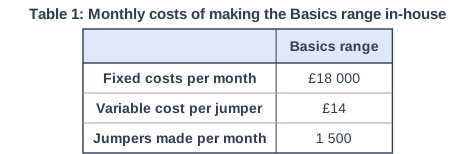
Slitrig makes 1 500 Basics jumpers a month. Table 1 shows the monthly costs of making the Basics range in the business's own machine room.

The operations manager, Fiona, has been offered a contract by a knitwear factory in Leicester. The factory would make all of the Basics jumpers to Slitrig's design for £22 each, including delivery, with an order of at least 1 500 jumpers a month. If Slitrig outsources the Basics range, its fixed costs for the range would no longer be paid, and the machine room would become extra space for hand-finishing.

The eight machine operators would be offered retraining as hand-finishers. Fiona expects that three of them will choose redundancy instead. The Heritage range is very popular, and customers currently wait six weeks for an order because Slitrig does not have enough skilled hand-finishers.

The Leicester factory sent a sample of 50 Basics jumpers. Four had uneven stitching. Deliveries from Leicester would take five days, and the factory needs three weeks' notice to change the size of an order.

Recommend whether Slitrig Knitwear Ltd should outsource the production of its Basics range to the factory in Leicester. Give reasons for your recommendation.

Table 1: Monthly costs of making the Basics range in-house. Table with columns (row headings), "Basics range". Fixed costs per month; Basics range: £18 000 | Variable cost per jumper; Basics range: £14 | Jumpers made per month; Basics range: 1 500.

Model answer

Making a Basics jumper in-house costs Slitrig £26 on average: (£18 000 + £14 × 1 500) ÷ 1 500. The Leicester factory would charge £22 including delivery, so outsourcing would save £4 a jumper, or £6 000 a month (£72 000 a year) on 1 500 jumpers. This would increase the profit Slitrig makes on each £55 Basics jumper, so on cost alone outsourcing looks attractive.

Outsourcing could also help the Heritage range. Customers wait six weeks for a Heritage jumper because there are not enough skilled hand-finishers. If the machine room becomes hand-finishing space and five of the operators retrain, Slitrig could finish more £140 Heritage jumpers each month, reducing the waiting list and the risk that customers give up and buy elsewhere.

However, there are risks. Four of the 50 sample jumpers, 8%, had uneven stitching. Slitrig would no longer control quality, and if faulty jumpers reach shops the returns would cost money and damage Slitrig's reputation, which also supports its Heritage sales. The 'Made in the Scottish Borders' label would no longer be true for the Basics range, so it would have to change, and shops that buy from Slitrig because it is made locally might stop ordering. Supply would also be less flexible: the factory needs three weeks' notice to change an order, and Slitrig must take at least 1 500 jumpers a month even if demand falls. Three operators are likely to take redundancy, which costs money and may worry the remaining staff.

I recommend that Slitrig should outsource the Basics range, but only if the Leicester factory agrees to tighter quality standards and Slitrig checks each delivery when it arrives. The £72 000 a year saving and the chance to cut the six-week Heritage waiting list outweigh the risks, because each Heritage jumper earns far more than a Basics jumper. The decision depends on whether the stitching faults can be fixed and whether shops still buy the Basics range without the Borders label.

Explanation

A Level 3 answer uses the numbers (the £26 in-house cost against £22, and the 8% faulty sample) and the people issues (retraining, redundancy, the Heritage waiting list), then reaches a decision that says what it depends on. Answers that only describe outsourcing in general, or ignore the 'Made in the Scottish Borders' label and the quality risk, usually stay at Level 2.

Mark scheme
  1. 9 marks

    Levels of response (9 marks). AO2 = 3, AO3 = 6.
    Level 3 (7-9 marks): Detailed analysis and evaluation of topics based on the context. Sustained line of reasoning, which is coherent, relevant, substantiated with a focused conclusion that is fully justified. Business areas are fully analysed. Applies knowledge and understanding to the context sufficiently.
    Level 2 (4-6 marks): Sound analysis and evaluation of topics based on the context. A line of reasoning, with a conclusion that has some justification. Business areas are partially analysed. Applies some knowledge and understanding to the context.
    Level 1 (1-3 marks): Basic analysis and evaluation of topics based on the context. Basic line of reasoning with a conclusion. Basic analysis of business areas. Basic knowledge and understanding is applied to the context.
    0 marks: nothing to reward.

    Indicative content (not a checklist; credit other valid points): Application: in-house average unit cost = (£18 000 + £14 × 1 500) ÷ 1 500 = £26 a jumper, against £22 including delivery from Leicester, a saving of £4 a jumper, £6 000 a month or £72 000 a year on 1 500 jumpers; Basics sell for £55; the machine room would become hand-finishing space; Heritage jumpers sell for £140 and customers wait six weeks because of a shortage of hand-finishers; eight operators offered retraining, three expected to take redundancy; 4 of the 50 sample jumpers (8%) had uneven stitching; every jumper is labelled 'Made in the Scottish Borders'; deliveries take five days and three weeks' notice is needed to change order size; minimum order of 1 500 a month. Analysis for outsourcing: lower average unit cost raises the profit on each Basics jumper; retrained operators and the extra space let Slitrig finish more Heritage jumpers, cutting the six-week wait so fewer customers are lost, and Heritage earns far more per jumper; fewer fixed costs and less management time on machines. Analysis against: loss of control over quality, so faulty jumpers lead to returns, extra costs and damage to Slitrig's reputation, which also supports Heritage sales; the 'Made in the Scottish Borders' label would no longer be true for Basics, so it must change (goods must be as described), and shops may value the local origin; less flexible supply (three weeks' notice, minimum order) so Slitrig could be left with unsold stock if demand falls or run short if it rises; redundancy costs and lower morale among remaining staff; retraining takes time before operators are skilled. Evaluation (what does it depend on?): whether the Leicester factory can fix the stitching faults and whether Slitrig checks deliveries; whether shops buy Basics because they are made in the Borders; how quickly operators can be retrained to the Heritage standard; whether demand for Basics is stable enough for a 1 500 minimum order. Level 3 (7-9): a recommendation fully justified with a sustained line of reasoning using the case, e.g. weighing the £4 a jumper saving and the Heritage waiting list against the quality and label risks. Level 2 (4-6): sound analysis with a conclusion that has some justification. Level 1 (1-3): basic points with a simple conclusion. Cap: a generic answer that does not use the case cannot go above Level 2, however well developed. Either recommendation can reach Level 3; an answer with no recommendation cannot reach Level 3.

Ready to try the rest? Every answer you write is marked against the mark scheme, so you can see exactly where the marks are.

Study Helper Hints first, answers after you try

Stuck on this one? Ask for a hint and I’ll point you in the right direction, without giving the answer away. Once you’ve checked your answer, I’ll show you how the marks are awarded.