
Level:
Correct: 0
Incorrect: 0
Marks: 0/0
Exam Practice
Course:
Topics:
Avg
score:
–
Topics
done:
0/21

The economic climate on businesses

Practise 17 exam-style questions on The economic climate on businesses for AQA GCSE Business (Paper 1). Write your answer as you would in the exam and get it marked in seconds against the mark scheme, point by point, with the Study Helper on hand if you get stuck.

  • 17 questions
  • 1–12 marks each
  • Instant marking
  • No sign-up needed
17 questions, marked as you go

Sample questions with model answers

Here are 4 of the questions in this topic, each with a model answer, an explanation of why it earns the marks and the mark scheme an examiner would use.

Question 1

1 mark

Household incomes in the UK are falling. A business makes both basic school shoes and expensive designer trainers in the same factory.

Which one of the following is most likely to happen?

Choose your answer.

  • Demand for the designer trainers falls by more than demand for the school shoes
  • Demand for the school shoes falls by more than demand for the designer trainers
  • Demand for both products rises
  • Demand for both products stays the same

Model answer

Demand for the designer trainers falls by more than demand for the school shoes

Explanation

When incomes fall, households cut back first on luxury and non-essential items such as expensive designer trainers, while they still have to buy basics such as school shoes. The business may therefore make fewer trainers and move workers and machines onto the products that are still in demand. Choosing the school shoes is the common error: necessities are the last things people stop buying.

Mark scheme
  1. 1 mark

    Demand for the designer trainers falls by more than demand for the school shoes

    Accept a clear shortened form, eg 'demand for designer trainers falls more'. If more than one option is given, 0 marks.
Question 2

2 marks

Explain one drawback to a business of a low level of unemployment in its area.

Model answer

When unemployment is low, fewer people are looking for work, so it is harder for the business to fill its vacancies. This means it may not have enough staff to produce the output its customers have ordered.

Explanation

Low unemployment is good for demand, because more people have incomes to spend, but it makes recruitment harder because businesses compete for a small pool of workers. A full answer links the drawback to a consequence for the business, such as unfilled vacancies, higher wage costs or more staff leaving. Students sometimes confuse low and high unemployment and say people have less money to spend.

Mark scheme
  1. 1 mark

    Identifies a drawback: it is harder to recruit staff / fewer applicants for each job / it may have to pay higher wages to attract or keep staff / staff may leave for jobs elsewhere

    Answers may include: fewer people looking for work, so vacancies are hard to fill; competition with other employers for staff, so wages rise; higher labour turnover as staff can easily find other jobs; may have to recruit less experienced staff who need more training.

  2. 1 mark

    Explains the consequence: eg vacancies stay unfilled, so output falls or orders cannot be met / wage costs rise, so profit falls / recruitment and training costs rise as staff leave / existing staff work overtime, raising costs or lowering quality

    The consequence must follow from the drawback given. Examples of developed answers: It is harder to recruit staff (1) so vacancies stay unfilled and the business cannot produce enough to meet orders (1). It may have to raise wages to attract applicants (1) which increases its costs and reduces profit (1). Staff may leave for other jobs (1) so the business has to spend more on recruiting and training replacements (1). Do not accept 'customers have less money' - low unemployment means people have more income.

Question 3

4 marks

Item A
Pennine Crust Bakery Ltd

Pennine Crust Bakery Ltd is a family-owned bakery in Huddersfield, West Yorkshire. It bakes bread, cakes and pastries in a small factory and sells them to 140 cafes, delicatessens and farm shops across Yorkshire. About 40% of its revenue comes from celebration cakes, which sell for around £35 each.

The bakery employs 32 people. 24 are permanent bakers and packers, and 8 are temporary staff supplied by an agency, who are paid only for the hours they work. Bread is made using flow production, but each celebration cake is decorated by hand, which takes a skilled decorator about 40 minutes.

The bakery buys flour, butter and eggs from suppliers who must be paid within 30 days, but its own customers often take 60 days to pay. To cover the gap, the bakery is overdrawn by around £25 000 in most months. Interest rates in the UK have risen, and the bank has increased the interest rate it charges on the overdraft. The bakery has no other loans.

Household incomes in the area have been squeezed and the cafes report that their customers are cutting back on treats. Orders for celebration cakes have fallen by 15% over the last six months, although orders for bread have stayed the same. Several cafes have asked whether the bakery could supply smaller, cheaper cakes instead.

The bakery's manager, Tomasz, is now reviewing next month's production schedule and the number of agency staff the bakery will need.

Explain one way the fall in consumer spending may affect production at Pennine Crust Bakery Ltd.

You should use the information in Item A in your answer.

Model answer

When household incomes are squeezed, consumers spend less on treats, so the cafes order fewer celebration cakes from Pennine Crust - orders have already fallen by 15%. This means Tomasz will need to schedule fewer hours of hand decorating, as each cake takes a skilled decorator about 40 minutes. He is likely to cut the hours of some of the 8 agency staff, because they are paid only for the hours they work, which reduces wage costs while bread production carries on as normal. The bakery could also change production to make the smaller, cheaper cakes that several cafes have asked for, so that it keeps some of its cake sales.

Explanation

Level 2 needs the effect of falling consumer spending to be linked to production at the bakery using the case, such as the 15% fall in cake orders, the hand decorating or the 8 agency staff. Bread orders have not fallen because bread is a necessity, so a strong answer focuses on the cakes. A general answer that sales and profits will fall, with no link to production at Pennine Crust, stays in Level 1.

Mark scheme
  1. 4 marks

    Levels of response (4 marks). AO1 = 2, AO2 = 2.
    Level 2 (3-4 marks): Sound understanding and application of the topics. Applies knowledge and understanding to the context sufficiently. A sound understanding of one or more business concepts and issues.
    Level 1 (1-2 marks): Basic understanding and application of the topics. Applies basic knowledge and understanding to the context. A basic understanding of one or more business concepts.
    0 marks: nothing to reward.

    Indicative content (not a checklist; credit other valid points): Knowledge and application: when household incomes are squeezed, consumers spend less on non-essential items such as treats, so cafes order fewer celebration cakes - orders have fallen by 15% over six months; Pennine Crust will make fewer celebration cakes, so it needs fewer hours of hand decorating (about 40 minutes per cake); it may cut the hours of some of its 8 agency staff, who are paid only for the hours they work, reducing wage costs; it may change production to the smaller, cheaper cakes that several cafes have asked for; bread is a necessity and orders have not fallen, so bread production on the flow line can continue as normal; spare capacity in cake decorating could be used elsewhere. Level 2 needs a sound explanation of one effect on production applied to Pennine Crust, using the case. An answer not applied to Pennine Crust cannot go above Level 1. A general statement that 'sales and profits will fall' without an effect on production is Level 1 at most.

Question 4

9 marks

Item A
Brackenfield Precision Ltd

Brackenfield Precision Ltd is a private limited company in Walsall in the West Midlands. It employs 48 people and makes steel gears and shafts for businesses that build tractors and other farm machinery. Parts are made in batches on computer-controlled machines, and the business has a reputation for accurate parts delivered on time.

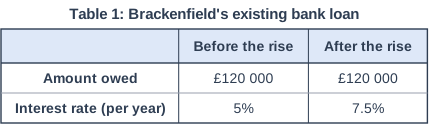
Three years ago Brackenfield borrowed money from its bank to buy two new machines, and it still owes £120 000. The loan has a variable interest rate, so the rate can change during the life of the loan. Interest rates in the UK have risen, and the bank has increased the rate on this loan, as shown in Table 1.

The production manager, Kezia, wants to buy a robotic welding cell costing £200 000. It would weld parts faster and more consistently than the current team of hand welders, and it could run overnight. It would be paid for with a new five-year bank loan at a fixed interest rate of 8% a year.

Unemployment in Walsall is low. Brackenfield has had four vacancies for skilled welders for more than six months, and two experienced welders retire next year. To keep up with orders, the current welders work overtime most weeks, which is paid at one and a half times the normal hourly rate. Last year 3% of welded parts were returned by customers because of faulty welds.

Orders are steady at the moment. However, the managing director is worried that higher interest rates will make farmers less willing to borrow money to buy new tractors, which could reduce Brackenfield's orders next year.

Kezia wants to buy the robotic welding cell now, using the new five-year bank loan.

Recommend whether Brackenfield Precision Ltd should buy the robotic welding cell now. Give reasons for your recommendation.

Table 1: Brackenfield's existing bank loan. Table with columns (row headings), "Before the rise", "After the rise". Amount owed; Before the rise: £120 000; After the rise: £120 000 | Interest rate (per year); Before the rise: 5%; After the rise: 7.5%.

Model answer

Brackenfield should buy the robotic welding cell now, even though interest rates have risen.

The main reason is that low unemployment in Walsall means Brackenfield cannot recruit the welders it needs. It has had four vacancies for skilled welders for over six months, and two more welders retire next year, so the problem will get worse. Without the cell, the remaining welders must keep working overtime at one and a half times the normal rate, which raises wage costs, and tired staff may make more mistakes. The cell can run overnight, so Brackenfield can keep up with orders without relying on staff it cannot find. Because the cell welds more consistently, it should also reduce the 3% of welded parts returned for faulty welds, protecting Brackenfield's reputation for accurate parts delivered on time.

However, borrowing is now more expensive. The interest on the existing £120 000 loan has already risen from £6 000 to £9 000 a year, and the new £200 000 loan at 8% would add up to £16 000 of interest in the first year. These are fixed costs that must be paid even if orders fall. The managing director fears that higher interest rates will stop farmers borrowing to buy tractors, so tractor makers may order fewer gears and shafts. If that happens, the cell could stand idle while Brackenfield still has to repay the loan, which would hit both profit and cash flow.

On balance, the cell is still the better choice. The 8% rate is fixed, so Brackenfield knows exactly what it will pay even if interest rates rise further, whereas the shortage of welders is a problem it faces now and cannot easily solve while unemployment stays low. The decision depends on how far orders fall: if the fall is small, the savings in overtime and returns should cover much of the extra interest. Brackenfield could reduce the risk by using the cell to cover the vacancies and retirements rather than making any welders redundant, so it keeps its skilled staff.

Explanation

The top level needs a clear recommendation that weighs the higher cost of borrowing against the benefits of the cell, using the evidence in the case such as the four unfilled vacancies, the overtime rate, the 3% returns and the extra interest. Strong answers notice that the fixed 8% rate removes the risk of further rises, and say what the decision depends on, such as how far orders fall. Answers that only list advantages and disadvantages of robots, without linking them to interest rates or unemployment in Walsall, stay in Level 2 at best.

Mark scheme
  1. 9 marks

    Levels of response (9 marks). AO2 = 3, AO3 = 6.
    Level 3 (7-9 marks): Detailed analysis and evaluation of topics based on the context. Sustained line of reasoning, which is coherent, relevant, substantiated with a focused conclusion that is fully justified. Business areas are fully analysed. Applies knowledge and understanding to the context sufficiently.
    Level 2 (4-6 marks): Sound analysis and evaluation of topics based on the context. A line of reasoning, with a conclusion that has some justification. Business areas are partially analysed. Applies some knowledge and understanding to the context.
    Level 1 (1-3 marks): Basic analysis and evaluation of topics based on the context. Basic line of reasoning with a conclusion. Basic analysis of business areas. Basic knowledge and understanding is applied to the context.
    0 marks: nothing to reward.

    Indicative content (not a checklist; credit other valid points): Application: the cell costs £200 000 on a five-year loan at a fixed 8% a year (up to about £16 000 interest in the first year); interest on the existing £120 000 loan has already risen from 5% to 7.5% (£6 000 to £9 000 a year, Table 1); low unemployment in Walsall - four welder vacancies unfilled for over six months and two welders retiring next year; welders work overtime most weeks at one and a half times the normal rate; 3% of welded parts returned for faulty welds; the cell could run overnight; orders are steady, but the managing director fears farmers will borrow less to buy tractors. Analysis (for buying now): the cell solves a recruitment problem caused by low unemployment, so Brackenfield can keep up with orders without scarce welders; overtime costs fall because the cell runs overnight; more consistent welds should cut the 3% returns, protecting its reputation for accurate, on-time parts; the fixed 8% rate means the interest cannot rise further even if interest rates keep rising. Analysis (against buying now): borrowing is more expensive, so the new loan adds a large interest cost on top of the extra £3 000 on the existing loan, raising fixed costs; if higher interest rates make farmers delay buying tractors, orders could fall, leaving the cell under-used while the loan must still be repaid, squeezing profit and cash flow; welders may fear for their jobs, lowering motivation; staff need training to run the cell. Evaluation - what does it depend on?: how much overtime and returns would cost compared with the interest; whether orders really fall, and for how long; whether welders could be recruited another way (higher pay, apprentices); whether waiting for interest rates to fall is realistic when the vacancies cannot be filled now. Accept any well-argued recommendation, including buying later or not at all. Level 3 needs a recommendation fully justified using the case, eg weighing the extra interest against the cost of unfilled vacancies. A generic answer that does not use the case cannot go above Level 2, however well developed.

Ready to try the rest? Every answer you write is marked against the mark scheme, so you can see exactly where the marks are.

Study Helper Hints first, answers after you try

Stuck on this one? Ask for a hint and I’ll point you in the right direction, without giving the answer away. Once you’ve checked your answer, I’ll show you how the marks are awarded.