Level:
Correct: 0
Incorrect: 0
Marks: 0/0
Exam Practice
Course:
Topics:
Avg
score:
–
Topics
done:
0/21

The concept of quality

Practise 26 exam-style questions on The concept of quality for AQA GCSE Business (Paper 1). Write your answer as you would in the exam and get it marked in seconds against the mark scheme, point by point, with the Study Helper on hand if you get stuck.

  • 26 questions
  • 1–12 marks each
  • Instant marking
  • No sign-up needed
20 questions, marked as you go

Sample questions with model answers

Here are 4 of the questions in this topic, each with a model answer, an explanation of why it earns the marks and the mark scheme an examiner would use.

Question 1

1 mark

A business inspects a sample of 400 products and finds that 6 of them are faulty.

What percentage of the sample is faulty?

Choose your answer.

  • 0.6%
  • 1.5%
  • 6%
  • 15%

Model answer

1.5%

Explanation

Percentage faulty = (number faulty ÷ number checked) × 100 = (6 ÷ 400) × 100 = 1.5%. 6% wrongly treats the number of faulty products as a percentage, 15% comes from misplacing the decimal point, and 0.6% would mean only 2.4 faulty products in 400. Defect rates like this let a business measure quality and see whether it is getting better or worse over time.

Mark scheme
  1. 1 mark

    1.5%

    If more than one option is given, 0 marks.

Question 2

2 marks

Explain one consequence for a business of having to recall a faulty product.

Model answer

A product recall damages the business's reputation, because news of the fault spreads through the media and online. This means customers may lose trust in the brand and buy from competitors instead, so sales fall.

Explanation

A recall happens when a business asks customers to return a faulty or unsafe product, so it brings both direct costs (collection, refunds and repairs) and longer-term damage to reputation and sales. Identify one consequence and then explain its effect on the business. Simply explaining what a recall is does not answer the question.

Mark scheme
  1. 1 mark

    Identifies a consequence, eg higher costs (of collecting, refunding, replacing or repairing products) / damaged reputation or bad publicity / lost sales or customers / retailers may stop stocking the product / legal action or compensation claims / production may stop while the fault is fixed / lower profit

  2. 1 mark

    ... explains the consequence, eg so profit falls / so customers lose trust in the brand and buy from competitors / so future sales fall / so the business has less money to invest

    Examples of developed answers: The business must pay to collect and replace the faulty products (1), so its costs rise and its profit falls (1). The recall gets bad publicity (1), so customers lose trust in the brand and buy from competitors (1). Do not accept a description of what a recall is, without a consequence.

Question 3

4 marks

Item A
Ellerby Homes Ltd

Ellerby Homes Ltd is a house builder based in Lincoln. For many years it built about 120 homes a year using its own team of bricklayers, carpenters and electricians, and it had a reputation for well-built homes. Its homes usually sold for about 5% more than similar new homes nearby.

To grow, Ellerby now builds on six sites at once instead of two, and it uses subcontractors for plumbing, electrics and roofing. Each site manager is responsible for about 60 homes. Many homes are finished in a rush at the end of each month to meet sales targets.

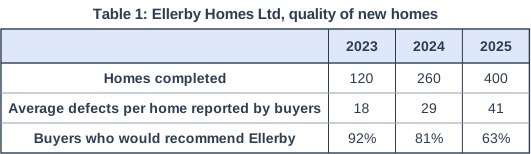
When buyers move in, they report any defects, such as doors that stick, cracks in plaster or leaking pipes, and Ellerby must fix them. Fixing a defect costs Ellerby about £85 on average. Some buyers have posted photographs of defects on social media, and sales on one site have slowed. Table 1 shows how the quality of Ellerby's homes has changed.

Explain one way Ellerby Homes Ltd could identify quality problems before buyers move in.

You should use the information in Item A in your answer.

Table 1: Ellerby Homes Ltd, quality of new homes. Table with columns (row headings), "2023", "2024", "2025". Homes completed; 2023: 120; 2024: 260; 2025: 400 | Average defects per home reported by buyers; 2023: 18; 2024: 29; 2025: 41 | Buyers who would recommend Ellerby; 2023: 92%; 2024: 81%; 2025: 63%.

Model answer

Ellerby could employ a quality inspector to check every home at key stages of building and again before the buyer moves in, using a checklist of common defects such as sticking doors, cracked plaster and leaking pipes. At the moment each site manager is responsible for about 60 homes and many homes are finished in a rush at the end of the month, so problems are being missed. Checking the subcontractors' plumbing and electrics before they are paid would find faults while the workers are still on site. Finding defects before handover is cheaper than fixing them after buyers move in, and protects Ellerby's reputation.

Explanation

Level 2 needs one method of identifying problems, such as stage inspections or a final checklist inspection, explained and linked to the case: site managers with 60 homes each, subcontracted work and the month-end rush. Saying 'inspect the homes' without explaining how or why it suits Ellerby stays at Level 1.

Mark scheme
  1. 4 marks

    Levels of response (4 marks). AO1 = 2, AO2 = 2.
    Level 2 (3-4 marks): Sound understanding and application of the topics. Applies knowledge and understanding to the context sufficiently. A sound understanding of one or more business concepts and issues.
    Level 1 (1-2 marks): Basic understanding and application of the topics. Applies basic knowledge and understanding to the context. A basic understanding of one or more business concepts.
    0 marks: nothing to reward.

    Indicative content (not a checklist; credit other valid points): Knowledge and application: inspection - a quality inspector (or more site managers) checking each home at key stages and before handover, using a checklist of common defects such as sticking doors, cracks in plaster and leaking pipes; checking or testing subcontractors' plumbing, electrics and roofing before they are paid or leave the site; testing pipes and electrics before walls are finished; TQM - each trade checks and signs off its own work at every stage. Application points: each site manager is responsible for about 60 homes; many homes are finished in a rush at the end of the month; subcontractors are used for plumbing, electrics and roofing; average defects per home rose from 18 to 41. Finding defects before handover is cheaper than fixing them later (about £85 each) and protects Ellerby's reputation. An answer that is not applied to Ellerby Homes Ltd cannot go above Level 1. Level 2 needs a sound explanation of one way to identify problems, applied to the case.

Question 4

9 marks

Item A
Soar Valley Appliances Ltd

Soar Valley Appliances Ltd makes toasters and kettles at a factory in Loughborough and sells them to department stores and online retailers. It employs 85 staff, including 70 production workers who are paid a bonus based on the number of toasters they assemble each day.

The business uses quality control. Three inspectors test a sample of finished toasters at the end of the production line. A faulty toaster found at this stage has to be taken apart and rebuilt, which takes about 20 minutes. Last year a fault in one batch was missed, and 4 800 toasters had to be recalled because their thermostats could overheat. The recall cost £96 000 for collecting, refunding and replacing toasters, and a large department store chain has stopped stocking Soar Valley's toasters.

The managing director, Harjit, is considering replacing quality control with total quality management (TQM). Every production worker would be trained to check their own work at each stage of assembly and would be able to stop the line if they found a problem. The training would cost £45 000, and the factory would lose two days of production while it took place. The three inspectors would become quality trainers. Some production workers have said they are worried that checking their own work will slow them down and reduce their bonuses.

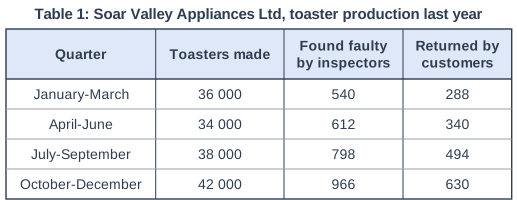
Table 1 shows the factory's toaster production last year.

Harjit wants to reduce the number of faulty toasters.

Recommend whether Soar Valley Appliances Ltd should replace quality control with total quality management (TQM). Give reasons for your recommendation.

Table 1: Soar Valley Appliances Ltd, toaster production last year. Table with columns "Quarter", "Toasters made", "Found faulty by inspectors", "Returned by customers". Quarter: January-March; Toasters made: 36 000; Found faulty by inspectors: 540; Returned by customers: 288 | Quarter: April-June; Toasters made: 34 000; Found faulty by inspectors: 612; Returned by customers: 340 | Quarter: July-September; Toasters made: 38 000; Found faulty by inspectors: 798; Returned by customers: 494 | Quarter: October-December; Toasters made: 42 000; Found faulty by inspectors: 966; Returned by customers: 630.

Model answer

Soar Valley's quality control is not working well. Faults found by inspectors rose from 540 in January-March (1.5% of toasters made) to 966 in October-December (2.3%), and returns from customers rose from 288 to 630. Because the inspectors test only a sample at the end of the line, some faults are missed: one missed fault led to a recall of 4 800 toasters that cost £96 000 and lost the business a large department store customer.

TQM would tackle these problems at their source. If every worker checks their own work at each stage and can stop the line, a fault is put right immediately instead of being found at the end, when the toaster has to be taken apart and rebuilt in about 20 minutes. In October-December alone, rebuilding 966 toasters took about 322 hours of work, so preventing faults would save labour and materials and lower the cost of each toaster. Fewer faulty toasters would also mean fewer returns and less risk of another recall, which would protect Soar Valley's reputation and could help win back the department store chain. The £45 000 training cost is less than half the cost of the last recall.

However, TQM only works if the workers are committed to it. At the moment they are paid a bonus for each toaster they assemble, so they are rewarded for speed, not quality. Some already fear that checking their work will cut their bonuses, so they may rush their checks and quality may not improve. The business would also lose two days of production during the training.

I recommend that Soar Valley should introduce TQM, because its rising fault rate and costly recall show that checking a sample at the end of the line is not enough. However, this depends on Harjit changing the bonus so that it rewards toasters made without faults; otherwise workers will have no reason to take responsibility for quality. Keeping a final safety test on a sample of toasters for the first few months would also reduce the risk while TQM is introduced.

Explanation

Level 3 answers use the data to show the problem is growing (faults found rose from 1.5% to 2.3% of output and returns more than doubled), compare the £45 000 cost of TQM with the £96 000 recall, and weigh this against the bonus scheme, which rewards speed rather than quality. The recommendation should be justified and can include conditions, such as changing the bonus. Confusing TQM with more inspection, or making generic points about TQM, will not reach the top level.

Mark scheme
  1. 9 marks

    Levels of response (9 marks). AO2 = 3, AO3 = 6.
    Level 3 (7-9 marks): Detailed analysis and evaluation of topics based on the context. Sustained line of reasoning, which is coherent, relevant, substantiated with a focused conclusion that is fully justified. Business areas are fully analysed. Applies knowledge and understanding to the context sufficiently.
    Level 2 (4-6 marks): Sound analysis and evaluation of topics based on the context. A line of reasoning, with a conclusion that has some justification. Business areas are partially analysed. Applies some knowledge and understanding to the context.
    Level 1 (1-3 marks): Basic analysis and evaluation of topics based on the context. Basic line of reasoning with a conclusion. Basic analysis of business areas. Basic knowledge and understanding is applied to the context.
    0 marks: nothing to reward.

    Indicative content (not a checklist; credit other valid points): Application: faults found by inspectors rose from 540 (1.5% of toasters made) in January-March to 966 (2.3%) in October-December, and customer returns rose from 288 (0.8%) to 630 (1.5%); inspectors test only a sample at the end of the line, so faults are missed; a missed fault led to a recall of 4 800 toasters costing £96 000 (about £20 a toaster) and the loss of a large department store customer; each fault found at the end takes about 20 minutes to rebuild (966 faults in October-December is about 322 hours); TQM training costs £45 000 and two days of lost production; the three inspectors would become trainers; workers are paid a bonus per toaster assembled and fear TQM will cut their bonuses. Analysis: with TQM every worker checks their own work and can stop the line, so faults are prevented or fixed at once, before more work is added, which cuts rework time, waste and the unit cost of each toaster; fewer faults reach customers, so returns fall and another costly recall is less likely, protecting the brand and possibly winning back the department store; the £45 000 cost is less than half the cost of one recall; but TQM needs the commitment of every worker, and a bonus based on quantity rewards speed rather than quality, so workers may rush their checks and quality may not improve; two days of lost production reduce output and revenue in the short term. Evaluation (what does it depend on?): whether the bonus scheme is changed to reward fault-free output; how committed and well trained the workers are; whether a final safety test should be kept alongside TQM; how quickly faults fall compared with the £45 000 cost. Any justified recommendation is acceptable. A generic answer that does not use the case cannot go above Level 2, however well developed; answers that treat TQM as more inspection show weak understanding. Level 3 needs a focused recommendation justified with the case evidence, eg the rising fault and return rates, the cost of the recall and the conflict with the bonus scheme.

Ready to try the rest? Every answer you write is marked against the mark scheme, so you can see exactly where the marks are.

Study Helper Hints first, answers after you try

Stuck on this one? Ask for a hint and I’ll point you in the right direction, without giving the answer away. Once you’ve checked your answer, I’ll show you how the marks are awarded.