Item B: Haughmond Logistics Ltd
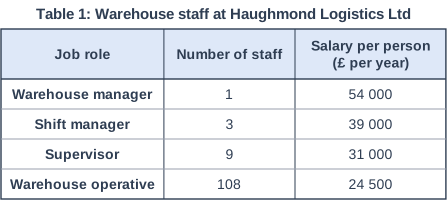
Haughmond Logistics Ltd runs a large warehouse near Doncaster that stores and packs goods for online retailers. The warehouse works three eight-hour shifts a day, seven days a week, and employs 121 people. Table 1 shows the warehouse staff.
Each shift manager is responsible for one shift and manages three supervisors. Each supervisor manages a team of twelve warehouse operatives, checks their work, deals with problems such as damaged stock and trains new operatives. Many of the supervisors were promoted from operative roles, and several operatives say they hope to become supervisors.
Competition from other warehouses has forced Haughmond to cut its prices, and its profit has fallen for two years. The operations director, Mark, wants to delayer by removing the supervisor level. All nine supervisors would be made redundant, at a one-off cost of £58 000, and the three shift managers would each be paid an extra £4 000 a year for managing their operatives directly.
Mark points out that every operative now uses a handheld scanner that records each item picked, so shift managers can see errors on a screen straight away. However, the warehouse uses forklift trucks, and Haughmond's health and safety manager is worried that shift managers will not be able to watch over so many operatives. Haughmond's error rate in picking orders is 0.4%, one of the lowest in the industry, and its largest customer has said that accuracy is the main reason it uses Haughmond.
Recommend whether Haughmond Logistics should remove the supervisor level.
Give reasons for your recommendation.
Model answer
I recommend that Haughmond does not remove the whole supervisor level, but reduces the number of supervisors instead.
Removing the supervisor level would save Haughmond a large amount of money. The nine supervisors earn £31 000 each, so after paying the three shift managers an extra £4 000 each, salary costs would fall by £267 000 a year. The one-off redundancy cost of £58 000 would be covered within the first year. As Haughmond's profit has fallen for two years because competitors have forced it to cut its prices, this saving would help it to compete. Removing a level would also shorten the chain of command, so instructions from the warehouse manager would reach operatives faster, and the handheld scanners mean shift managers can see picking errors on screen straight away.
However, the change would give each shift manager a span of control of 36 operatives instead of 3 supervisors. That is very wide, and supervisors do much more than check errors: they deal with damaged stock, train new operatives and watch over safety in a warehouse with forklift trucks. With 36 people each, shift managers could not do all of this, so accidents and mistakes could increase. Accuracy matters a great deal to Haughmond, because its error rate of 0.4% is one of the lowest in the industry and its largest customer says accuracy is the main reason it uses Haughmond. If errors rose, Haughmond could lose this customer, and the lost revenue could be far greater than £267 000. Removing supervisors would also end the main promotion route for operatives, which could demotivate them and increase staff turnover.
The decision depends on whether the scanners can really replace the supervision that supervisors give. Because accuracy and safety are so important to Haughmond, the risk of removing the whole level is too high. A better option would be to keep fewer supervisors with larger teams, for example six supervisors with eighteen operatives each, which would still save money while keeping supervision, training and a route for promotion.