Item A
Deveron Oatcakes Ltd
Deveron Oatcakes Ltd is a private limited company in Huntly, Aberdeenshire. It employs 42 staff and bakes oatcakes and shortbread, which it sells to delicatessens, farm shops and hotels across Scotland. Its customers value the products for their freshness and because they are made with oats grown in the north-east.
The bakery uses just-in-case (JIC) stock control. Twice a month it orders large quantities of oats, flour, butter and packaging, which are kept in a rented warehouse next to the bakery. Buying in bulk earns an 8% discount on its ingredient bill, which is £16 000 a month before the discount. However, last year £7 200 of butter and packaging had to be thrown away because the butter passed its use-by date or the packaging design changed.
The managing director, Morag, wants to reduce the capital tied up in stock and is considering a change to just-in-time (JIT) stock control. Ingredients would arrive three times a week, and the warehouse would be replaced by a much smaller store. The oat mill is 15 miles away and has never missed a delivery. The butter comes from a dairy near Glasgow, and in winter snow sometimes closes the main road for a day or more. Demand for shortbread doubles in November and December, when hotels and shops order gift tins.
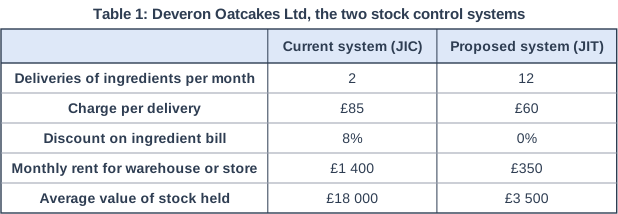
Table 1 compares the two systems.
Deveron Oatcakes Ltd's customers value fresh products, and demand for shortbread doubles in November and December.
Recommend whether Deveron Oatcakes Ltd should change to just-in-time (JIT) stock control. Give reasons for your recommendation.
Model answer
Changing to JIT would free a lot of capital. The average value of stock held would fall from £18 000 to £3 500, releasing £14 500 that Morag could use elsewhere, for example to buy a new oven or to win more hotel customers. JIT would also cut storage costs, because the rent would fall from £1 400 to £350 a month, a saving of £1 050. Because ingredients would arrive three times a week, the butter would be fresher and less of it would pass its use-by date, so much of the £7 200 thrown away last year (about £600 a month) could be saved. Fresher ingredients also protect the quality that delicatessens and hotels value, which helps Deveron keep its customers.
However, JIT has real costs. Delivery charges would rise from £170 to £720 a month, an extra £550, and Deveron would lose its 8% bulk-buying discount, which is worth £1 280 a month on a £16 000 bill. These extra costs of about £1 830 a month are slightly more than the savings of about £1 650, so the cost of making each pack would not fall. The bigger risk is reliability. With only a few days' stock, a snowfall that closes the road from Glasgow could stop the butter arriving, and the bakery would have to stop production. If this happened in November or December, when demand for shortbread doubles, Deveron could miss orders for gift tins, losing sales at its most important time and damaging its relationships with hotels and shops.
I recommend that Deveron should not switch fully to JIT. The cost savings are almost cancelled out by the higher delivery charges and the lost discount, so the main gain is the £14 500 of capital, and this is not worth risking the Christmas peak. A better choice would be to use JIT for oats, because the mill is local and has never missed a delivery, while keeping a buffer stock of butter and packaging before November. This depends on whether butter can be stored safely for a few weeks, but it would reduce waste without risking the busiest months.
Explanation
To reach Level 3, use the numbers in Table 1 to weigh the savings (capital freed, rent and waste) against the costs (extra delivery charges and the lost 8% discount), and then consider the risk to supply at the busiest time. A recommendation must be justified with the case evidence; a partial answer such as JIT for oats but a buffer stock of butter is fine if it is explained. Generic points about JIT, with no use of Deveron's figures or its winter supply problem, cannot reach the top level.