Level:
Correct: 0
Incorrect: 0
Marks: 0/0
Exam Practice
Subject:
Topics:
Avg
score:
–
Topics
done:
0/21

Issue: upgrading a squatter settlement

Practise 23 exam-style questions on Issue: upgrading a squatter settlement for AQA GCSE Geography (Paper 3). Write your answer as you would in the exam and get it marked in seconds against the mark scheme, point by point, with an AI tutor on hand if you get stuck.

  • 23 questions
  • 1–12 marks each
  • Instant marking
  • No sign-up needed
20 questions, marked as you go

Sample questions with model answers

Here are 4 of the questions in this topic, each with a model answer, an explanation of why it earns the marks and the mark scheme an examiner would use.

Question 1

1 mark

Option 2 for Morro Azul, a squatter settlement in Porto Claro, Brazil, is a site-and-service scheme.

Which one of the following describes a site-and-service scheme?

A The government demolishes squatter homes and builds blocks of flats for the residents
B Residents are given land with basic services such as water, sewers and electricity, and build or improve their own homes
C Residents are paid to return to the rural areas they migrated from
D A transnational company builds a factory and housing for its workers

Give the letter of your answer.

Model answer

B

Explanation

In a site-and-service scheme the authorities provide the plot (the site) and the basic infrastructure (the services), and residents do the building themselves, often with cheap loans or materials. This makes it much cheaper than clearance and rehousing (option A), which is a top-down scheme.

Mark scheme
  1. 1 mark

    B (residents are given land with basic services and build or improve their own homes)

    accept the letter or the option written out; do not accept more than one answer
Question 2

2 marks

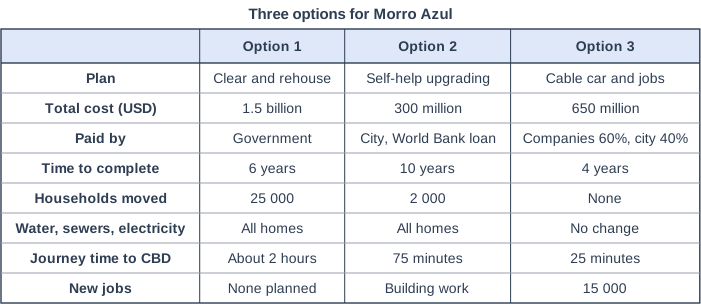
Figure 1 shows three options for Morro Azul, a squatter settlement of 25 000 households in Porto Claro, Brazil.

Using Figure 1, calculate the cost of option 1 for each household moved. Give your answer in US dollars.

Three options for Morro Azul. Table with columns "", "Option 1", "Option 2", "Option 3". : Plan; Option 1: Clear and rehouse; Option 2: Self-help upgrading; Option 3: Cable car and jobs | : Total cost (USD); Option 1: 1.5 billion; Option 2: 300 million; Option 3: 650 million | : Paid by; Option 1: Government; Option 2: City, World Bank loan; Option 3: Companies 60%, city 40% | : Time to complete; Option 1: 6 years; Option 2: 10 years; Option 3: 4 years | : Households moved; Option 1: 25 000; Option 2: 2 000; Option 3: None | : Water, sewers, electricity; Option 1: All homes; Option 2: All homes; Option 3: No change | : Journey time to CBD; Option 1: About 2 hours; Option 2: 75 minutes; Option 3: 25 minutes | : New jobs; Option 1: None planned; Option 2: Building work; Option 3: 15 000.

Model answer

1.5 billion = 1 500 000 000. 1 500 000 000 ÷ 25 000 = USD 60 000 per household.

Explanation

Write 1.5 billion in full (1 500 000 000) before dividing to avoid errors with zeros. For comparison, option 2 costs USD 300 million for all 25 000 households, which is USD 12 000 per household - one fifth of the cost of option 1.

Mark scheme
  1. 1 mark

    Working: 1 500 000 000 ÷ 25 000

    correct answer with no working scores full marks

  2. 1 mark

    USD 60 000 per household

    accept 60 000 US dollars / 60 thousand; do not accept 60 or 6000

Question 3

4 marks

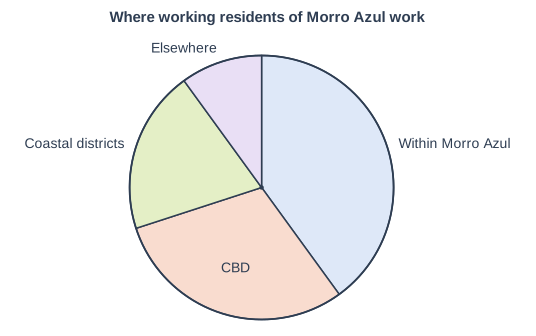
Figure 1 shows where the working residents of Morro Azul, a squatter settlement in Porto Claro, Brazil, work. Under option 1, Morro Azul would be cleared and all its residents rehoused in high-rise flats at Campo Largo, on the edge of the city 35 km from the CBD. The bus journey from Campo Largo to the CBD would take about 2 hours. About 55% of Morro Azul's workers have informal jobs.

Using Figure 1, suggest why option 1 could harm the incomes of many residents.

Where working residents of Morro Azul work. Pie chart. A circle divided into sectors, drawn clockwise from the top (12 o'clock): Within Morro Azul, 144°; CBD, 108°; Coastal districts, 72°; Elsewhere, 36°. (Angles are not printed on the chart; these are the drawn sizes, which can be measured with a protractor.)

Model answer

Figure 1 shows that 40% of working residents work within Morro Azul itself, probably in small shops, workshops and market stalls in the informal economy. If Morro Azul were cleared, these businesses would lose their premises and their customers, so these people would lose their income completely. Another 50% work in the CBD (30%) or the coastal districts (20%). From Campo Largo, 35 km away, the bus journey to the CBD would take about 2 hours each way, so workers would spend much of their low wages on bus fares and might lose jobs that need early starts, such as domestic or cleaning work. Informal workers also depend on contacts built up over many years, which would be broken up by the move.

Explanation

The strongest answers use the pie chart to identify different groups - those who work inside Morro Azul and those who commute - and explain a different impact on each. Answers that only say 'Campo Largo is far away' without linking it to costs, time or lost businesses stay in Level 1.

Mark scheme
  1. 4 marks

    Levels of response (4 marks).
    Level 2 (3-4 marks): Clear, developed suggestions of how option 1 could reduce incomes, linked to different groups of workers, with effective use of evidence from Figure 1 (e.g. 40% work within Morro Azul, 30% in the CBD) and the information given.
    Level 1 (1-2 marks): Basic suggestions (e.g. 'they would be far from work') with little development and little or no use of Figure 1.
    0 marks: nothing worthy of credit.

    Indicative content (not a checklist; credit other valid points): 40% work within Morro Azul (shops, workshops, market stalls, home businesses) - clearing the settlement destroys these businesses and their customers, so these jobs are lost completely; 30% work in the CBD and 20% in the coastal districts (half of all workers) - from Campo Largo the journey would take about 2 hours each way, so long commutes and bus fares would take a large share of low incomes; some may lose jobs that need early starts or long hours (e.g. domestic work, cleaning, construction); informal workers (55%) rely on customers, contacts and networks built up over years, which would be broken up; there are few jobs at Campo Largo on the edge of the city; with lower incomes, families may struggle to pay rent or bills for the new flats and may move back into squatter settlements nearer the centre.

Question 4

9 marks

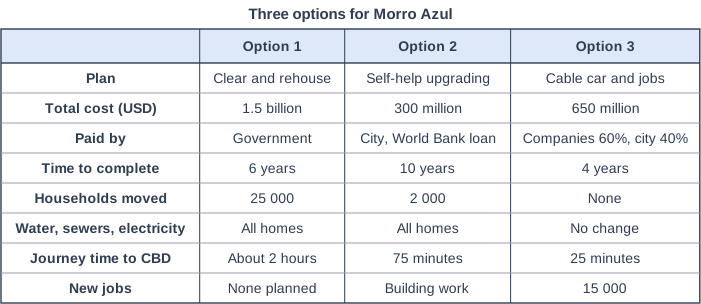
Morro Azul is a squatter settlement of about 100 000 people in Porto Claro, Brazil, 6 km from the CBD. Unemployment is 22% and the bus journey to the CBD takes 75 minutes. Option 3 would build a cable car linking Morro Azul to the city's metro and a new industrial zone 4 km away with 15 000 jobs. Homes, water supply and sewers in Morro Azul would not be changed. Figure 1 compares option 3 with the other two options.

Using Figure 1 and your own knowledge, evaluate option 3 as a plan for Morro Azul.

Three options for Morro Azul. Table with columns "", "Option 1", "Option 2", "Option 3". : Plan; Option 1: Clear and rehouse; Option 2: Self-help upgrading; Option 3: Cable car and jobs | : Total cost (USD); Option 1: 1.5 billion; Option 2: 300 million; Option 3: 650 million | : Paid by; Option 1: Government; Option 2: City, World Bank loan; Option 3: Companies 60%, city 40% | : Time to complete; Option 1: 6 years; Option 2: 10 years; Option 3: 4 years | : Households moved; Option 1: 25 000; Option 2: 2 000; Option 3: None | : Water, sewers, electricity; Option 1: All homes; Option 2: All homes; Option 3: No change | : Journey time to CBD; Option 1: About 2 hours; Option 2: 75 minutes; Option 3: 25 minutes | : New jobs; Option 1: None planned; Option 2: Building work; Option 3: 15 000.

Model answer

Option 3 tries to tackle one of the main causes of poverty in Morro Azul: the lack of well-paid jobs. Figure 1 shows that the industrial zone would create 15 000 jobs. With unemployment at 22%, formal jobs with regular wages could greatly increase household incomes. Residents with more money could then improve their own homes and spend more in local shops, creating a positive multiplier effect. The cable car would cut the journey to the CBD from 75 minutes to 25 minutes, so residents could also reach many more jobs, colleges and hospitals across the city. In Medellín, Colombia, cable cars linking hillside settlements to the metro have helped residents reach jobs in the city.

Option 3 is also attractive to the city government. It would be finished in only 4 years and private companies would pay 60% of the USD 650 million cost, so the city would pay about USD 260 million - less than option 2 and far less than option 1. No households would be moved, so the community and the informal economy would survive.

However, option 3 has serious weaknesses. Figure 1 shows there would be no change to water, sewers or electricity, so the health problems caused by poor sanitation, such as high infant mortality, would continue, and sewage would still pollute the Rio Verde. Families on the steep slopes and the flood plain would still be at risk of landslides and floods like the one that killed 9 people in 2022. There is also no guarantee that residents would get the new jobs: only 25% of adults have completed secondary school, so companies might employ skilled workers from elsewhere. Private companies might pay low wages or leave if profits fall, and the industrial zone could create air and water pollution. Better transport and jobs might even attract more migrants, making overcrowding worse. The cable car in Rio's Complexo do Alemão later closed because of funding problems, which shows such schemes need long-term money.

Overall, option 3 is a useful long-term plan because it tackles unemployment and isolation, which are causes of poverty. However, it fails to deal with the most urgent problems of safety and sanitation, so on its own it would not be enough; it would work best combined with upgrading services.

Explanation

'Evaluate' means weighing strengths against weaknesses and reaching a judgement. Strong answers use specific data from the table (journey times, cost share, jobs), consider who really benefits from the jobs, and recognise what option 3 leaves out (services and safety). Calculating the city's share of the cost is a good way to use the resource.

Mark scheme
  1. 9 marks

    Levels of response (9 marks).
    Level 3 (7-9 marks): Thorough evaluation of option 3, weighing its advantages against its disadvantages for different stakeholders, with social, economic and environmental effects and the short and long term. Reaches a clear, substantiated judgement about how effective option 3 would be. Makes detailed use of evidence from Figure 1 and accurate own knowledge.
    Level 2 (4-6 marks): Clear discussion of advantages and disadvantages of option 3 with some evaluation, but may be unbalanced. Some use of Figure 1 and own knowledge. A judgement may be stated but is not fully supported.
    Level 1 (1-3 marks): Basic statements about option 3 with little evaluation; little use of Figure 1.
    0 marks: nothing worthy of credit.

    Indicative content (not a checklist; credit other valid points): Advantages: 15 000 formal jobs with regular wages could cut unemployment (22%) and raise incomes; journey to the CBD falls from 75 to 25 minutes, opening access to more jobs, schools and hospitals; quickest option (4 years); costs the city government least, as 60% (about USD 390 million) is paid by private companies, leaving the city about USD 260 million; no households moved, so the community and informal economy stay intact; higher incomes may allow residents to improve their own homes (positive multiplier effect: more spending supports local businesses, more taxes); cable car is a low-carbon form of transport and avoids building roads on steep slopes. Disadvantages: no improvement to water, sewers or electricity, so health problems and sewage pollution continue; homes on steep slopes and the flood plain remain at risk of landslides and floods; jobs may go to skilled workers from elsewhere rather than residents with low education (25% completed secondary school); companies may pay low wages or close and leave; industrial zone may cause air and water pollution; better transport and jobs may attract more migrants, increasing overcrowding; cable cars can be expensive to run and maintain. Own knowledge: Medellín in Colombia built cable cars (Metrocable) linking hillside settlements to the metro, cutting journey times; a cable car over the Complexo do Alemão favelas in Rio de Janeiro later closed because of funding problems; credit any appropriate named example. Judgement may be that option 3 tackles the causes of poverty (jobs, access) but not the immediate needs (services, safety), or any supported view.

Ready to try the rest? Every answer you write is marked against the mark scheme, so you can see exactly where the marks are.

AI Tutor Hints first, answers after you try

Hi! Stuck? Ask me for a hint and I’ll help you work it out. Once you’ve checked your answer I can explain exactly where the marks are.