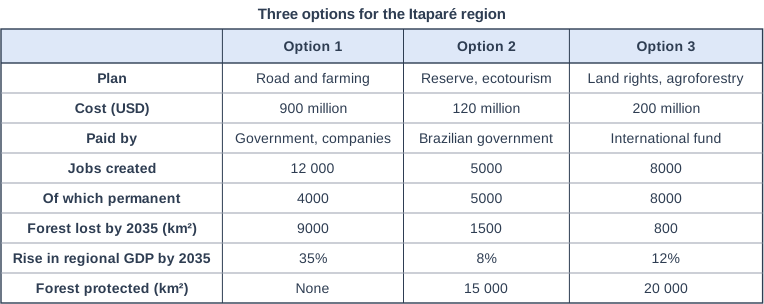
Option 3 for the Itaparé region of the Brazilian Amazon is to legally recognise 20 000 km² of indigenous territories and to support small farmers to practise agroforestry (growing açaí, cocoa and Brazil nuts among trees) on land that has already been cleared. It would be paid for by an international climate fund (USD 200 million over 10 years) and is expected to create 8000 permanent jobs, raise regional GDP by 12% and limit forest loss to 800 km² by 2035. By comparison, option 1 (a paved road and commercial farming) would create 4000 permanent jobs, raise GDP by 35% and lose 9000 km² of forest.
To what extent would option 3 be a sustainable solution for the Itaparé region? Use evidence from the information above and your own knowledge.
Model answer
A sustainable solution meets the needs of people today without damaging the environment or the ability of future generations to meet their needs. I think option 3 is sustainable to a large extent, although it has some economic weaknesses.
Environmentally, option 3 is the most sustainable option. Only 800 km² of forest would be lost by 2035, and 20 000 km² would be protected as indigenous territories. Indigenous communities have a strong record of protecting forest, and studies show deforestation is much lower inside indigenous lands than outside them. Agroforestry would restore tree cover on land that has already been cleared, protecting the soil from heavy rain, reducing erosion and leaching, and storing carbon, which helps to reduce climate change globally.
Socially, option 3 secures the land rights of indigenous people, protecting their homes, food sources and culture, and reduces conflict with loggers and miners. It also gives 8000 permanent jobs to local smallholders, twice as many permanent jobs as option 1, so families can stay in the region rather than migrating to cities.
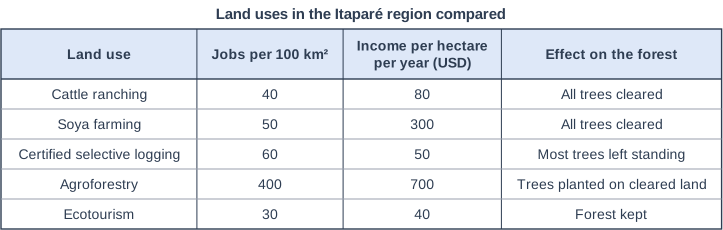
Economically, the picture is more mixed. Agroforestry earns far more per hectare than cattle ranching and employs many more people, and crops like açaí, cocoa and Brazil nuts have growing markets in Brazil and abroad. Farmers growing several crops are less at risk if one fails. Agroforestry already works in places such as Tomé-Açu in Pará. However, the regional GDP would rise by only 12%, compared with 35% under option 1, and new trees take several years to produce crops, so farmers need support at first. The biggest weakness is that the scheme depends on international funding for 10 years; if the money stops, the support for farmers and the protection of territories could collapse. Land rights also need to be enforced, or illegal loggers and miners may still invade.
Overall, option 3 is highly sustainable environmentally and socially, and its economic base of agroforestry is more sustainable in the long term than cattle ranching on soils that lose fertility. Its sustainability depends on funding continuing and the law being enforced, but on balance it is the most sustainable of the three options.
Explanation
A 'to what extent' answer needs a judgement, so weigh the strengths of each strand of sustainability against the risks (dependence on foreign funding, slower economic growth, enforcement). Using comparisons with the other options and an example such as Tomé-Açu supports a Level 3 judgement.