Level:
Correct: 0
Incorrect: 0
Marks: 0/0
Exam Practice
Subject:
Topics:
Avg
score:
–
Topics
done:
0/21

Issue: oil and gas in the Arctic

Practise 23 exam-style questions on Issue: oil and gas in the Arctic for AQA GCSE Geography (Paper 3). Write your answer as you would in the exam and get it marked in seconds against the mark scheme, point by point, with an AI tutor on hand if you get stuck.

  • 23 questions
  • 1–12 marks each
  • Instant marking
  • No sign-up needed
20 questions, marked as you go

Sample questions with model answers

Here are 4 of the questions in this topic, each with a model answer, an explanation of why it earns the marks and the mark scheme an examiner would use.

Question 1

1 mark

Supporters of drilling for oil on the Siku coastal plain in Alaska argue that it would improve the energy security of the USA.

Which one of the following best describes energy security?

A Protecting oil pipelines from damage and theft
B Having a reliable supply of affordable energy, with less dependence on other countries
C Using only renewable sources of energy
D Storing oil underground so that it does not leak

Give the letter of your answer.

Model answer

B

Explanation

A country has energy security when it has reliable access to enough affordable energy. Producing more oil at home reduces dependence on imports, which can be cut off or rise sharply in price because of conflicts or political decisions in other countries.

Mark scheme
  1. 1 mark

    B (having a reliable supply of affordable energy, with less dependence on other countries)

    accept the letter or the option written out; do not accept more than one answer

Question 2

2 marks

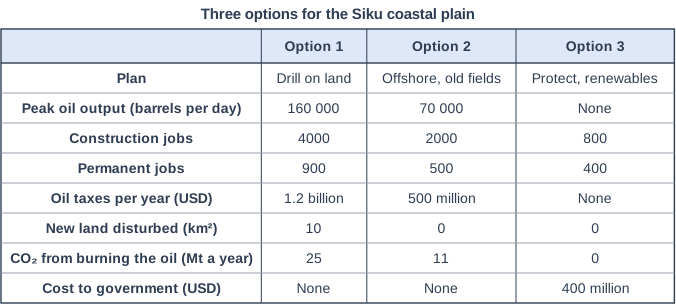
Figure 1 shows three options for the Siku coastal plain in northern Alaska.

Using Figure 1, calculate how much oil option 1 would produce in one year at its peak output. Give your answer in millions of barrels.

Three options for the Siku coastal plain. Table with columns "", "Option 1", "Option 2", "Option 3". : Plan; Option 1: Drill on land; Option 2: Offshore, old fields; Option 3: Protect, renewables | : Peak oil output (barrels per day); Option 1: 160 000; Option 2: 70 000; Option 3: None | : Construction jobs; Option 1: 4000; Option 2: 2000; Option 3: 800 | : Permanent jobs; Option 1: 900; Option 2: 500; Option 3: 400 | : Oil taxes per year (USD); Option 1: 1.2 billion; Option 2: 500 million; Option 3: None | : New land disturbed (km²); Option 1: 10; Option 2: 0; Option 3: 0 | : CO₂ from burning the oil (Mt a year); Option 1: 25; Option 2: 11; Option 3: 0 | : Cost to government (USD); Option 1: None; Option 2: None; Option 3: 400 million.

Model answer

160 000 barrels a day × 365 days = 58 400 000 barrels = 58.4 million barrels a year.

Explanation

Multiply the daily output by the number of days in a year, then convert to millions by dividing by 1 000 000. For comparison, option 2 would produce 70 000 × 365 = 25.6 million barrels a year at peak.

Mark scheme
  1. 1 mark

    Working: 160 000 × 365

    correct answer with no working scores full marks

  2. 1 mark

    58.4 million barrels

    accept 58.4 million or 58 400 000; accept 58.6 million (using 366 days)

Question 3

4 marks

Option 1 would allow drilling for oil on the Siku coastal plain in northern Alaska, including the calving grounds of a caribou herd of about 150 000 animals. Each year the herd migrates hundreds of kilometres between the coastal plain and the mountains to the south. Gwich'in communities live inland, south of the mountains.

A Gwich'in elder said: 'The caribou are our food and our culture. The coastal plain is where their calves are born. If you disturb it, you disturb our survival.'

Suggest why Gwich'in communities oppose option 1.

Model answer

The Gwich'in depend on caribou for food, clothing and their culture, so anything that harms the herd threatens their way of life. Option 1 would put drilling sites, roads and pipelines in the calving grounds, where calves are born. Noise, traffic and people could disturb mothers, so fewer calves may survive, and research suggests caribou avoid calving close to roads, so less of the calving ground would be used. Pipelines and roads could also change the herd's migration routes, so the caribou might not pass Gwich'in communities when expected, leaving people short of food in remote areas where shop food is very expensive. Because the Gwich'in live far from the oilfield, they would gain few of the jobs or tax benefits while bearing most of the costs.

Explanation

The key chain is oil development → harm to caribou (calving, migration) → harm to Gwich'in food supply and culture. Good answers go beyond the quote, for example by noting that the Gwich'in gain little from oil jobs and taxes.

Mark scheme
  1. 4 marks

    Levels of response (4 marks).
    Level 2 (3-4 marks): Clear, developed suggestions linking oil development to effects on the caribou and, through the caribou, to Gwich'in food, culture and way of life. Uses the information and quote effectively and goes beyond it.
    Level 1 (1-2 marks): Basic suggestions with little development, or largely repeats the quote.
    0 marks: nothing worthy of credit.

    Indicative content (not a checklist; credit other valid points): Gwich'in depend on caribou for food (subsistence hunting), clothing, tools and culture; the coastal plain is the calving ground, so disturbance from drilling, roads, pipelines, noise and aircraft could reduce calf survival and herd numbers; caribou avoid roads during calving (fewer calve near infrastructure), so less of the calving ground may be used; pipelines and roads could block or change migration routes, so caribou may not pass their communities at the usual times; oil spills or pollution could poison plants or water; fewer caribou would mean food shortages and more expensive store-bought food in remote communities; loss of traditional knowledge and culture; they live far from the oilfield, so they gain few of the jobs and taxes but bear the costs; climate change from burning the oil also threatens the Arctic environment they rely on.

Question 4

9 marks

Option 3 for the Siku coastal plain in northern Alaska is to protect the area permanently as wilderness, with no oil drilling. Instead, the US government would invest USD 400 million over 10 years in renewable energy (wind turbines, solar panels and batteries) and insulation for Alaskan communities, many of which currently rely on expensive diesel generators. It would create 800 construction jobs and 400 permanent jobs, but no oil taxes. Option 1 (drilling on land) would instead create 900 permanent jobs and USD 1.2 billion a year in oil taxes.

To what extent would option 3 be a sustainable choice? Use evidence from the information above and your own knowledge.

Model answer

A sustainable choice meets the needs of people today without damaging the environment or the ability of future generations to meet their own needs. Option 3 is sustainable to a large extent, especially environmentally, but it has some economic weaknesses.

Environmentally, option 3 is by far the most sustainable option. The coastal plain would stay as wilderness, protecting the caribou calving grounds, the wetlands where migrating birds nest, and the fragile permafrost and tundra. There would be no risk of an oil spill. Because the oil would stay in the ground, it would not be burned, so no extra carbon dioxide would be added to the atmosphere, helping the USA meet its commitments under the Paris Agreement. Replacing diesel generators in Alaskan communities with wind turbines, solar panels and batteries would cut emissions and local air pollution even further.

Socially, option 3 protects the Gwich'in, who depend on the caribou for food and culture. Remote communities would also benefit from cheaper and more reliable electricity once renewables replace expensive diesel, and from local jobs installing and maintaining the equipment. However, Iñupiat communities such as Nanuq would lose the oil tax income that could have paid for their school, clinic and water supply, so not everyone would benefit.

Economically, the picture is less positive. Option 3 creates only 400 permanent jobs compared with 900 for option 1, provides no oil taxes compared with USD 1.2 billion a year under option 1, and costs the government USD 400 million. On the other hand, renewable energy reduces fuel costs for decades and is not affected by rising oil prices, and it builds skills in a growing industry. There are also practical problems: in the Arctic winter there are months of darkness, so solar panels produce little, and extreme cold affects batteries, so backup will still be needed. In addition, if the USA simply imports more oil, the emissions and spill risks may just move to another part of the world.

Overall, option 3 is highly sustainable environmentally and for most communities socially, and it is the only option that fits a future in which fossil fuel use must fall. Its weaknesses are economic and short term, so it is the most sustainable choice in the long term, provided the investment in renewables is reliable enough to meet communities' needs.

Explanation

A 'to what extent' answer needs a judgement. Weigh each strand of sustainability, recognise who loses (communities expecting oil taxes, the state economy) and practical problems (winter darkness for solar power), and consider whether emissions simply move elsewhere. A supported conclusion such as 'sustainable in the long term but economically challenging in the short term' reaches Level 3.

Mark scheme
  1. 9 marks

    Levels of response (9 marks).
    Level 3 (7-9 marks): Thorough evaluation of how far option 3 is sustainable, considering environmental, social and economic sustainability, different stakeholders and scales, and the short and long term. Weighs strengths against weaknesses and reaches a clear, substantiated judgement about the extent. Makes detailed use of the information and accurate own knowledge.
    Level 2 (4-6 marks): Clear discussion of how option 3 could be sustainable, with some consideration of weaknesses; may be unbalanced. Some use of the information. A judgement may be given but is not fully supported.
    Level 1 (1-3 marks): Basic statements about the benefits or problems of option 3, with little reference to sustainability. Little or no judgement.
    0 marks: nothing worthy of credit.

    Indicative content (not a checklist; credit other valid points): Environmental: protects caribou calving grounds, bird-nesting wetlands, permafrost and tundra; no risk of oil spills; no extra CO₂ from burning the oil, helping to meet the Paris Agreement; renewables replace diesel generators, cutting emissions and local air pollution; wilderness retained for future generations. Social: protects the Gwich'in food supply and culture; cheaper, more reliable electricity in remote communities once renewables are installed; local jobs installing and maintaining equipment; but the Iñupiat community of Nanuq loses potential oil tax income for schools and clinics. Economic: 400 permanent jobs is fewer than option 1's 900; no oil taxes (USD 1.2 billion a year lost under option 1); costs the government USD 400 million; but renewables reduce fuel costs for decades and are not affected by oil prices; skills in a growing industry; possible ecotourism; avoids clean-up costs. Weaknesses: the USA may import more oil, so emissions and spill risks may simply move elsewhere and energy security falls; wind and solar are intermittent in the Arctic (months of winter darkness), so backup or storage is needed; extreme cold affects batteries and equipment; Alaska's economy depends heavily on oil. Judgement: e.g. environmentally very sustainable and socially beneficial for most, but economically less certain in the short term, or any supported view.

Ready to try the rest? Every answer you write is marked against the mark scheme, so you can see exactly where the marks are.

AI Tutor Hints first, answers after you try

Hi! Stuck? Ask me for a hint and I’ll help you work it out. Once you’ve checked your answer I can explain exactly where the marks are.