
Level:
Correct: 0
Incorrect: 0
Marks: 0/0
Exam Practice
Course:
Topics:
Edexcel GCSE Physics (Paper 1) Smart practice A mixed round aimed at your weak spots
Unit 1
Key concepts of physics
Unit 2
Motion and forces
Unit 3
Conservation of energy
Unit 4
Waves
Unit 5
Light and the electromagnetic spectrum
Unit 6
Radioactivity
Unit 7
Astronomy
Avg
score:
–
Topics
done:
0/40

Thermal radiation, temperature and the Earth

Practise 17 exam-style questions on Thermal radiation, temperature and the Earth for Edexcel GCSE Physics (Paper 1). Write your answer as you would in the exam and get it marked in seconds against the mark scheme, point by point, with the Study Helper on hand if you get stuck.

  • 17 questions
  • 1–6 marks each
  • Instant marking
  • No sign-up needed
17 questions, marked as you go

Sample questions with model answers

Here are 4 of the questions in this topic, each with a model answer, an explanation of why it earns the marks and the mark scheme an examiner would use.

Question 1

1 mark

In the core practical on surfaces and radiation, the same volume of hot water is poured into containers covered in different materials. A lid is then put on each container.

What is the main reason for using the lids?

Choose your answer.

  • A to reduce cooling by evaporation
  • B to stop the sides emitting radiation
  • C to keep the room temperature constant
  • D to make the water cool more quickly

Model answer

A (to reduce cooling by evaporation)

Explanation

Without lids, a lot of energy would be transferred from the open water surface by evaporation (and convection), which could hide the differences caused by the surfaces of the containers. With lids, differences in cooling are mainly due to the different surfaces radiating at different rates.

Mark scheme
  1. 1 mark

    A / to reduce cooling by evaporation (1)

    The only correct answer is A. B is not correct because the lid covers only the top, and the sides still emit radiation (that is what is being compared); C is not correct because a lid on a container has no effect on the room; D is not correct because a lid slows the cooling. Accept the letter or the option. If more than one option is given, do not award the mark.
Question 2

2 marks

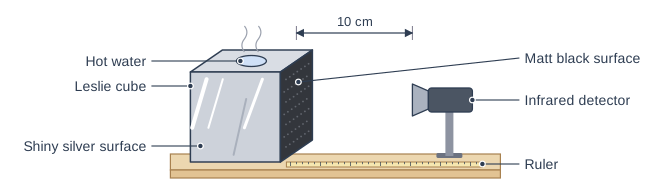
Zoe uses a Leslie cube to investigate how the nature of a surface affects the amount of thermal energy radiated. The cube is hollow and made of metal. Its four vertical faces have different surfaces: matt black, shiny black, matt white and shiny silver.

She fills the cube with hot water. She turns the cube so that each face in turn points at an infrared detector placed 10 cm away, and records the detector reading. The figure shows the apparatus.

Zoe's friend suggests that, instead of using the detector, Zoe could hold a thermometer 10 cm in front of each face and record its reading.

Suggest two reasons why the infrared detector gives better results than the thermometer.

Diagram of a Leslie cube and an infrared detector. A Leslie cube full of hot water stands on a bench. Its front face is shiny silver and the face pointing at the infrared detector is matt black. The detector is on a stand a short distance away, with a ruler lying on the bench between them. The distance from the cube to the detector is marked 10 cm. Labelled parts: Hot water, Leslie cube, Shiny silver surface, Matt black surface, Infrared detector, Ruler.

Model answer

The infrared detector is much more sensitive than a thermometer. The radiation from a face 10 cm away would raise the temperature of a thermometer only a little, so the small differences between some of the faces might not show up on the thermometer.

A thermometer held near the hot cube would also be heated by warm air rising from the cube, so its reading would not depend only on the radiation from the face, but the detector responds only to the infrared radiation.

A thermometer also takes a long time to reach a steady reading, and the water would cool while Zoe waits; the detector gives a reading almost at once.

Explanation

Choosing apparatus is about measuring only the variable you want, with enough sensitivity and quickly enough. The detector responds directly and quickly to the infrared radiation, while a thermometer in the air near the cube gives only a small, slow change that is also affected by convection. Vague answers such as 'the detector is more accurate' or 'human error' do not give a reason, so they are not credited.

Mark scheme
  1. 1 mark

    the change in the thermometer reading would be (very) small, so small differences between the faces might not be detected / the thermometer's resolution is too low / the detector is more sensitive (1)

    Any two from the three points; max 2. Mark each point independently. ignore 'the detector is more accurate' or 'more reliable' on its own; ignore 'human error' and 'the thermometer could break'.

  2. 1 mark

    the thermometer would also be heated by warm air rising from / moving around the hot cube (convection), so its reading would not depend only on the radiation, but the detector responds only to the (infrared) radiation (1)

    accept 'the thermometer measures the temperature of the air, not the radiation from the face'. 'The thermometer measures air temperature' and 'the detector measures the radiation' are the same idea: credit them once only.

  3. 1 mark

    a thermometer takes a long time to reach a steady reading, and the water / the faces cool during this time / the detector gives a reading (almost) immediately, so all four readings can be taken quickly (1)

    accept 'the detector responds faster'; accept 'the thermometer would have to cool back to room temperature before the next face is measured'. ignore 'the detector is quicker to use' with no reason.

Question 3

3 marks

In June 1991 the volcano Mount Pinatubo in the Philippines erupted. It sent millions of tonnes of sulfur dioxide high into the atmosphere, where it formed tiny droplets that spread around the Earth and reflected some of the Sun's radiation back into space.

NASA scientists found that the average temperature of the Earth fell by about 0.5 °C over the following year. Over the next few years, the droplets gradually fell out of the atmosphere.

Explain why the average temperature of the Earth fell after the eruption.

Suggest what happened to the average temperature as the droplets fell out of the atmosphere.

Model answer

The droplets reflected some of the Sun's radiation back into space, so less radiation was absorbed by the Earth. The Earth was then emitting more power than it absorbed, so its temperature fell.

As the droplets fell out of the atmosphere, more of the Sun's radiation was absorbed again, so the Earth absorbed more power than it emitted and its temperature rose back towards its earlier value.

Explanation

Anything that changes the power the Earth absorbs or the power it emits upsets the balance and changes the temperature. Volcanic droplets in the upper atmosphere reflect sunlight, so the Earth emits more than it absorbs and cools until a new balance is reached; when they are removed, the absorbed power rises and the Earth warms again. Simply repeating that the droplets reflected sunlight scores little.

Mark scheme
  1. 1 mark

    less radiation (from the Sun) was absorbed by the Earth (1)

    accept less radiation reached the surface; do not award this point for repeating that the droplets reflected radiation, without saying that less is absorbed.

  2. 1 mark

    so the Earth emitted more power than it absorbed (so it cooled) (1)

    accept the outgoing radiation was greater than the absorbed radiation.

  3. 1 mark

    the temperature rose again (back towards its earlier value), because the Earth absorbed more radiation again / absorbed more than it emitted (1)

    a reason is needed for this mark; do not accept 'it went back to normal' with no reason.

Question 4

4 marks

NASA scientists estimate that, averaged over the whole Earth and over a year:
- 340 W/m² of radiation from the Sun reaches the top of the atmosphere
- about 100 W/m² of this is reflected back into space by clouds, particles in the air and bright surfaces such as snow and ice
- the rest is absorbed by the atmosphere and the surface.

(W/m² means watts for each square metre. Data: NASA Earth Observatory)

Calculate the percentage of the radiation reaching the top of the atmosphere that is reflected back into space.

State the average power per square metre that the Earth must emit into space for its temperature to stay constant.

Satellite measurements show that, at present, the Earth emits slightly less power into space than this. State what is happening to the temperature of the Earth.

Model answer

percentage reflected = 100 ÷ 340 × 100 = 29 %

The Earth absorbs 340 - 100 = 240 W/m², so for its temperature to stay constant it must emit 240 W/m² into space.

The Earth is emitting less power than it absorbs, so its temperature is increasing: the Earth is warming.

Explanation

For a constant temperature a body must radiate the same average power as it absorbs, and the Earth absorbs only the part of the incoming radiation that is not reflected (240 W/m²). If it emits less than this, it gains energy and warms. A common error is to say the Earth must emit 340 W/m², forgetting the reflected radiation.

Mark scheme
  1. 1 mark

    (percentage reflected =) 100 ÷ 340 (× 100) (1)

    An answer of 29 % with no working scores marking points 1 and 2.

  2. 1 mark

    29 (%) (1)

    accept values that round to 29 (e.g. 29.4); 0.29 with no % sign scores marking point 1 only.

  3. 1 mark

    240 W/m² (1)

    accept 340 - 100; the unit is not required.

  4. 1 mark

    it is increasing / the Earth is warming (1)

    accept the Earth is gaining energy, so it is getting hotter; do not accept 'it stays the same'.

Ready to try the rest? Every answer you write is marked against the mark scheme, so you can see exactly where the marks are.

Study Helper Hints first, answers after you try

Stuck on this one? Ask for a hint and I’ll point you in the right direction, without giving the answer away. Once you’ve checked your answer, I’ll show you how the marks are awarded.