
Level:
Correct: 0
Incorrect: 0
Marks: 0/0
Exam Practice
Course:
Topics:
Edexcel GCSE Physics (Paper 1) Smart practice A mixed round aimed at your weak spots
Unit 1
Key concepts of physics
Unit 2
Motion and forces
Unit 3
Conservation of energy
Unit 4
Waves
Unit 5
Light and the electromagnetic spectrum
Unit 6
Radioactivity
Unit 7
Astronomy
Avg
score:
–
Topics
done:
0/40

Momentum and force

Practise 16 exam-style questions on Momentum and force for Edexcel GCSE Physics (Paper 1). Write your answer as you would in the exam and get it marked in seconds against the mark scheme, point by point, with the Study Helper on hand if you get stuck.

  • 16 questions
  • 1–6 marks each
  • Instant marking
  • No sign-up needed
16 questions, marked as you go

Sample questions with model answers

Here are 4 of the questions in this topic, each with a model answer, an explanation of why it earns the marks and the mark scheme an examiner would use.

Question 1

1 mark

A ten-pin bowling ball rolls into a stationary pin. After the collision, the ball and the pin both move forwards.

Which statement about the collision is correct?

Choose your answer.

  • A the ball's momentum is unchanged
  • B momentum is lost as sound
  • C total momentum is conserved
  • D the ball pushes harder on the pin

Model answer

C - total momentum is conserved.

Explanation

Momentum is conserved in every collision: the momentum lost by the ball equals the momentum gained by the pin. It is energy, not momentum, that can be transferred to sound and thermal stores. Mixing up momentum and energy is the commonest error in this topic.

Mark scheme
  1. 1 mark

    C / total momentum is conserved (1)

    The only correct answer is C: in a collision, the total momentum of the objects before the collision equals the total momentum after (when no external forces act). A is not correct because the ball pushes the pin forwards and the pin pushes back on the ball, so the ball loses momentum and the pin gains the same amount; B is not correct because momentum cannot be changed into sound - some kinetic energy is transferred as sound, but momentum is not a form of energy; D is not correct because, by Newton's third law, the force of the ball on the pin and the force of the pin on the ball are equal in size (and opposite in direction), even though the ball has the greater mass. Accept the letter or the option. If more than one option is given, do not award the mark.
Question 2

2 marks

A spacecraft is in deep space, far from any planet. There is no air around it. When its rocket engine is fired, hot exhaust gases are pushed out of the back of the engine at high speed.

Using the idea of momentum, explain why the spacecraft accelerates forwards even though there is no air for the exhaust gases to push against.

Model answer

The engine pushes the exhaust gases out backwards at high speed, so the gases gain momentum backwards. Momentum is conserved, so the spacecraft gains an equal amount of momentum in the forward direction, which means its velocity forwards increases.

Explanation

The spacecraft and its exhaust gases form a system whose total momentum is conserved: the backward momentum given to the gases is matched by forward momentum gained by the spacecraft. Equivalently, the engine pushes on the gases and the gases push back on the spacecraft. A common misconception is that a rocket needs air to push against.

Mark scheme
  1. 1 mark

    the exhaust gases gain momentum backwards (1)

    An explanation linking two of the three points; max 2. accept 'the gases are given momentum in the opposite direction to the spacecraft'.

  2. 1 mark

    (total) momentum is conserved, so the spacecraft gains (an equal amount of) momentum forwards (1)

    accept 'the momentum of the gases backwards is equal to the increase in momentum of the spacecraft forwards'.

  3. 1 mark

    the engine pushes the gases backwards and (by Newton's third law) the gases push the spacecraft forwards with an equal force (1)

    Do not accept 'the gases push against the air / space' (there is nothing to push against).

Question 3

3 marks

A student uses an air track to investigate collisions. Glider A has a mass of 0.20 kg and moves at 0.60 m/s. It hits glider B, which is at rest. The gliders stick together and move off together.

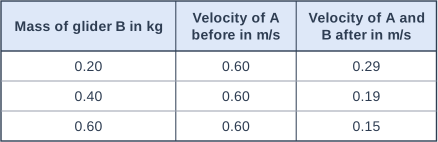
The student repeats the experiment with three different masses of glider B. The table shows the results.

The student says: 'My results show that momentum is conserved in these collisions.'

Evaluate the student's statement. Use the results in your answer.

Table with columns "Mass of glider B in kg", "Velocity of A before in m/s", "Velocity of A and B after in m/s". Mass of glider B in kg: 0.20; Velocity of A before in m/s: 0.60; Velocity of A and B after in m/s: 0.29 | Mass of glider B in kg: 0.40; Velocity of A before in m/s: 0.60; Velocity of A and B after in m/s: 0.19 | Mass of glider B in kg: 0.60; Velocity of A before in m/s: 0.60; Velocity of A and B after in m/s: 0.15.

Model answer

Momentum before each collision = 0.20 × 0.60 = 0.12 kg m/s.
Momentum after: 0.40 × 0.29 = 0.116 kg m/s; 0.60 × 0.19 = 0.114 kg m/s; 0.80 × 0.15 = 0.12 kg m/s.
The momentum after is the same as before, or only slightly less (by up to 5%), in every collision. The small losses can be explained by friction or air resistance on the gliders, or by errors in measuring the velocities, so the results support the student's statement that momentum is conserved. However, there are only three collisions with no repeats, so the evidence is limited.

Explanation

To test conservation, calculate the total momentum before (0.12 kg m/s each time) and after (total mass × common velocity) for each collision. The values agree to within about 5%, which is within what you would expect from friction and measurement error, so the claim is supported. Remember to add the masses of both gliders after they stick together.

Mark scheme
  1. 1 mark

    momentum before = 0.20 × 0.60 = 0.12 (kg m/s) in every collision (1)

    Any three of the six points; max 3.

  2. 1 mark

    momentum after calculated correctly for at least one collision, e.g. (0.20 + 0.20) × 0.29 = 0.116 / 0.60 × 0.19 = 0.114 / 0.80 × 0.15 = 0.12 (kg m/s) (1)

    the total mass of both gliders must be used. accept 0.12 or 0.11 for the first two values when rounded. Do not accept 0.20 × 0.29 = 0.058 (mass of glider A only).

  3. 1 mark

    the momentum after is (almost) the same as before in all three collisions / within about 5% (1)

    accept 'slightly less after in two collisions, the same in the third'.

  4. 1 mark

    the small differences can be explained by friction / air resistance on the gliders / errors in measuring the velocities (1)

    Do not accept 'momentum is not conserved because the numbers are not exactly equal' with no reference to experimental error.

  5. 1 mark

    a limitation, e.g. only three collisions / one result for each mass, with no repeats / only one starting velocity / only collisions in which the gliders stick together, so the evidence is limited (1)

    accept any other valid limitation of the data. Ignore 'human error' with no detail.

  6. 1 mark

    (judgement) the results support the statement (1)

    award only if supported by at least one correct momentum calculation.

Question 4

4 marks

A firefighter holds a hose. Each second, 8.0 kg of water leaves the nozzle horizontally at 30 m/s. Assume that the water is at rest just before the nozzle accelerates it.

Calculate the force that the hose exerts on the water. Then explain why the firefighter has to push forwards on the hose to keep it still.

Use the equation
F = (mv − mu) ÷ t

Model answer

In 1.0 s, the momentum of the water changes from 0 to 8.0 × 30 = 240 kg m/s.
F = (mv − mu) ÷ t = (240 − 0) ÷ 1.0 = 240 N forwards on the water.
By Newton's third law, the water pushes back on the hose with an equal force of 240 N in the opposite direction (backwards). To keep the hose still, the resultant force on it must be zero, so the firefighter must push forwards on it with a force of 240 N.

Explanation

Each second the nozzle gives 8.0 kg of water 240 kg m/s of momentum, so it pushes the water forwards with 240 N. The water pushes the hose backwards with an equal and opposite force (Newton's third law), so the firefighter must push forwards to balance it. Real hand-held fire hoses have reaction forces of a few hundred newtons, which is why they can be hard to hold.

Mark scheme
  1. 1 mark

    substitution: (F =) (8.0 × 30 − 8.0 × 0) ÷ 1.0 (1)

    Award 2 marks for 240 N without working.

  2. 1 mark

    evaluation: 240 (N) (1)

    A power of ten error scores 1 mark.

  3. 1 mark

    (by Newton's third law) the water exerts an equal force (240 N) on the hose in the opposite direction / backwards (1)

    allow ecf from an incorrect force. accept 'the water pushes the hose backwards with the same size force'.

  4. 1 mark

    so the firefighter must push forwards with a force of 240 N (to make the resultant force on the hose zero) (1)

    allow ecf. accept 'otherwise there would be a resultant force on the hose and it would accelerate backwards'. Do not accept 'the water pushes forwards on the hose'.

Ready to try the rest? Every answer you write is marked against the mark scheme, so you can see exactly where the marks are.

Study Helper Hints first, answers after you try

Stuck on this one? Ask for a hint and I’ll point you in the right direction, without giving the answer away. Once you’ve checked your answer, I’ll show you how the marks are awarded.